

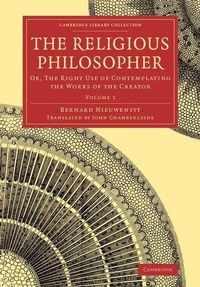
The Religious Philosopher
Or, The Right Use of Contemplating the Works of the Creator
Published on 13. November 2014
Book
Paperback/Softback
332 pages
978-1-108-07753-8 (ISBN)
Description
Originally published in Dutch in 1715, this two-volume work by the philosopher and theologian Bernard Nieuwentyt (1654-1718) is reissued here in the 1724 third edition of the English translation by John Chamberlayne (1668/9-1723). The book seeks to persuade both Christians and atheists that scientific examination of the natural world is compatible with religious belief. According to Chamberlayne, Nieuwentyt published this illustrated work to 'magnify the Wisdom and Goodness of God' while challenging those who did not see proof of the divine in nature. The work is known to have influenced the natural theology of the English philosopher William Paley (1743-1805), whose famous analogy of the watchmaker is believed to have been taken directly from Nieuwentyt. Arguing against rationalist philosophers such as Spinoza, Volume 1 defends natural theology and presents a series of detailed 'contemplations' about the complexity of the human body.
More details
Series
Language
English
Place of publication
Cambridge
United Kingdom
Target group
Professional and scholarly
Product notice
Paperback (trade)
Illustrations
11 Line drawings, unspecified
Dimensions
Height: 244 mm
Width: 170 mm
Thickness: 18 mm
Weight
575 gr
ISBN-13
978-1-108-07753-8 (9781108077538)
Copyright in bibliographic data and cover images is held by Nielsen Book Services Limited or by the publishers or by their respective licensors: all rights reserved.
Schweitzer Classification
Other editions
Complete work / Part of the work
Bernard Nieuwentyt
The Religious Philosopher 2 Volume Set
Or, The Right Use of Contemplating the Works of the Creator
Book
11/2014
Cambridge University Press
€85.00
Shipment within 15-20 days
Persons
Content
The introduction; 1. Of the vanity of all worldly things; 2. Of all that is visible, and of our selves in particular; 3. Of some particulars in the mouth; 4. Of the throat, stomach, and bowels; 5. Of the venae lacteae, and ductus chylicus; 6. Of the heart; 7. Of respiration; 8. Of the structure of the veins; 9. Of the nerves, and briefly of the lymphatick vessels, glands, and membranes; 10. Of the muscles; 11. Of the bones; 12. Of the sight; 13. Of the hearing; 14. Of the senses of tasting, smelling and feeling; 15. Of the union of the soul and body, of the imagination and memory; 16. Of the humane passions or inclinations, and briefly of procreation; 17. Of the air; 18. Of meteors.