

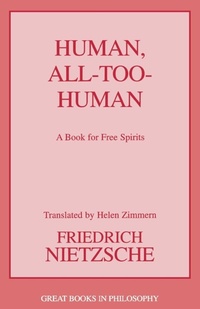
Human, All Too Human
Published on 16. December 2008
Book
Paperback/Softback
536 pages
978-1-59102-678-5 (ISBN)
Description
Human, All Too Human (1878) is often considered the start of Friedrich Nietzsche's mature period. A complex work that explores many themes to which Nietzsche later returned, it marks a significant departure from his previous thinking. Here Nietzsche breaks with his early allegiance to Schopenhauer and Wagner, and establishes the overall framework of his later philosophy. In contrast to his previous disdain for science, now Nietzsche views science as key to undercutting traditional metaphysics. This he sees as a crucial step in the emergence of free spirits who will be the avant-garde of culture.
In summing up the crucial change of perspective expressed in Human, All Too Human, Nietzsche used the following words in his later work Ecce Homo:
"Human, All Too Human is a memorial of a crisis.... [W]ith this book I liberated myself from that in my nature which did not belong to me. Idealism does not belong to me...realities were altogether lacking in my knowledge, and the 'idealities' were worth damn all! A downright burning thirst seized hold of me: thenceforward I pursued in fact nothing other than physiology, medicine, and natural science."
This is an essential work for anyone who wishes to understand Nietzsche's incisive critique of Western culture and values.
In summing up the crucial change of perspective expressed in Human, All Too Human, Nietzsche used the following words in his later work Ecce Homo:
"Human, All Too Human is a memorial of a crisis.... [W]ith this book I liberated myself from that in my nature which did not belong to me. Idealism does not belong to me...realities were altogether lacking in my knowledge, and the 'idealities' were worth damn all! A downright burning thirst seized hold of me: thenceforward I pursued in fact nothing other than physiology, medicine, and natural science."
This is an essential work for anyone who wishes to understand Nietzsche's incisive critique of Western culture and values.
More details
Language
English
Place of publication
United States
Product notice
Paperback (trade)
Dimensions
Height: 216 mm
Width: 140 mm
Thickness: 32 mm
Weight
759 gr
ISBN-13
978-1-59102-678-5 (9781591026785)
Copyright in bibliographic data and cover images is held by Nielsen Book Services Limited or by the publishers or by their respective licensors: all rights reserved.
Schweitzer Classification
Persons
Friedrich Wilhelm Nietzsche was a German philosopher, classical scholar, and cultural critic, known for his profound influence on modern thought. Born on October 15, 1844, in R cken, Germany, Nietzsche initially pursued a career as a classical philologist before transitioning to philosophy. His works challenged traditional beliefs, and his critiques of culture, religion, and morality made him one of the most influential philosophers of the 19th century. Nietzsche's writings explored complex concepts such as the "will to power," the " bermensch," and the idea of the eternal recurrence. His works, including "Thus Spoke Zarathustra" and "Beyond Good and Evil," questioned the foundations of Western philosophy and introduced ideas that would later shape existentialism and postmodernism. Nietzsche s intellectual journey was influenced by figures like Arthur Schopenhauer and Fyodor Dostoevsky. He faced personal struggles throughout his life, including mental illness, which led to his decline in health. He passed away on August 25, 1900, in Weimar, Germany, at the age of 55. Nietzsche s parents were Carl Ludwig Nietzsche and Franziska Oehler, and he had a brother, Ludwig Joseph Nietzsche, and a sister, Elisabeth F rster-Nietzsche. His groundbreaking ideas continue to resonate in contemporary philosophy and culture.
Content
PART ONE -- Introduction; Author's Preface; First Division: First and Last Things; Second Division: The History of the Moral Sentiments; Third Division: The Religious Life; Fourth Division: Concerning the Soul of Artists and Authors; Fifth Division: The Signs of Higher and Lower Culture; Sixth Division: Man in Society; Seventh Division: Wife and Child; Eighth Division: A Glance at the State; Ninth Division: Man Alone by Himself; An Epode -- Among Friends. PART TWO -- Introduction; Author's Preface; Part I: Miscellaneous Maxims and Opinions; Part II: The Wanderer and His Shadow.