

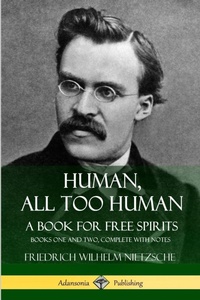
Human, All Too Human, A Book for Free Spirits: Books One and Two, Complete with Notes
Books One and Two, Complete with Notes
Published on 25. June 2019
Book
Paperback/Softback
204 pages
978-1-387-78339-7 (ISBN)
Description
Human, All Too Human is the first book by Friedrich Nietzsche to use the aphoristic style that would become emblematic of his most famous philosophy.
This compact and inexpensive print edition ensures that you can absorb and appreciate these philosophical insights at little expense. His style, combining Nietzsche's vehement brand of argument with keynote nihilistic energy, is evident. Quickfire, furious nature of the points made in some respects foreshadow later works in which these qualities are enhanced still further.
For the clinical yet perceptive style present in this early work, Nietzsche's adherents compare Human, All Too Human to the earliest works of psychology. Throughout the text, Nietzsche examines human traits and behaviours in a series of short passages, presenting a number of posits and philosophic arguments in each. The shortest of these are only a single paragraph, while the longest run for several.
More details
Language
English
Place of publication
Morrisville
United States
Dimensions
Height: 229 mm
Width: 152 mm
Thickness: 13 mm
Weight
343 gr
ISBN-13
978-1-387-78339-7 (9781387783397)
Copyright in bibliographic data and cover images is held by Nielsen Book Services Limited or by the publishers or by their respective licensors: all rights reserved.
Schweitzer Classification
Persons
Friedrich Wilhelm Nietzsche was a German philosopher, classical scholar, and cultural critic, known for his profound influence on modern thought. Born on October 15, 1844, in R cken, Germany, Nietzsche initially pursued a career as a classical philologist before transitioning to philosophy. His works challenged traditional beliefs, and his critiques of culture, religion, and morality made him one of the most influential philosophers of the 19th century. Nietzsche's writings explored complex concepts such as the "will to power," the " bermensch," and the idea of the eternal recurrence. His works, including "Thus Spoke Zarathustra" and "Beyond Good and Evil," questioned the foundations of Western philosophy and introduced ideas that would later shape existentialism and postmodernism. Nietzsche s intellectual journey was influenced by figures like Arthur Schopenhauer and Fyodor Dostoevsky. He faced personal struggles throughout his life, including mental illness, which led to his decline in health. He passed away on August 25, 1900, in Weimar, Germany, at the age of 55. Nietzsche s parents were Carl Ludwig Nietzsche and Franziska Oehler, and he had a brother, Ludwig Joseph Nietzsche, and a sister, Elisabeth F rster-Nietzsche. His groundbreaking ideas continue to resonate in contemporary philosophy and culture.