

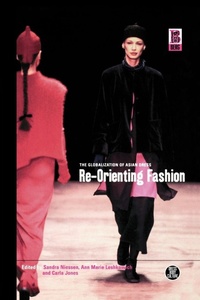
Re-Orienting Fashion
The Globalization of Asian Dress
Published on 1. April 2003
Book
Paperback/Softback
296 pages
978-1-85973-539-8 (ISBN)
Description
When Hong Kong entrepreneur David Tang opened his Shanghai Tang boutique on New York's Madison Avenue, it was not an isolated example of the globalization of Asian fashion. Further evidence is written on the labels in our closets, and paraded in the form of salwaar-kameez and silk sarongs by the rich and famous of London. The phenomenon merits scrutiny. This vanguard attempt points to the colonial era as the origin of fashion globalization, and describes its development as paralleling the gradual take-over of Asian daily wear by Western dress. From indigenous Batak weavers to Hong Kong designers, and from Indonesian businesswomen's power suits to Korean feminists' national costume, this book explores the sartorial interface of East and West.The globalization of Asian dress needs to be understood as part of an ongoing Orientalism that construes Asia as a feminine Other to the masculine West. The conventional Orientalist definition of fashion as an exclusively Western phenomenon has proved self-fulfilling in both East and West so that the conceptual boundary between the two is continually reasserted by design.
Paying close attention to Asians' decisions about what clothing to make, sell, buy, and wear, the case studies in this book challenge Orientalist stereotypes of Asian style as passive and traditional and highlight how these actions are often made invisible by global cultural, rhetorical, and material practices that feminize Asia and the fashion world. This timely book will be of interest to dress and fashion theorists, anthropologists, sociologists, historians, art historians and all those interested in globalization, Orientalism and their effects.
Paying close attention to Asians' decisions about what clothing to make, sell, buy, and wear, the case studies in this book challenge Orientalist stereotypes of Asian style as passive and traditional and highlight how these actions are often made invisible by global cultural, rhetorical, and material practices that feminize Asia and the fashion world. This timely book will be of interest to dress and fashion theorists, anthropologists, sociologists, historians, art historians and all those interested in globalization, Orientalism and their effects.
Reviews / Votes
'This is a very good book that will be read with great appreciation by people who understand the importance of fashion in the web of human society.'Fashion Theory 'This book will be useful to readers (or fashion theorists) who are interested in understanding globalization of Asian dress from anthropological, sociological, political and historical perspectives.'Myoung Kim, University of Wisconsin, in International Textile and Apparel Association newsletter (Jan 06)More details
Series
Language
English
Place of publication
London
United Kingdom
Publishing group
Bloomsbury Publishing PLC
Target group
Professional and scholarly
Illustrations
30 illustrations, bibliography, index
Dimensions
Height: 234 mm
Width: 156 mm
Thickness: 17 mm
Weight
453 gr
ISBN-13
978-1-85973-539-8 (9781859735398)
Copyright in bibliographic data and cover images is held by Nielsen Book Services Limited or by the publishers or by their respective licensors: all rights reserved.
Schweitzer Classification
Persons
Sandra Niessen is an Anthropologist, Department of Human Ecology, University of Alberta. Ann Marie Leshkowich is Assistant Professor of Anthropology, College of the Holy Cross. Carla Jones is Vernacular Modernities Postdoctoral Fellow, Emory University.
Content
Contents Notes on Contributorsvii Acknowledgmentsix Introduction: The Globalization of Asian Dress: Re-Orienting Fashion or Re-Orientalizing Asia?1 Carla Jones and Ann Marie Leshkowich 1Three Scenarios from Batak Clothing History: Designing Participation in the Global Fashion Trajectory49 Sandra Niessen 2The Ao Dai Goes Global: How International Influences and Female Entrepreneurs Have Shaped Vietnam's "National Costume"79 Ann Marie Leshkowich 3Korean Alterations: Nationalism, Social Consciousness, and "Traditional" Clothing 117 Rebecca Ruhlen 4Designing Diasporic Markets: Asian Fashion Entrepreneurs in London139 Parminder Bhachu 5National Colors: Ethnic Minorities in Vietnamese Public Imagery159 Hjorleifur R. Jonsson and Nora A. Taylor 6Dress for Sukses: Fashioning Femininity and Nationality in Urban Indonesia185 Carla Jones 7Fashion-Nation: A Japanese Globalization Experience and a Hong Kong Dilemma215 Lise Skov Afterword: Re-Orienting Fashion Theory243 Sandra Niessen Index267