

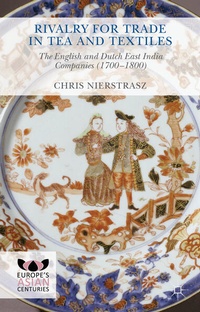
Rivalry for Trade in Tea and Textiles
The English and Dutch East India companies (1700-1800)
Published on 21. September 2015
Book
Hardback
XVI, 226 pages
978-1-137-48652-3 (ISBN)
Description
The rivalry for trade in tea and textiles between the English and Dutch East India companies is very much a global history. This trade is strongly connected to emblematic events such as the opening of Western trade with China, the Boston Tea Party, the establishment of British Empire in Bengal and the Industrial Revolution.
Reviews / Votes
"It does adopt important and influential ideas from historians of consumption to explore the growing demand for items such as tea and textiles in eighteenth-century Europe. . Ultimately, the narrative power and the interpretative possibilities offered by the single, individual company are strong and will always remain attractive to scholars, students and general readers. . Rivalry for Trade in Tea and Textiles reminds us of the importance of the cornucopia of commodities imported by Europe's East India companies." (John McAleer, International Journal of Maritime History, Vol. 28 (3), August, 2016)More details
Series
Edition
1st ed. 2015
Language
English
Place of publication
London
United Kingdom
Target group
Professional and scholarly
Product notice
sewn/stitched
Cloth over boards
With dust jacket
Illustrations
25 s/w Abbildungen
XVI, 226 p. 25 illus.
Dimensions
Height: 218 mm
Width: 140 mm
Thickness: 20 mm
Weight
454 gr
ISBN-13
978-1-137-48652-3 (9781137486523)
DOI
10.1057/9781137486530
Schweitzer Classification
Other editions
Additional editions
Chris Nierstrasz
Rivalry for Trade in Tea and Textiles
The English and Dutch East India companies (1700-1800)
E-Book
09/2015
Palgrave Macmillan
€128.39
Available for download

Chris Nierstrasz
Rivalry for Trade in Tea and Textiles
The English and Dutch East India Companies (1700-1800)
Book
01/2014
Palgrave Macmillan
€85.59
The article will not be published
Person
Chris Nierstrasz, Lecturer at the Erasmus University Rotterdam in the Netherlands, is the author of In the Shadow of the Company: The Dutch East India Company and its Servants in the Period of its Decline (1740-1796) (2012). He has also contributed to the editing of Goods from the East, 1600-1800 (2015) for the Europe's Asian Centuries project.
Content
PART I: IMPERFECT MONOPOLIES 1. Imperfect monopoly in trade 1.1 Mix of commodities 1.2 Monopoly and private trade 2. Imperfect monopoly in Europe 2.1 Silver and taxation 2.2 Re-export of Asian commodities 3. Imperfect monopoly in Asia 3.1 Beyond Silver 3.2 Intra-Asian trade and Empire 3.3 Empire and the home-state Conclusion PART II: RIVALRY FOR TEA: EMPIRES AND PRIVATE TRADE 1. Tea and monopoly 1.1 Competition for monopoly (1685-1730) 1.2 A Competitive Market (1730-1790) 2. Empires and Tea 2.1 Direct trade and empire 2.2 EIC intra-Asian trade and English country trade 2.3 British Empire and Canton 3. Private trade and tea 3.1 The 'Discovery' of Tea 3.2 Private Trade and Batavia 3.3 Private trade in tea as a tool of competition 3.4 English Private Trade in Tea Conclusion PART III: POPULARISATION OF TEA: SMUGGLERS AND DIFFERENT VARIETIES OF TEA 1. Smuggling and Britain 1.1 The problem of contraband tea 1.2 An answer to smuggling 2. Smuggling and America 2.1 Unnoticed smuggling 2.2 British Empires connect 3. Selections of tea 3.1 Different varieties, different prices 3.2 A different selection of tea Conclusion PART IV RIVALRY FOR TEXTILES: A GLOBAL MARKET 1. Europe and India 1.1 Imports of Indian Textiles 1.2 Textiles and Mercantilism 2. Textiles and Empire in Asia 2.1 Intra-Asian trade and textiles 2.2 Balancing Asia and Europe 2.3 English dominance Conclusion PART V: THE CONSUMPTION OF TEXTILES: RETURN CARGOES AND VARIETY 1. Different regions, different textiles 2. Competition for textiles 2.1 Muslins 2.2 White Calicoes 2.3 Coloured Calicoes 3. Imports of Indian textiles and the Industrial Revolution Conclusion