

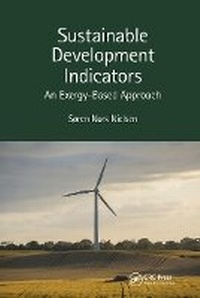
Sustainable Development Indicators
An Exergy-Based Approach
1st Edition
Published on 21. January 2023
Book
Paperback/Softback
238 pages
978-1-032-47449-6 (ISBN)
Description
Analyzing the self-sufficient Danish island of Samso, this book explains sustainability through a bio-geophysical understanding of how to best use society's limited resources to achieve true sustainability. The method used derives from the thermodynamic function of exergy. By analyzing exergy flows and establishing a system for evaluating the energy and the materials used in a society, the author creates a platform for monitoring certain indicators of sustainability. These indicators inform readers about the actions that must be taken and the time frames for achieving sustainability goals. The exergy-based approach is an important tool for carrying out such an analysis because it
Focuses on several key thermodynamic concepts and the usefulness of exergy analysis for evaluating sustainability
Explains sustainability by implementing thermodynamic laws to societal consumption and the use of resources
Discusses new methods that integrate energy and material fluxes and evaluates them against each other
Provides direct indicators for finding the largest problems/obstacles and deciding where measures should be taken
Includes instructions on how to establish an accounting system for evaluating the energy and the materials used in a society
This book is aimed for professionals, researchers, and students working on nature conservation and environmental management projects related to sustainability.
Focuses on several key thermodynamic concepts and the usefulness of exergy analysis for evaluating sustainability
Explains sustainability by implementing thermodynamic laws to societal consumption and the use of resources
Discusses new methods that integrate energy and material fluxes and evaluates them against each other
Provides direct indicators for finding the largest problems/obstacles and deciding where measures should be taken
Includes instructions on how to establish an accounting system for evaluating the energy and the materials used in a society
This book is aimed for professionals, researchers, and students working on nature conservation and environmental management projects related to sustainability.
More details
Series
Language
English
Place of publication
London
United Kingdom
Publishing group
Taylor & Francis Ltd
Target group
College/higher education
Academic and Professional Practice & Development
Illustrations
26 s/w Abbildungen
26 Illustrations, black and white
Dimensions
Height: 234 mm
Width: 156 mm
Weight
440 gr
ISBN-13
978-1-032-47449-6 (9781032474496)
Copyright in bibliographic data and cover images is held by Nielsen Book Services Limited or by the publishers or by their respective licensors: all rights reserved.
Schweitzer Classification
Other editions
Additional editions
Book
05/2020
1st Edition
CRC Press
€132.40
Shipment within 15-20 days
E-Book
05/2020
1st Edition
CRC Press
€65.99
Available for download
E-Book
05/2020
1st Edition
CRC Press
€65.99
Available for download
Person
Soren Nors Nielsen obtained the PhD in Structurally Dynamic Modelling in 1992, in the University of Copenhagen, and the "Agregacao" in 2009, in the University of Coimbra. He is a world expert on the application of thermodynamic methods for the analysis and assessment of biological systems functioning, mainly in aquatic environments, and of ecological modeling in environmental management. He authored or co-authored a large number of papers in peer review journals, book chapters and books.
Content
1. Introduction to Sustainability and Work Energy Analysis 2. Work Energy and Sustainability 3. Methodological Considerations 4. Analysis of the Energy Sector 5. Work Energy Analysis of the Public Sector 6. Work Energy and Private Sector 7. Work Energy Analysis of the Agriculture, Forestry and Fisheries Sector 8. Work Energies of the Industry, Trade and Commerce Sector 9. Work Energy Analysis of Nature 10. Solid Waste-Estimating Amounts and Potentials 11. Work Energy Budgets-Overview and Discussion 12. Conclusions and Perspectives