

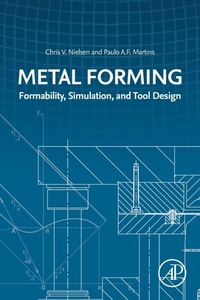
Metal Forming
Formability, Simulation, and Tool Design
Published on 17. February 2021
Book
Paperback/Softback
428 pages
978-0-323-85255-5 (ISBN)
Description
Metal Forming: Formability, Simulation, and Tool Design focuses on metal formability, finite element modeling, and tool design, providing readers with an integrated overview of the theory, experimentation and practice of metal forming. The book includes formability and finite element topics, including insights on plastic instability, necking, nucleation and coalescence of voids. Chapters discuss the finite element method, including its accuracy, reliability and validity and finite element flow formulation, helping readers understand finite element formulations, iterative solution methods, friction and contact between objects, and other factors. The book's final sections discuss tool design for cold, warm and hot forming processes.
Examples of tools, design guidelines, and information related to tool materials, lubricants, finishes, and tool failure are included as well.
Examples of tools, design guidelines, and information related to tool materials, lubricants, finishes, and tool failure are included as well.
More details
Language
English
Place of publication
Oxford
United Kingdom
Publishing group
Elsevier Science & Technology
Target group
Professional and scholarly
Product notice
Paperback (trade)
Illustrations
Approx. 150 illustrations (30 in full color)
Dimensions
Height: 229 mm
Width: 152 mm
Thickness: 22 mm
Weight
573 gr
ISBN-13
978-0-323-85255-5 (9780323852555)
Copyright in bibliographic data and cover images is held by Nielsen Book Services Limited or by the publishers or by their respective licensors: all rights reserved.
Schweitzer Classification
Other editions
Additional editions
E-Book
02/2021
Academic Press
€175.00
Available for download
Persons
Chris Nielsen is Associate Professor at the Technical University of Denmark, research affiliate and recipient of the F.W. Taylor Medal Award by the International Academy for Production Engineering (CIRP), recipient of the International KARL-KOLLE Prize for metal forming by the German Metal Forming Association. He is the co-author of two books, two book chapters, and has authored 60 papers in international journals and conferences. His research focuses on metal forming, metal forming tribology, resistance welding, and resistance sintering. Most research involves a combination of experimentation and numerical modeling. Paulo Martins is Professor of Manufacturing, at the Instituto Superior Tecnico, University of Lisbon, Portugal. He is also Doctor Technices Honoris Causa of the Technical University of Denmark, and a Fellow of the International Academy for Production Engineering (CIRP). He is co-author of six books, several international patents and over 350 papers in international journals and conferences. His main research area is manufacturing, specifically numerical and experimental-based development of forming and joining by forming processes.
Content
1. Introduction2. Formability3. Finite element simulation: A user's perspective4. Finite element flow formulation5. Introduction to the finite element solid formulation6. Tool design
AppendicesA. Algebraic decomposition of the stress triaxialityB. Large elastic-plastic and rigid-plastic deformationsC. Mathematics for continuum mechanicsD. Force increment ratio that is necessary for an elastic element to yieldE. Basic cold forging processesF. Calculation of deflections and stress distributions in the die core and stress ringsG. MATLAB computer programH. Fit recommendations
AppendicesA. Algebraic decomposition of the stress triaxialityB. Large elastic-plastic and rigid-plastic deformationsC. Mathematics for continuum mechanicsD. Force increment ratio that is necessary for an elastic element to yieldE. Basic cold forging processesF. Calculation of deflections and stress distributions in the die core and stress ringsG. MATLAB computer programH. Fit recommendations