

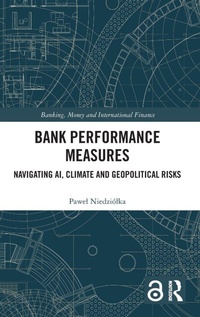
Bank Performance Measures
Navigating AI, Climate and Geopolitical Risks
1st Edition
Will be published approx. on 22. January 2026
Book
Hardback
206 pages
978-1-041-13602-6 (ISBN)
Description
The reforms introduced in the aftermath of the global financial crisis of 2007-2009 have had the desired effect, in that banks are better capitalised, have higher liquidity buffers and the share of non-performing loans is low. Macroprudential policies have been implemented, banking sector supervision has been overhauled, and the new resolution framework gives hope that bank failures will not escalate systemic risk.
This book argues, however, that we still need to remain vigilant. The world has not yet recovered from the pandemic, and we are now faced with new challenges, particularly climate, technological and geopolitical risks affecting international trade, the availability and prices of energy carriers, and the cost of capital etc. In this context, it asks what measures should be used to assess a commercial bank, whether as a potential shareholder, client, member of the bank's bodies or as a supervisory institution. It provides a broad overview of bank performance measures used in contemporary investment, management and supervisory practice in the most important areas of a bank's activity, as well as metrics that synthetically reflect the bank's standing.
The book evaluates a commercial bank in the context of the climate crisis and risk, the growing importance of FinTech, cybersecurity and AI technology as well as the challenges related to the escalation of geopolitical risk. It also includes an assessment of the standing of Global Systemically Important Banks (G-SiBs) and banking sectors in Europe, indicating potential directions for changes to the tools used so far. It will find a broad audience among students, academics, researchers in finance and banking, as well as policymakers and regulators.
This book argues, however, that we still need to remain vigilant. The world has not yet recovered from the pandemic, and we are now faced with new challenges, particularly climate, technological and geopolitical risks affecting international trade, the availability and prices of energy carriers, and the cost of capital etc. In this context, it asks what measures should be used to assess a commercial bank, whether as a potential shareholder, client, member of the bank's bodies or as a supervisory institution. It provides a broad overview of bank performance measures used in contemporary investment, management and supervisory practice in the most important areas of a bank's activity, as well as metrics that synthetically reflect the bank's standing.
The book evaluates a commercial bank in the context of the climate crisis and risk, the growing importance of FinTech, cybersecurity and AI technology as well as the challenges related to the escalation of geopolitical risk. It also includes an assessment of the standing of Global Systemically Important Banks (G-SiBs) and banking sectors in Europe, indicating potential directions for changes to the tools used so far. It will find a broad audience among students, academics, researchers in finance and banking, as well as policymakers and regulators.
More details
Series
Language
English
Place of publication
London
United Kingdom
Publishing group
Taylor & Francis Ltd
Target group
College/higher education
Professional and scholarly
Postgraduate
Illustrations
31 s/w Tabellen, 48 s/w Zeichnungen, 48 s/w Abbildungen
31 Tables, black and white; 48 Line drawings, black and white; 48 Illustrations, black and white
Dimensions
Height: 240 mm
Width: 161 mm
Thickness: 17 mm
Weight
526 gr
ISBN-13
978-1-041-13602-6 (9781041136026)
Copyright in bibliographic data and cover images is held by Nielsen Book Services Limited or by the publishers or by their respective licensors: all rights reserved.
Schweitzer Classification
Other editions
Additional editions
E-Book
01/2026
Routledge
€205.99
Available for download
E-Book
01/2026
Routledge
€205.99
Available for download
Person
Pawel Niedziolka is an Associate Professor and Head of the Financial Risk Management Department, Institute of Banking, Collegium of Socio-Economics, Warsaw School of Economics, Poland.
Content
1 Introduction - Is financial stability stable? 2 Value and valuation of a bank in turbulent times 3 The quality of the loan portfolio and its concentration - have the crises of the last decade left their mark on European banks? 4 Profitability, efficiency and dynamics of lending in an unstable environment 5 Capital adequacy as an antidote to banks' losses caused by the escalation of the crisis 6 Liquidity - a necessary condition for the survival of banks during a crisis 7 Credit ratings of banks - have the crises of the third decade of the 21st century improved the methodologies used by rating agencies to assess banks? 8 ESG scoring and other measures of banks' commitment to sustainable development goals 9 Synthetic measures of commercial bank standing 10 FinTech and its impact on bank performance 11 AI in banking - opportunities and threats 12 Instead of final conclusions. Geopolitical risk - the most important challenge for banks