

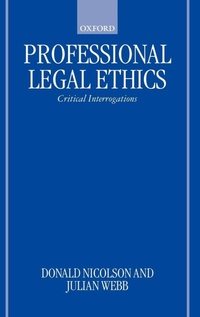
Professional Legal Ethics
Critical Interrogations
Published on 3. February 2000
Book
Hardback
342 pages
978-0-19-876471-7 (ISBN)
Description
Ethics and regulation have become catchwords of the late 1990s, yet relatively little has been written about the ethical discourse and regulation of the legal professions in England and Wales. This book represents the first attempt to subject the ethical discourse of the English legal professions to in-depth analysis and sustained critique. Drawing on insights from moral philosophy, social theory, the sociology of the legal profession, public law theories of regulation, and the extensive American literature on lawyers' ethics, it argues that, in seeking to provide definitive answers to particular problems of professional conduct, professional legal ethics has failed to deliver an approach which requires lawyers actively to engage with the ethical issues raised by legal practice. Through an analysis of the core issues facing lawyers, the authors locate this failure in the profession's reliance on a liberal and adversarial role morality that conceptualises the ethical values of human dignity, autonomy and equality in a formalistic and narrowly legalistic manner. This encourages lawyers to overlook the real invasions of these values so often wrought by upholding clients legal rights, and to ignore the competing claims of affected third parties, the wider community and the environment In seeking to move beyond critique, the authors develop throughout the book a contextual approach to individual ethical decision-making and outline a range of institutional, regulatory and educational reforms which, they suggest, could form the basis for a more ethical brand of professionalism.
Professional Legal Ethics: Critical Interrogations is a wide-ranging and thought-provoking analysis written for lawyers, ethicists and policy-makers interested in this neglected area of professional ethics and regulation.
Professional Legal Ethics: Critical Interrogations is a wide-ranging and thought-provoking analysis written for lawyers, ethicists and policy-makers interested in this neglected area of professional ethics and regulation.
Reviews / Votes
Nicolson and Webb's lucid exploration of specifically Anglo-Welsh professional ethics is extremely valuable, both for its comprehensive coverage of the issues and for its critical appraisal of them...This is an excellent book. Its assessments are clear-eyed and convincing...It works both as an outstanding primer on the current debate on adversarial ethics and as a serious proposal for their future. I highly recommend it. * Emily Henderson Cambridge Law Journal * detailed treatment of a formidably wide range of legal ethics. * David Wood, Journal of Law and Society Vol 27 No 3 (2000) *More details
Language
English
Place of publication
Oxford
United Kingdom
Target group
College/higher education
Professional and scholarly
Dimensions
Height: 240 mm
Width: 161 mm
Thickness: 23 mm
Weight
681 gr
ISBN-13
978-0-19-876471-7 (9780198764717)
Copyright in bibliographic data and cover images is held by Nielsen Book Services Limited or by the publishers or by their respective licensors: all rights reserved.
Schweitzer Classification
Other editions
Additional editions
E-Book
02/2000
1st Edition
OUP eBook
€148.99
Available for download
Persons
Donald Nicolson taught at the Universities of Cape Town, Warwick and Reading before taking up a post at the University of Bristol in 1992. Here he taught jurisprudence, legal methods, criminal law and gender and the law. He also has a research interest in evidence theory. He is currently at the School of Law at the University of Strathclyde. Julian Webb: After completing a research degree at Warwick University in the early 1980s, Julian held various teaching and research posts in London before moving to the University of the West of England, Bristol in 1988, where he was consecutively a senior and principal lecturer in the Law Faculty and, finally, Professor of Socio-Legal Studies. In March 1999 he returned to London as Professor of Law at the University of Westminster, where he continues to teach and research in the areas of dispute resolution, legal ethics and legal education.
Content
1. INTRODUCTION ; LAWYERS AND JUSTICE ; DEFINING PROFESSIONAL LEGAL ETHICS ; AIMS, METHODS AND ARGUMENTS ; 2. THE PHILOSOPHICAL CONTEXT: THEORETICAL APPROACHES TO THE CONTENT AND STATUS OF ETHICS ; INTRODUCTION ; THE SCOPE OF PHILOSOPHICAL ETHICS ; DEONTOLOGICAL ETHICS ; CONSEQUENTIALISM ; VIRTUE ETHICS ; PSYCHOLOGY, FEMINISM AND THE ETHIC OF CARE ; POSTMODERNISM AND THE ETHICS OF ALTERITY ; CONCLUSION ; 3. THE SOCIAL CONTEXT: PROFESSIONAL DEALS AND INSTITUTIONAL SETTINGS ; INTRODUCTION ; THE IDEALS OF THE LEGAL PROFESSIONS ; THE PROCEDURAL CONTEXT ; PROFESSIONAL STRUCTURES AND INSTITUTIONAL CONTEXTS ; THE DEMOGRAPHIC CONTEXT ; THE EDUCATIONAL CONTEXT ; THE BUSINESS CONTEXT ; CONCLUSIONS ; 4. THE REGULATORY CONTEXT: ETHICS AND PROFESSIONAL SELF-REGULATION ; INTRODUCTION ; THE INSTITUTIONS OF SELF-REGULATION ; CODES OF CONDUCT ; THE ENFORCEMENT MECHANISMS ; 5. DUTIES TO THE CLIENT: AUTONOMY AND CONTROL IN THE LAWYER-CLIENT RELATIONSHIP ; INTRODUCTION ; BOUNDARIES OF AUTONOMY ; THE LEGAL BASIS OF LAWYER-CLIENT RELATIONS ; CONTROL IN THE LAWYER-CLIENT RELATIONSHIP ; AUTONOMY: A CRITIQUE AND RE-EVALUATION ; RECONCEPTUALISING DUTIES TO THE CLIENT ; CONCLUSION: IMPLICATION FOR THE FORM AND FOCUS OF CODES ; 6. THE LAWYERS AMORAL ROLE AND LAWYER IMMORALITY ; INTRODUCTION ; THE LAWYERS AMORAL ROLE ; CRITICISMS OF LAWYER BEHAVIOUR ; CONCLUSION ; 7. JUSTIFYING NEUTRAL PARTISANSHIP ; INTRODUCTION ; NEUTRAL PARTISANSHIP AND ADVERSARIAL SYSTEM ; NEUTRAL PARTISANSHIP AND LIBERAL VALUES ; NEUTRAL PARTISANSHIP AND THE INSTITUTIONS OF LIBERAL GOVERNMENT ; CONCLUSION ; 8. REFORMING THE LAWYERS AMORAL ROLE ; INTRODUCTION ; ALTERNATIVES TO NEUTRAL PARTISANSHIP ; MORAL ACTIVISM AND ETHICAL FOUNDATIONS ; A CONTEXTUAL APPROACH TO IMMORAL ENDS AND MEANS ; IMMORAL ENDS AND DECISIONS TO REPRESENT ; IMMORAL MEANS AND LAWYER TACTICS ; A DECISION MAKING SCHEMA FOR MORALLY ACTIVIST LAWYERS ; 9. CONFIDENTIALITY ; INTRODUCTION ; THE CURRENT POSITION ; CRITICISMS OF THE CURRENT POSITION ; JUSITFYING CONFIDENTIALITY ; A CONTEXTUAL APPROACH TO CONFIDENTIALITY ; CONCLUSION ; 10. CONCLUSION: TOWARDS A MORE ETHICAL PROFESSION ; THE DOMINANCE OF FORMALISM AND LIBERALISM ; THE CONTEXTUAL ALTERNATIVE ; POSSIBLE OBJECTIONS TO A CONTEXTUAL APPROACH ; INSTITUTIONALISING AN ETHICAL PROFESSIONALISM