

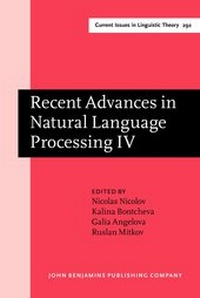
Recent Advances in Natural Language Processing IV
Selected papers from RANLP 2005
Published on 13. December 2007
Book
Hardback
307 pages
978-90-272-4807-7 (ISBN)
Description
This volume brings together selected and revised papers from the international conference on "Recent Advances in Natural Language Processing", held in Borovets, Bulgaria, in September 2005. The best papers have been selected for this volume with the aim to reflect the most promising and significant trends in natural language processing. The volume covers a wide variety of topics in Natural Language Processing, including information extraction, indexing, latent semantic analysis, dependency parsing, anaphora and referring expressions, spam analysis, document classification, rhetorical relations, textual entailment, question answering, ontologies, word sense disambiguation, machine translation, treebanks and corpora.
More details
Series
Language
English
Place of publication
Amsterdam
Netherlands
Target group
Professional and scholarly
Dimensions
Height: 245 mm
Width: 164 mm
Weight
705 gr
ISBN-13
978-90-272-4807-7 (9789027248077)
Copyright in bibliographic data and cover images is held by Nielsen Book Services Limited or by the publishers or by their respective licensors: all rights reserved.
Schweitzer Classification
Other editions
Additional editions
Nicolas Nicolov | Kalina Bontcheva | Galia Angelova
Recent Advances in Natural Language Processing IV
Selected papers from RANLP 2005
E-Book
12/2007
1st Edition
John Benjamins Publishing Company
€144.99
Available for download
Persons
Content
1. Editors' Foreword; 2. Part I. Computation for linguistics; 3. Linguistic challenges for computationalists (by Nerbonne, John); 4. Part II. Information extraction & indexing; 5. NLP: An information extraction perspective (by Grishman, Ralph); 6. Semantic indexing using minimum redundancy cut in ontologies (by Seydoux, Florian); 7. Indexing and querying linguistic metadata and document content (by Aswani, Niraj); 8. Term representation with Generalized Latent Semantic Analysis (by Matveeva, Irina); 9. Part III. Parsing; 10. Multilingual dependency parsing: A pipeline approach (by Chang, Ming-Wei); 11. How does treebank annotation influence parsing? Or how not to compare apples and oranges (by Kubler, Sandra); 12. The SenSem project: Syntactico-semantic annotation of sentences in Spanish (by Alonso i Alemany, Laura); 13. Part IV. Anaphora & referring expressions; 14. Generating referring expressions: Past, present and future (by Dale, Robert); 15. A data-driven approach to pronominal anaphora resolution for German (by Hinrichs, Erhard W.); 16. Part V. Classification; 17. Efficient spam analysis for weblogs through URL segmentation (by Nicolov, Nicolas); 18. Document classification using semantic networks with an adaptive similarity measure (by Ginter, Filip); 19. Text summarization for improved text classification (by Mihalcea, Rada); 20. Exploiting linguistic cues to classify rhetorical relations (by Sporleder, Caroline); 21. Part VI. Textual entailment & question answering; 22. Tree edit distance for textual entailment (by Kouylekov, Milen); 23. A genetic algorithm for optimising information retrieval with linguistic features in question answering (by Tiedemann, Jorg); 24. Lexico-syntactic subsumption for textual entailment (by Rus, Vasile); 25. A knowledge-based approach to text-to-text similarity (by Corley, Courtney); 26. Part VII. Ontologies; 27. A simple WWW-based method for semantic word class acquisition (by Shinzato, Keiji); 28. Automatic building of Wordnets (by Barbu, Eduard); 29. Part VIII. Machine translation; 30. Lexical transfer selection using annotated parallel corpora (by Piperidis, Stelios); 31. Multi-perspective evaluation of the FAME speech-to-speech translation system for Catalan, English and Spanish (by Arranz, Victoria); 32. Parallel corpora for medium density languages (by Varga, Daniel); 33. Part IX. Corpora; 34. The role of data in NLP: The case for dataset profiling (by De Roeck, Anne); 35. Even very frequent function words do not distribute homogeneously (by De Roeck, Anne); 36. Exploiting parallel texts to produce a multilingual sense tagged corpus for word sense disambiguation (by Specia, Lucia); 37. Detecting dangerous coordination ambiguities using word distribution (by Chantree, Francis); 38. List and addresses of contributors; 39. Index of subjects and terms