

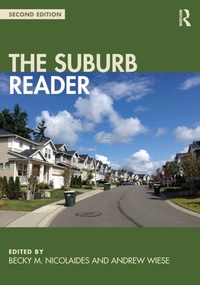
The Suburb Reader
2nd Edition
Published on 24. May 2016
Book
Paperback/Softback
682 pages
978-1-138-81858-3 (ISBN)
Description
Since the 1920s, the United States has seen a dramatic reversal in living patterns, with a majority of Americans now residing in suburbs. This mass emigration from cities is one of the most fundamental social and geographical transformations in recent US history. Suburbanization has not only produced a distinct physical environment-it has become a major defining force in the construction of twentieth-century American culture.
Employing over 200 primary sources, illustrations, and critical essays, The Suburb Reader documents the rise of North American suburbanization from the 1700s through the present day. Through thematically organized chapters it explores multiple facets of suburbia's creation and addresses its indelible impact on the shaping of gender and family ideologies, politics, race relations, technology, design, and public policy. Becky Nicolaides' and Andrew Wiese's concise commentaries introduce the selections and contextualize the major themes of each chapter. Distinctive in its integration of multiple perspectives on the evolution of the suburban landscape, The Suburb Reader pays particular attention to the long, complex experiences of African Americans, immigrants, and working people in suburbia. Encompassing an impressive breadth of chronology and themes, The Suburb Reader is a landmark collection of the best works on the rise of this modern social phenomenon.
New to the edition
The second edition incorporates important new research that explores the complex history and cultures of the American suburbs
More coverage of transnational cases and the influence of American suburbia internationally
More coverage of the post-financial crisis and housing crisis in the U. S.,including rising suburban inequality
The positive sides of suburban living are further emphasized, balancing the critical approaches of the text, including, "best practices" in policy.
Deeper coverage of ethnically diverse suburbs, including politics and lifeways in Asian American and Latino suburbs
Expanded coverage of recent exclusionary tactics, from cultural politics to violence in Ferguson
New material on popular culture representations, in film, television, music, and children's literature
New coverage of the future of suburbs, including further economic, political, and social transformations and recent initiatives in sustainability and regional equity
Employing over 200 primary sources, illustrations, and critical essays, The Suburb Reader documents the rise of North American suburbanization from the 1700s through the present day. Through thematically organized chapters it explores multiple facets of suburbia's creation and addresses its indelible impact on the shaping of gender and family ideologies, politics, race relations, technology, design, and public policy. Becky Nicolaides' and Andrew Wiese's concise commentaries introduce the selections and contextualize the major themes of each chapter. Distinctive in its integration of multiple perspectives on the evolution of the suburban landscape, The Suburb Reader pays particular attention to the long, complex experiences of African Americans, immigrants, and working people in suburbia. Encompassing an impressive breadth of chronology and themes, The Suburb Reader is a landmark collection of the best works on the rise of this modern social phenomenon.
New to the edition
The second edition incorporates important new research that explores the complex history and cultures of the American suburbs
More coverage of transnational cases and the influence of American suburbia internationally
More coverage of the post-financial crisis and housing crisis in the U. S.,including rising suburban inequality
The positive sides of suburban living are further emphasized, balancing the critical approaches of the text, including, "best practices" in policy.
Deeper coverage of ethnically diverse suburbs, including politics and lifeways in Asian American and Latino suburbs
Expanded coverage of recent exclusionary tactics, from cultural politics to violence in Ferguson
New material on popular culture representations, in film, television, music, and children's literature
New coverage of the future of suburbs, including further economic, political, and social transformations and recent initiatives in sustainability and regional equity
Reviews / Votes
The Suburb Reader is the essential guide to the history of the world's first suburban nation. Nicolaides and Wiese have assembled an extraordinary collection of documents, illustrations, and maps, augmented with well-chosen essays by field-defining scholars. I can't wait to teach this book.-Thomas J. Sugrue, Kahn Professor of History and Sociology, University of Pennsylvania
This fabulous collection brings together richly textured documents and classic scholarly essays to illuminate how the United States became a suburban nation. Ideally suited for students, scholars, and general readers, the book includes multiple views of the suburbs-pro and con-and delves deeply into issues of race, class, gender, and politics. The Suburb Reader enriches our understanding not only of suburbia, but of America itself.
-Elaine Tyler May, author of Homeward Bound: American Families in the Cold War Era
More details
Edition
2nd edition
Language
English
Place of publication
London
United Kingdom
Publishing group
Taylor & Francis Ltd
Target group
College/higher education
Illustrations
1 s/w Tabelle
1 Tables, black and white
Dimensions
Height: 254 mm
Width: 178 mm
Thickness: 36 mm
Weight
1264 gr
ISBN-13
978-1-138-81858-3 (9781138818583)
Copyright in bibliographic data and cover images is held by Nielsen Book Services Limited or by the publishers or by their respective licensors: all rights reserved.
Schweitzer Classification
Other editions
Previous edition
Book
09/2006
Routledge
€74.46
Article exhausted; check for reprint
Persons
Becky M. Nicolaides is an Affiliated Research Scholar at the Huntington-USC Institute on California and the West, a Research Affiliate at the UCLA Center for the Study of Women, and the author of My Blue Heaven: Life and Politics in the Working Class Suburbs of Los Angeles, 1920-1965.
Andrew Wiese is Professor of History at San Diego State University and the author of Places of Their Own: African American Suburbanization in the Twentieth Century.
Andrew Wiese is Professor of History at San Diego State University and the author of Places of Their Own: African American Suburbanization in the Twentieth Century.
Content
Part I: The Emergence of Suburbia 1750-1940
Chapter 1. The Transnational Origins of the Elite Suburb
Chapter 2. Family and Gender in the Making of Suburbia
Chapter 3. Technology and Decentralization
Chapter 4. Economic and Class Diversity on the Early Suburban Fringe
Chapter 5. The Politics of Early Suburbia
Chapter 6. Imagining Suburbia: Visions and Plans from the Turn of the Century
Chapter 7. The Other Suburbanites: class, racial, & ethnic diversity in early suburbia
Chapter 8. The Tools of Exclusion: From Local Initiatives to Federal Policy
Part II: Postwar Suburbia 1940-1970
Chapter 9. Postwar America: Suburban Apotheosis
Chapter 10. Culture Wars: Polarized Constructions of Suburban Life
Chapter 11.Postwar Suburbs and the Construction of Race
Chapter 12. The City-Suburb Divide
Part III: Recent Suburbia, 1970 to the Present
Chapter 13. The Political Culture of Suburbia
Chapter 14. Suburban Transformations Since 1970
Chapter 15. Economic and Class Transformations
Chapter 16. Our Town: Enduring Exclusion in Recent Suburbia
Chapter 17. The Future of Suburbia
Chapter 1. The Transnational Origins of the Elite Suburb
Chapter 2. Family and Gender in the Making of Suburbia
Chapter 3. Technology and Decentralization
Chapter 4. Economic and Class Diversity on the Early Suburban Fringe
Chapter 5. The Politics of Early Suburbia
Chapter 6. Imagining Suburbia: Visions and Plans from the Turn of the Century
Chapter 7. The Other Suburbanites: class, racial, & ethnic diversity in early suburbia
Chapter 8. The Tools of Exclusion: From Local Initiatives to Federal Policy
Part II: Postwar Suburbia 1940-1970
Chapter 9. Postwar America: Suburban Apotheosis
Chapter 10. Culture Wars: Polarized Constructions of Suburban Life
Chapter 11.Postwar Suburbs and the Construction of Race
Chapter 12. The City-Suburb Divide
Part III: Recent Suburbia, 1970 to the Present
Chapter 13. The Political Culture of Suburbia
Chapter 14. Suburban Transformations Since 1970
Chapter 15. Economic and Class Transformations
Chapter 16. Our Town: Enduring Exclusion in Recent Suburbia
Chapter 17. The Future of Suburbia