

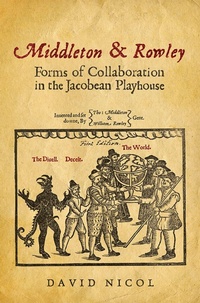
Middleton & Rowley
Forms of Collaboration in the Jacobean Playhouse
Published on 18. January 2018
Book
Paperback/Softback
228 pages
978-1-4875-2265-0 (ISBN)
Description
Can the inadvertent clashes between collaborators produce more powerful effects than their concordances? For Thomas Middleton and William Rowley, the playwriting team best known for their tragedy The Changeling, disagreements and friction proved quite beneficial for their work.
This first full-length study of Middleton and Rowley uses their plays to propose a new model for the study of collaborative authorship in early modern English drama. David Nicol highlights the diverse forms of collaborative relationships that factor into a play's meaning, including playwrights, actors, companies, playhouses, and patrons. This kaleidoscopic approach, which views the plays from all these perspectives, throws new light on the Middleton-Rowley oeuvre and on early modern dramatic collaboration as a whole.
This first full-length study of Middleton and Rowley uses their plays to propose a new model for the study of collaborative authorship in early modern English drama. David Nicol highlights the diverse forms of collaborative relationships that factor into a play's meaning, including playwrights, actors, companies, playhouses, and patrons. This kaleidoscopic approach, which views the plays from all these perspectives, throws new light on the Middleton-Rowley oeuvre and on early modern dramatic collaboration as a whole.
Reviews / Votes
'In this welcome study of working relationship between two early modern playwrights, David Nicol fuses new approach with old....This approach produces fascinating and often persuasive insights.'- Mark Hutchings (SHARP News August 20, 2016) 'For its attention to details of theatrical performance and its illuminating readings of multiple plays, Nicol's book is an important contribution to the study of early modern authorship and collaboration.' - Hetaher A. Hirschfeld (Early Theatre vol 17:01:2014) "Nicol combines this critical project with a survey of different ways of imagining collaborative authorship prompted by the Middleton-Rowley canon... Nicol's study is an important inquiry into the practises of collaborative authorship and a major contribution to recognizing Rowley. Nicol largely avoids the risk of defining the sense of each author's creative disposition too narrowly, and his carful scholarship illustrates the productive insights to be gained from pursuing a separationist approach."
- Andrew Gordon (Renaissance Quarterly: Vol 67:02:2014)
More details
Language
English
Place of publication
Toronto
Canada
Target group
Professional and scholarly
Product notice
Paperback (trade)
Dimensions
Height: 226 mm
Width: 152 mm
Thickness: 15 mm
Weight
363 gr
ISBN-13
978-1-4875-2265-0 (9781487522650)
Copyright in bibliographic data and cover images is held by Nielsen Book Services Limited or by the publishers or by their respective licensors: all rights reserved.
Schweitzer Classification
Person
David Nicol is an assistant professor in the Department of Theatre at Dalhousie University.
Content
Acknowledgements
Note on the Citation of Early Modern Dramatic Texts
1. Middleton and Rowley: Writing About Collaborative Drama
- Critical Approaches to Collaboration: The Case of The Changeling
- Middleton, Rowley and Authorship
- Authorial Divisions and the Process of Collaboration
- Analyzing Collaborative Drama
2. Collaborators and Individual Style: Choice and Religion in The Changeling
- Choosing to Sin in All`s Lost by Lust
- The Mind of the Sinner
- Calvinism and Middleton`s Tragedies
- Collaboration and Choice in The Changeling
- Divided Authors
3. The Actor as Collaborator: Wit at Several Weapons and the Incorporation of Persona
- Rowley's Persona Under Different Playwrights
- The Rowleyan Clown in All's Lost by Lust
- The Structure of Rowley's Clown Plots
- Middleton, Rowley, and the Clown: Wit at Several Weapons
- The Clown's Perspective
4. Collaborators and Playing Companies: Class and Genre in A Fair Quarrel
- Middleton and the Factious Comedy
- Rowley and Romance
- The Double Ending of A Fair Quarrel
-- Duelling Genres
5. A Presence in the Crowd: Multiple Authorship and the Individual Voice in The Spanish Gypsy, The World Tosesed at Teninis and The Old Law
- An Actor's Presence in The Spanish Gypsy and The Changeling
- The Patron's Presence in The World Tossed at Tennis and The Old Law
- Epilogue: The Presence of the Absent Author
Appendix: A Middleton-Rowley Chronology
Note on the Citation of Early Modern Dramatic Texts
1. Middleton and Rowley: Writing About Collaborative Drama
- Critical Approaches to Collaboration: The Case of The Changeling
- Middleton, Rowley and Authorship
- Authorial Divisions and the Process of Collaboration
- Analyzing Collaborative Drama
2. Collaborators and Individual Style: Choice and Religion in The Changeling
- Choosing to Sin in All`s Lost by Lust
- The Mind of the Sinner
- Calvinism and Middleton`s Tragedies
- Collaboration and Choice in The Changeling
- Divided Authors
3. The Actor as Collaborator: Wit at Several Weapons and the Incorporation of Persona
- Rowley's Persona Under Different Playwrights
- The Rowleyan Clown in All's Lost by Lust
- The Structure of Rowley's Clown Plots
- Middleton, Rowley, and the Clown: Wit at Several Weapons
- The Clown's Perspective
4. Collaborators and Playing Companies: Class and Genre in A Fair Quarrel
- Middleton and the Factious Comedy
- Rowley and Romance
- The Double Ending of A Fair Quarrel
-- Duelling Genres
5. A Presence in the Crowd: Multiple Authorship and the Individual Voice in The Spanish Gypsy, The World Tosesed at Teninis and The Old Law
- An Actor's Presence in The Spanish Gypsy and The Changeling
- The Patron's Presence in The World Tossed at Tennis and The Old Law
- Epilogue: The Presence of the Absent Author
Appendix: A Middleton-Rowley Chronology