

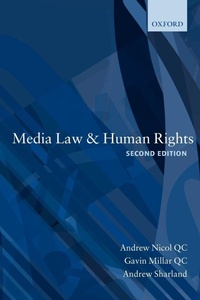
Media Law and Human Rights
2nd Edition
Published on 26. February 2009
Book
Paperback/Softback
352 pages
978-0-19-921750-2 (ISBN)
Description
The incorporation of the European Convention of Human Rights in UK Law, has made the principle of free speech a positive right. But what is the law of freedom of expression and privacy and how does it affect the media? This new edition of Media Law and Human Rights provides practical coverage of the impact of human rights principles in media law.
Providing a comprehensive guide to the Strasbourg case law as it affects the media, this book also examines how the UK courts have grappled with the concepts of privacy and freedom of expression as developed by the European Court. It considers the potential for further influence and looks at the special provisions in the structure of the Human Rights Act and how, if the UK courts still do not provide a remedy, a case can be taken to Strasbourg.
This new edition offers comprehensive and up to date coverage of the all the important English case law and decisions of the European Court of Human Rights that have occurred since the publication of the first edition, including key cases on libel, such as Steel and Morris v UK (McLibel), privacy such as Douglas v Hello, Campbell v MGM Ltd and Mosley v News Group Ltd and political advertising such as R(Animal Defenders) v Secretary of State for Culture. This edition also covers major developments outside the UK and Europe including decisions of the US, and Canadian Supreme Courts.
This title particularly investigates the issues concerning Article 10 as regards its guarantee of freedom of expression. The right is not absolute, but judgements of the European Court of Human Rights have illustrated how valuable the Convention has been in maintaining freedom of expression. The Contempt of Court Act, rights of appeal against reporting restrictions, and the new approach to privilege in libel have all been the product of Article 10. The authors also consider hhow the courts have responded to the Human Rights Act, in particular the way in which the interrelationship between the right to respect for privacy and freedom of expression.
Barristers and solicitors who specialise in media law and who need to understand the implications of the European Convention on Human Rights and the Human Rights Act will find this an essential purchase.
Providing a comprehensive guide to the Strasbourg case law as it affects the media, this book also examines how the UK courts have grappled with the concepts of privacy and freedom of expression as developed by the European Court. It considers the potential for further influence and looks at the special provisions in the structure of the Human Rights Act and how, if the UK courts still do not provide a remedy, a case can be taken to Strasbourg.
This new edition offers comprehensive and up to date coverage of the all the important English case law and decisions of the European Court of Human Rights that have occurred since the publication of the first edition, including key cases on libel, such as Steel and Morris v UK (McLibel), privacy such as Douglas v Hello, Campbell v MGM Ltd and Mosley v News Group Ltd and political advertising such as R(Animal Defenders) v Secretary of State for Culture. This edition also covers major developments outside the UK and Europe including decisions of the US, and Canadian Supreme Courts.
This title particularly investigates the issues concerning Article 10 as regards its guarantee of freedom of expression. The right is not absolute, but judgements of the European Court of Human Rights have illustrated how valuable the Convention has been in maintaining freedom of expression. The Contempt of Court Act, rights of appeal against reporting restrictions, and the new approach to privilege in libel have all been the product of Article 10. The authors also consider hhow the courts have responded to the Human Rights Act, in particular the way in which the interrelationship between the right to respect for privacy and freedom of expression.
Barristers and solicitors who specialise in media law and who need to understand the implications of the European Convention on Human Rights and the Human Rights Act will find this an essential purchase.
Reviews / Votes
...this book is good value. It has astute, practical guidance, well-selected, up-to-date case law citation and an accessible style. * Rosalind M M McInnes, Legal Department, BBC Scotland *More details
Edition
2nd Revised edition
Language
English
Place of publication
Oxford
United Kingdom
Target group
Professional and scholarly
Edition type
Revised edition
Dimensions
Height: 234 mm
Width: 156 mm
Thickness: 18 mm
Weight
518 gr
ISBN-13
978-0-19-921750-2 (9780199217502)
Copyright in bibliographic data and cover images is held by Nielsen Book Services Limited or by the publishers or by their respective licensors: all rights reserved.
Schweitzer Classification
Persons
The Honourable Mr Justice Nicol is a High Court Judge. He was formerly a barrister at Doughty Street Chambers specialising in media, immigration and human rights cases and has written widely on media law.
Gavin Millar QC practises at Doughty Street Chambers specialsing in media, public, and employment law. He is a Council of Europe Expert on freedom of expression and a Recorder of the Crown Court.
Andrew Sharland is a barrister at 4-5 Gray's Inn Square Chambers. He specialises in public, employment and media law. He has lectured widely on media law both in the UK and throughout Europe. He is also a member of the Council of Europe's Panel of Experts on Media Law.
Andrew Sharland is a barrister at 4-5 Gray's Inn Square. His practice focuses on media law, public law and employment law.
Gavin Millar QC is a barrister at Doughty Street Chambers, where his practice covers media, defamation, employment and public law.
Gavin Millar QC practises at Doughty Street Chambers specialsing in media, public, and employment law. He is a Council of Europe Expert on freedom of expression and a Recorder of the Crown Court.
Andrew Sharland is a barrister at 4-5 Gray's Inn Square Chambers. He specialises in public, employment and media law. He has lectured widely on media law both in the UK and throughout Europe. He is also a member of the Council of Europe's Panel of Experts on Media Law.
Andrew Sharland is a barrister at 4-5 Gray's Inn Square. His practice focuses on media law, public law and employment law.
Gavin Millar QC is a barrister at Doughty Street Chambers, where his practice covers media, defamation, employment and public law.
Content
1. Freedom of Expression and Privacy: An Introduction ; 2. Freedom of Expression and the Right to Respect for Private Life and Media Law: General Principles ; 3. The Human Rights Act 1998 ; 4. When Rights Have Not Been Brought Home: Taking a Case to Strasbourg ; 5. Defamation ; 6. Privacy and Confidential Information ; 7. Racial Hatred ; 8. Obscenity and Blasphemy ; 9. Court Reporting and Contempt of Court ; 10. Reporting on Elections and Parliament ; 11. Licensing and Regulation of the Media ; 12. Commercial Speech ; 13. Official Secrets, National Security, and Public Disorder ; Human Rights Act 1998 ; European Convention on Human Rights