

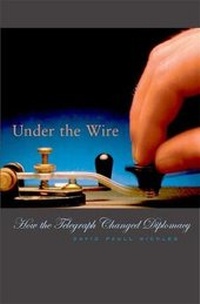
Under the Wire
How the Telegraph Changed Diplomacy
Published on 30. November 2003
Book
Hardback
272 pages
978-0-674-01035-2 (ISBN)
Description
How did the telegraph, a new and revolutionary form of communication, affect diplomats, who tended to resist change? In a study based on impressive multinational research, David Paull Nickles examines the critical impact of the telegraph on the diplomacy of the nineteenth and early twentieth centuries.
Case studies in crisis diplomacy--the War of 1812, the Trent affair during the U.S. Civil War, and the famous 1917 Zimmermann telegram--introduce wide-ranging thematic discussions on the autonomy of diplomats; the effects of increased speed on decision making and public opinion; the neglected role of clerks in diplomacy; and the issues of expense, garbled text, espionage, and technophobia that initially made foreign ministries wary of telegraphy. Ultimately, the introduction of the telegraph contributed to the centralization of foreign ministries and the rising importance of signals intelligence. The faster pace of diplomatic disputes invited more emotional decisions by statesmen, while public opinion often exercised a belligerent influence on crises developing over a shorter time period.
Under the Wire offers a fascinating new perspective on the culture of diplomacy and the social history of technology.
Case studies in crisis diplomacy--the War of 1812, the Trent affair during the U.S. Civil War, and the famous 1917 Zimmermann telegram--introduce wide-ranging thematic discussions on the autonomy of diplomats; the effects of increased speed on decision making and public opinion; the neglected role of clerks in diplomacy; and the issues of expense, garbled text, espionage, and technophobia that initially made foreign ministries wary of telegraphy. Ultimately, the introduction of the telegraph contributed to the centralization of foreign ministries and the rising importance of signals intelligence. The faster pace of diplomatic disputes invited more emotional decisions by statesmen, while public opinion often exercised a belligerent influence on crises developing over a shorter time period.
Under the Wire offers a fascinating new perspective on the culture of diplomacy and the social history of technology.
Reviews / Votes
In this study of the impact of telegraphy on the management of international relations, the reader is rewarded time and again by finding original observations regarding familiar events. This is a book that can have a shaping effect not only on the field of international relations but on many others, since it compels one to think hard about how changes in technology affect behavior and thought among groups with deeply rooted traditions and beliefs. -- Ernest R. May, Harvard University David Paull Nickles has plumbed the archives of four countries to determine just how transformative [the invention of the telegraph] really was. Under the Wire is a subtle and impressive examination of history. -- Christian D. Brose * Wall Street Journal * Nickles offers often interesting and different interpretations of well-known events. His is a timely and readable study of how changing technology impacted the role of traditional diplomats--and the degree to which they could be controlled from Washington. * Communication Booknotes Quarterly * In a study based on impressive multinational research, Nickles examines the critical impact of the telegraph on the diplomacy of the nineteenth and twentieth centuries?It is an interesting study by a knowledgeable author and includes an excellent discussion of the Zimmerman Telegram incident. * Cryptologia * By focusing on the telegraph, Nickles reveals the complexity of interactions between technology and human behavior...in analyzing how telegraphy transformed diplomacy, he has made a signal contribution to the literatures on communications technology and on diplomatic history. And best of all, his book is a delight to read. -- Daniel Headrick * Victorian Studies *More details
Series
Language
English
Place of publication
Cambridge, Mass
United States
Target group
Professional and scholarly
US School Grade: College Graduate Student
Illustrations
8 halftones
Dimensions
Height: 235 mm
Width: 156 mm
Weight
531 gr
ISBN-13
978-0-674-01035-2 (9780674010352)
Copyright in bibliographic data and cover images is held by Nielsen Book Services Limited or by the publishers or by their respective licensors: all rights reserved.
Schweitzer Classification
Other editions
Additional editions
E-Book
07/2009
Harvard University Press
€135.99
Available for download
Person
David Paull Nickles is a historian at the U.S. Department of State.
Content
Introduction I. Control 1. The Anglo-American Crisis of 1812 2. Diplomatic Autonomy and Telecommunications II. Speed 3. The Trent Affair 4. Speed and Diplomacy 5. Diplomatic Time III. The Medium 6. The Zimmermann Telegram 7. Technical and Economic Factors Conclusion Abbreviations Notes Acknowledgments Index