

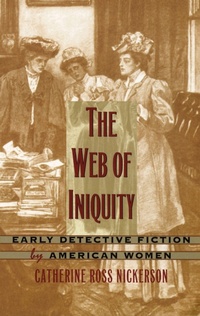
The Web of Iniquity
Early Detective Fiction by American Women
Will be published approx. on 5. January 1999
Book
Hardback
296 pages
978-0-8223-2251-1 (ISBN)
Description
The Web of Iniquity is a study of detective fiction written by American women between the Civil War and World War II. Refuting the idea that no American detective fiction of substance was produced between the times of Edgar Allan Poe and Dashiell Hammett, Catherine Ross Nickerson shows how these women writers blended Gothic elements into domestic fiction to create a unique and all-but-ignored subgenre that she labels "domestic detective fiction."
This subgenre allowed women writers to participate in postbellum culture and to critique other aspects of a rapidly changing society. Domestic detective fiction combined elements of sensationalist papers, popular nonfiction crime stories, and the domestic novel. Nickerson shows how it also incorporated the gothic tropes found in the work of Harriet Beecher Stowe, Louisa May Alcott, and Charlotte BrontE and influenced the work of Pauline Hopkins. Mid-nineteenth-century writer Metta Fuller Victor, who represented such important areas of cultural conflict as the role of professions in the formation of class identity and the possibility of women's independence and self-determination, paved the way for the appearance of women detectives in the late-nineteenth-century fiction of Anna Katharine Green. Nickerson credits Mary Roberts Rinehart, in particular, for bringing sophistication to the subgenre by amplifying the humorous, terrifying, and feminist elements inherent in earlier detective novels by women. Throughout the volume, Nickerson focuses on the narrative qualities of the domestic novel tradition and the ways in which it reflected ideologies of domesticity and gender. Also included are a discussion of various rewritings of the Lizzie Borden scandal in this tradition and an afterword on the relation of domestic detective fiction to the hard-boiled style.
The Web of Iniquity places the detective fiction written by women between 1850 and 1940 into ongoing discussions regarding women, culture, and literature and will appeal to scholars and students of women's studies, American studies, and literary history.
This subgenre allowed women writers to participate in postbellum culture and to critique other aspects of a rapidly changing society. Domestic detective fiction combined elements of sensationalist papers, popular nonfiction crime stories, and the domestic novel. Nickerson shows how it also incorporated the gothic tropes found in the work of Harriet Beecher Stowe, Louisa May Alcott, and Charlotte BrontE and influenced the work of Pauline Hopkins. Mid-nineteenth-century writer Metta Fuller Victor, who represented such important areas of cultural conflict as the role of professions in the formation of class identity and the possibility of women's independence and self-determination, paved the way for the appearance of women detectives in the late-nineteenth-century fiction of Anna Katharine Green. Nickerson credits Mary Roberts Rinehart, in particular, for bringing sophistication to the subgenre by amplifying the humorous, terrifying, and feminist elements inherent in earlier detective novels by women. Throughout the volume, Nickerson focuses on the narrative qualities of the domestic novel tradition and the ways in which it reflected ideologies of domesticity and gender. Also included are a discussion of various rewritings of the Lizzie Borden scandal in this tradition and an afterword on the relation of domestic detective fiction to the hard-boiled style.
The Web of Iniquity places the detective fiction written by women between 1850 and 1940 into ongoing discussions regarding women, culture, and literature and will appeal to scholars and students of women's studies, American studies, and literary history.
Reviews / Votes
"The Web of Iniquity presents strikingly original research on an intriguing subject: the origins of the American detective novel in mid-nineteenth-century domestic fiction. Nickerson has hit upon a rich and absorbing subject. No other book has treated this area of women's literary history in America."-Gillian Brown, author of Domestic Individualism: Imagining Self in Nineteenth-Century America "A genuinely original, terrifically interesting book."-Dana Nelson, author of National Manhood: Capitalist Citizenship and the Imagined Fraternity of White MenMore details
Language
English
Place of publication
North Carolina
United States
Target group
Professional and scholarly
Product notice
Cloth over boards
Dimensions
Height: 242 mm
Width: 154 mm
Thickness: 28 mm
Weight
640 gr
ISBN-13
978-0-8223-2251-1 (9780822322511)
Copyright in bibliographic data and cover images is held by Nielsen Book Services Limited or by the publishers or by their respective licensors: all rights reserved.
Schweitzer Classification
Person
Catherine Ross Nickerson is Associate Professor of American Studies and English at Emory University.
Content
Preface
Acknowledgments
The Advent of Detective Fiction and the Postbellum Period
1. "To Trace a Lie, to Discover a Disguisse" : Genres of Crime and Secrecy
2. "The Eye of Suspicion": The Erotics of Detection in The Dead Letter
3. The Loop of Surveillance in The Figure Eight and Hagar's Daughter
Anna Katharine Green and the Gilded Age
4. " A Woman with a Secret": Knowing and Telling in The Leavenworth Case
5. " A Woman's Hand": Good Works and the Woman Detective
Mary Roberts Rinehart and the Modern Era
6. "No Place for a Spinster" : The Architecture of Retrospection in The Circular Staircase
7. " I suppose They Stood It as Long as They Could": Mothers, Daughters, and Axe Murder in The Album
Afterword
Notes
Selected Bibliography
Index
Acknowledgments
The Advent of Detective Fiction and the Postbellum Period
1. "To Trace a Lie, to Discover a Disguisse" : Genres of Crime and Secrecy
2. "The Eye of Suspicion": The Erotics of Detection in The Dead Letter
3. The Loop of Surveillance in The Figure Eight and Hagar's Daughter
Anna Katharine Green and the Gilded Age
4. " A Woman with a Secret": Knowing and Telling in The Leavenworth Case
5. " A Woman's Hand": Good Works and the Woman Detective
Mary Roberts Rinehart and the Modern Era
6. "No Place for a Spinster" : The Architecture of Retrospection in The Circular Staircase
7. " I suppose They Stood It as Long as They Could": Mothers, Daughters, and Axe Murder in The Album
Afterword
Notes
Selected Bibliography
Index