

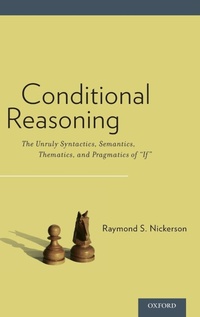
Conditional Reasoning
The Unruly Syntactics, Semantics, Thematics, and Pragmatics of "If"
Published on 20. August 2015
Book
Hardback
472 pages
978-0-19-020299-6 (ISBN)
Description
Conditional reasoning is reasoning that involves statements of the sort If A (Antecedent) then C (Consequent). This type of reasoning is ubiquitous; everyone engages in it. Indeed, the ability to do so may be considered a defining human characteristic. Without this ability, human cognition would be greatly impoverished. "What-if" thinking could not occur. There would be no retrospective efforts to understand history by imagining how it could have taken a different course. Decisions that take possible contingencies into account could not be made; there could be no attempts to influence the future by selecting actions on the basis of their expected effects.
Despite the commonness and importance of conditional reasoning and the considerable attention it has received from scholars, it remains the subject of much continuing debate. Unsettled questions, both normative and empirical, continue to be asked. What constitutes normative conditional reasoning? How do people engage in it? Does what people do match what would be expected of a rational agent with the abilities and limitations of human beings? If not, how does it deviate and how might people's ability to engage in it be improved?
This book reviews the work of prominent psychologists and philosophers on conditional reasoning. It describes empirical research on how people deal with conditional arguments and on how conditional statements are used and interpreted in everyday communication. It examines philosophical and theoretical treatments of the mental processes that support conditional reasoning. Its extensive coverage of the subject makes it an ideal resource for students, teachers, and researchers with a focus on cognition across disciplines.
Despite the commonness and importance of conditional reasoning and the considerable attention it has received from scholars, it remains the subject of much continuing debate. Unsettled questions, both normative and empirical, continue to be asked. What constitutes normative conditional reasoning? How do people engage in it? Does what people do match what would be expected of a rational agent with the abilities and limitations of human beings? If not, how does it deviate and how might people's ability to engage in it be improved?
This book reviews the work of prominent psychologists and philosophers on conditional reasoning. It describes empirical research on how people deal with conditional arguments and on how conditional statements are used and interpreted in everyday communication. It examines philosophical and theoretical treatments of the mental processes that support conditional reasoning. Its extensive coverage of the subject makes it an ideal resource for students, teachers, and researchers with a focus on cognition across disciplines.
Reviews / Votes
This book is an encyclopedic tour through the philosophical, linguistic, and psychological literatures on conditional reasoning by an eminent cognitive scientist. A final chapter summarizes what can be claimed to be known and what issues are yet to be resolved. It is truly amazing that there are so many ways to interpret 'If.'" * Thomas B. Sheridan, Ford Professor of Engineering and Applied Psychology Emeritus, MIT* Raymond Nickerson, a preeminent contemporary student of human thought, has once again provided a novel and deep analysis of a kind of human reasoning. From several different points of view he now considers the logic and psychology of conditional reasoning, specifically the significance-loaded word 'if.' The depth of his analysis makes this a must read for anyone in the psychological community. His work is a model of what psychology can be. * William Uttal, Professor Emeritus (Engineering), Arizona State University and Professor Emeritus (Psychology), University of Michigan
* A major contribution to the study of conditional reasoning by a leading cognitive psychologist."
-Richard E. Nisbett, Theodore M. Newcomb Distinguished University Professor, Department of Psychology, University of Michigan
More details
Language
English
Place of publication
New York
United States
Target group
College/higher education
Dimensions
Height: 240 mm
Width: 161 mm
Thickness: 30 mm
Weight
869 gr
ISBN-13
978-0-19-020299-6 (9780190202996)
Copyright in bibliographic data and cover images is held by Nielsen Book Services Limited or by the publishers or by their respective licensors: all rights reserved.
Schweitzer Classification
Other editions
Additional editions
Raymond Nickerson
Conditional Reasoning
The Unruly Syntactics, Semantics, Thematics, and Pragmatics of If
Book
09/2017
Oxford University Press Inc
€58.40
Shipment within 15-20 days
Raymond Nickerson
Conditional Reasoning
The Unruly Syntactics, Semantics, Thematics, and Pragmatics of "If"
E-Book
06/2015
1st Edition
OUP eBook
€28.99
Available for download
Raymond Nickerson
Conditional Reasoning
The Unruly Syntactics, Semantics, Thematics, and Pragmatics of "If"
E-Book
06/2015
1st Edition
OUP eBook
€28.99
Available for download
Person
Raymond S. Nickerson is Research Professor of Psychology at Tufts University.
Content
Preface ; 1. Getting Started ; 2. Conditionals ; 3. Experimental Approaches to the Study of Conditional Reasoning ; 4. Logic and Conditional Reasoning ; 5. Syntactics, Semantics, and Pragmatics in Conditional Reasoning ; 6. Rule Checking ; 7. Counterfactual Thinking ; 8. Counterfactual Thinking 2 ; 9. Conditional Reasoning as Probabilistic Reasoning ; 10. The Probability of the Conditional and the Conditional Probability ; 11. Individual Differences ; 12. Theoretical Accounts of Conditional Reasoning ; 13. More Theoretical Accounts ; 14. Final Comments ; References ; Index