

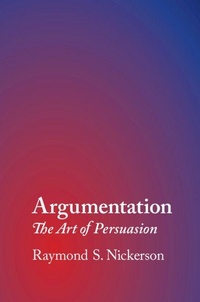
Argumentation
The Art of Persuasion
Published on 17. December 2020
Book
Paperback/Softback
458 pages
978-1-108-79987-4 (ISBN)
Description
Drawing from the study of human reasoning, Argumentation describes different types of arguments and explains how they influence beliefs and behaviour. Raymond Nickerson identifies many of the fallacies, biases, and other flaws often found in arguments as well as 'stratagems' (schemes, illogical and alogical tactics) that people regularly use to persuade others. Much attention is given to the evaluation of arguments. Readers will learn a new schematic for evaluating arguments based on cognitive science. As a source for understanding and evaluating arguments in decision-making, it is ideal for courses on cognition, reasoning, and psychology.
More details
Language
English
Place of publication
Cambridge
United Kingdom
Target group
Professional and scholarly
Product notice
Paperback (trade)
Illustrations
Worked examples or Exercises
Dimensions
Height: 225 mm
Width: 150 mm
Thickness: 25 mm
Weight
672 gr
ISBN-13
978-1-108-79987-4 (9781108799874)
Copyright in bibliographic data and cover images is held by Nielsen Book Services Limited or by the publishers or by their respective licensors: all rights reserved.
Schweitzer Classification
Other editions
Additional editions
Book
12/2020
Cambridge University Press
€129.50
Shipment within 15-20 days
E-Book
12/2020
Cambridge University Press
€28.99
Available for download
Person
Raymond S. Nickerson is Research Professor of Psychology at Tufts University, USA. He is a former senior vice president of Bolt Beranek and Newman Inc. (BBN Systems and Technologies) and the founding editor of the Journal of Experimental Psychology: Applied. Argumentation is his tenth book. The American Psychological Association established the Raymond S. Nickerson Best Paper Award in his honor.
Content
1. Argumentation; 2. Types of arguments; 3. Evaluating arguments; 4. Persuasiveness; 5. Plausibility; 6. Fallacies; 7. Biases; 8. Other flaws; 9. Stratagems; 10. Improving argumentation.