

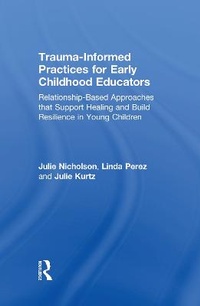
Trauma-Informed Practices for Early Childhood Educators
Relationship-Based Approaches that Support Healing and Build Resilience in Young Children
1st Edition
Published on 1. October 2018
Book
Hardback
266 pages
978-1-138-30638-7 (ISBN)
Description
Trauma-Informed Practices for Early Childhood Educators guides child care providers and early educators working with infants, toddlers, preschoolers, and early elementary aged children to understand trauma as well as its impact on young children's brains, behavior, learning, and development. The book introduces a range of trauma-informed teaching and family engagement strategies that readers can use in their early childhood programs to create strength-based environments that support children's health, healing, and resiliency. Supervisors and coaches will learn a range of powerful trauma-informed practices that they can use to support workforce development and enhance their quality improvement initiatives.
More details
Language
English
Place of publication
London
United Kingdom
Publishing group
Taylor & Francis Ltd
Target group
Professional and scholarly
Professional and Professional Practice & Development
Illustrations
24 s/w Tabellen, 11 s/w Zeichnungen, 34 s/w Photographien bzw. Rasterbilder
24 Tables, black and white; 11 Line drawings, black and white; 34 Halftones, black and white
Dimensions
Height: 229 mm
Width: 152 mm
Weight
635 gr
ISBN-13
978-1-138-30638-7 (9781138306387)
Copyright in bibliographic data and cover images is held by Nielsen Book Services Limited or by the publishers or by their respective licensors: all rights reserved.
Schweitzer Classification
Other editions
New editions
Julie Nicholson | Linda Perez | Julie Kurtz
Trauma-Informed Practices for Early Childhood Educators
Relationship-Based Approaches that Reduce Stress, Build Resilience and Support Healing in Young Children
Book
05/2023
2nd Edition
Routledge
€195.20
Shipment within 10-20 days
Additional editions
Julie Nicholson | Linda Perez | Julie Kurtz
Trauma-Informed Practices for Early Childhood Educators
Relationship-Based Approaches that Support Healing and Build Resilience in Young Children
Book
10/2018
1st Edition
Routledge
€55.95
Article exhausted; check for reprint
Persons
Julie Nicholson, PhD, is Deputy Director for WestEd's Center for Child and Family Studies and Adjunct Professor at Mills College, USA.
Linda Perez, PhD, Licensed Clinical Psychologist and Professor of Education at Mills College, is Co-Director of the Mills Infant Mental Health Program and Clinical Director of the Epiphany Center Family Treatment Program.
Julie Kurtz, MS, LMFT, is Co-Director for the Trauma-Informed Practices in Early Childhood Education Project and a Regional Director for California's Center on the Social and Emotional Foundations for Early Learning/Teaching Pyramid at WestEd's Center for Child and Family Studies. She also operates a private therapy practice in the California Bay Area Region.
Linda Perez, PhD, Licensed Clinical Psychologist and Professor of Education at Mills College, is Co-Director of the Mills Infant Mental Health Program and Clinical Director of the Epiphany Center Family Treatment Program.
Julie Kurtz, MS, LMFT, is Co-Director for the Trauma-Informed Practices in Early Childhood Education Project and a Regional Director for California's Center on the Social and Emotional Foundations for Early Learning/Teaching Pyramid at WestEd's Center for Child and Family Studies. She also operates a private therapy practice in the California Bay Area Region.
Content
1. Understanding the Neurobiology of Trauma 2. Foundations of Trauma-Informed Practice for Early Childhood Education 3. Trauma-Sensitive Early Childhood Programs 4. Case Study: Infant and Mother Living in a Homeless Shelter 5. Case Study: Toddler with a History of Neglect and Three Foster Home Parents 6. Case Study: Preschooler with an Undocumented Father Who Suddenly Disappears Due to Deportation 7. Case Study: 1st Grader Who Recently Witnessed a Drive by Shooting while Playing at School 8. The Importance of Self-Care in TIP Work: Taking Care of Yourself in Order to Prevent Burnout, Compassion Fatigue and Secondary Traumatic Stress 9. Conclusion 10. Resources on Trauma and Trauma Informed Practices