

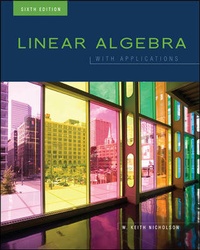
Linear Algebra with Applications
6th Edition
Published on 16. February 2009
Book
Hardback
544 pages
978-0-07-098510-0 (ISBN)
Description
"Nicholson Linear Algebra" 6e introduces the general idea of Linear Algebra much earlier than the competition keeping with the same rigorous and concise approach to linear algebra. Along with the many diagrams and examples that help students visualize, the 6e also keeps with the continuous introduction of concepts. Number 1 advantage is in Chap 5 known as the 'bridging chapter' helps stop students from 'hitting the wall' when abstract vector spaces are introduced in chap 6.
More details
Edition
6th edition
Language
English
Place of publication
London
United States
Publishing group
McGraw-Hill Education - Europe
Dimensions
Height: 257 mm
Width: 203 mm
Thickness: 28 mm
Weight
1157 gr
ISBN-13
978-0-07-098510-0 (9780070985100)
Copyright in bibliographic data and cover images is held by Nielsen Book Services Limited or by the publishers or by their respective licensors: all rights reserved.
Schweitzer Classification
Person
Dr. W. Keith Nicholson earned his undergraduate Degree in Applied Mathematics at the University of Alberta, and received his Ph.D. in Pure Mathematics from the University of California at Santa Barbara in 1970. He then moved to the University of Calgary, and has been a professor in the Department of Mathematics and Statistics since 1979, where he has been carrying out research in a branch of algebra called "Ring Theory". His continuing interest in teaching undergraduate students has led to another book in Linear Algebra (now in its third edition), a text in Abstract Algebra (second edition), and the creation (with Professor Claude Laflamme), of an internet tutorial for Linear Algebra called ILAW (Interactive Linear Algebra on the Web). Keith is married and has two grown sons.
Content
Chapter 1: Systems of Linear EquationsChapter 2: Matrix AlgebraChapter 3: Determinants and DiagonalizationChapter 4: Vector GeometryChapter 5: The Vector Space RnChapter 6: Vector SpacesChapter 7: Linear TransformationsChapter 8: OrthogonalityChapter 9: Change of BasisChapter 10: Inner Product SpacesChapter 11:Canonical Forms Appendix A: Complex Numbers
Appendix B: Proofs
Appendix C: Mathematical Induction
Appendix D: Polynomials
Appendix B: Proofs
Appendix C: Mathematical Induction
Appendix D: Polynomials