

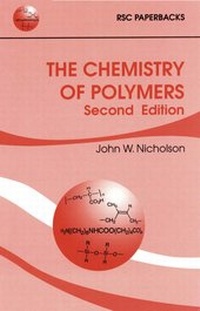
The Chemistry of Polymers
2nd Edition
Published on 23. May 1997
Book
Paperback/Softback
XII, 190 pages
978-0-85404-558-7 (ISBN)
Description
This updated new edition of the well established and highly readable introductory text book on polymer science is ideal for those requiring a broad overview of the subject. Following on from the success of the earlier editions, The Chemistry of Polymers, fourth edition, continues to explore the subject from an applications point of view, providing a comprehensive introduction to all aspects of polymer science including synthesis, structure, properties, degradation and dendrimers. Recent advances in special topics in polymer chemistry and polymers and the environment are also discussed in an informative and up-to-date manner.
Highlights include new sections on RAFT polymerization, polymers in drug delivery and polymer LEDs and updated sections on green polymerization, polymers for solar cells and polymers from renewable sources showcasing the recent developments and applications in this exciting area.
The Chemistry of Polymers, fourth edition, is essential reading for university students, teachers and scientists who wish to acquire an up-to-the-minute overview of polymer science and its many specialised topics in an informative and easy to read style.
Highlights include new sections on RAFT polymerization, polymers in drug delivery and polymer LEDs and updated sections on green polymerization, polymers for solar cells and polymers from renewable sources showcasing the recent developments and applications in this exciting area.
The Chemistry of Polymers, fourth edition, is essential reading for university students, teachers and scientists who wish to acquire an up-to-the-minute overview of polymer science and its many specialised topics in an informative and easy to read style.
Reviews / Votes
"There have been countless books on polymer science and chemistry, some more successful than others, with one of the best known being Brydsons' Plastics Materials. This book is in the same league, deserving equal reverence but covers the subject more succinctly, making it an excellent first purchase on the topic.""The text is very well written, dealing with a very scientific subject in a clear, easy to read manner."
"This is an excellent introduction and overview of the subject. It will be a useful core text for students studying polymers as part of a materials or chemistry degree and will help designers understand the properties of polymers. I would strongly recommend it as a first purchase in this subject area." -- Marion Ingle, MIMMM * Materials World Magazine *
More details
Edition
2., rev. and exp. ed.
Language
English
Place of publication
Cambridge
United Kingdom
Target group
College/higher education
Professional and scholarly
Edition type
New edition
Product notice
Paperback (UK-trade)
Illustrations
Not illustrated
Dimensions
Height: 216 mm
Width: 138 mm
Weight
400 gr
ISBN-13
978-0-85404-558-7 (9780854045587)
Schweitzer Classification
Other editions
New editions

John W. Nicholson
The Chemistry of Polymers
Book
04/2006
3rd Edition
Royal Society of Chemistry
€55.84
Article exhausted; check for reprint
Additional editions
John W. Nicholson
Chemistry of Polymers
E-Book
10/2007
2nd Edition
Royal Society of Chemistry
€27.49
Available for download
Previous edition

Nicholson
Chemistry of Polymers
Book
05/1991
Royal Society of Chemistry
€94.28
Article exhausted; check for reprint
Person
John Nicholson, CChem, CSci, EurChem, FRSC, is a Professor of Biomaterials Chemistry at the University of Greenwich, UK. He completed a BSc in Applied Chemistry at Kingston University, a PhD and then a SERC Post-doctoral Fellow at London South Bank University and a DSc at the University of Greenwich. He has worked as Head of Materials research at the Laboratory of the Government Chemist and Head of Biomaterials, King's College Dental Institute, London. He has published 170 original papers, 4 patents and 4 books.
Content
Polymer chemistry: basic concepts; the history of the concept of the macromolecule; classification of polymer; structure and properties of polymer: poly(ethylene), poly(propylene), poly(methyl methacrylate), poly(styrene), poly(vinylchloride) PVC, the nylons, epoxy resins, phenol-formaldehyde polymers, aminoresins, poly(tetrafluoroethylene) PTFE, polyurethanes, silicones, naturally occurring polymers, cellulose, starch, natural rubber, proteins, poly(B-hydroxybubycates), poly(ether ether ketones). Polymerisation reactions: chain polymerisation: initiation, propagation, termination, other reactions; arrangement of monomer units; kinetics of chain polymerisation; autoacceleration; practical methods of chain polymerisation: bulk polymerisation, solution polymerisation, suspension polymerisation, emulsion polymerisation, the loop process; other chain polymerisation mechanisms; step polymerisation; step polymerisation with polyfunctional monomers; copolymerization. Polymer structure: polymer stereochemistry; polymer crystallinity: orientation and crystallisation, the crystalline melting point, polyblends; thermal and mechanical properties: the glass transition temperature, the effects of plasticisers, ,ethos of determining glass trasition temperature; the effect of polymer stereochemistry on Tg; the relationship between crystalline melting point and Tg; other thermal transitions. Crosslinking: introduction; phenol-formaldehyde resins; unsaturated polyester resins; polyurethanes; epoxy resins. Polymer solutions: introduction; dissolution of polymers; solubility parameters; simple liquid mixtures and Raoult's law; entropy of mixing; real molecules in dilute solution; shapes of polymer molecules in solution; reputation model of molecular motion; water-soluble polymers; uses of high-viscosity polymer solutions; polymer melts. Methods of determining relative molar mass: introduction; molar masses from colligative properties: vapour phase osmometry; light scattering: experimental determination; viscosity methods of determining relative molar mass; end group analysis; gel permeation chromatography. Mechanical properties of polymers: introduction; stress, strain, and Young's modulus; brittle and though fracture; types of strength; the influence of surfaces; viscoelasticity; creep and stress relaxation; cold drawing; dynamic tests; time/temperature relationship; rubberlike elasticity; reinforced polymers; practical measurements of mechanical properties; further reading. (Part contents).