

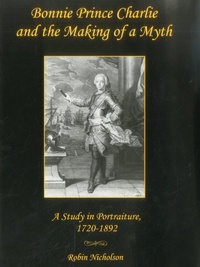
Bonnie Prince Charlie and the Making of a Myth
A Study in Portraiture, 1720-1892
Will be published approx. on 1. February 2002
Book
Hardback
160 pages
978-1-61148-150-1 (ISBN)
Description
The subject of this book-an Italian-born exiled Prince-has become an icon of misjudged romanticism and Scottish nationalism; much of this is due to the way he has been portrayed over the years. This study traces how the enduring visual image of Prince Charles Edward Stuart was created, beginning with his birth in 1720 and ending with the exhibition of John Pettie's Prince Charles Edward Stuart Entering the Ballroom at Holyrood - probably still the most enduring and popular image of the Stuart prince-at the Royal Academy in 1892.
This book considers the role of portraiture in the Stuart court, both before and after exile in 1688 and how the well-established traditions of royal portraiture and image-making were used by the Stuart dynasty to promote their ambitions and stature. Charles's birth in 1720 resulted in a flurry of portrait commissions in which he was depicted as the royal heir apparent. The messianic role with which he was invested reached its apotheosis with the Jacobite uprising of 1745. He adopted the costume and manners of an idealized Highland chieftain and within the space of a few months created an abiding iconography which was to endure long after his death.
The major portraits of Charles executed during his lifetime are considered, from the early court portraits of Antonio David and Domenico Dupra to the final images of a broken man by Ozias Humphrey and Hugh Douglas Hamilton. Alongside this, there is a thorough examination of a parallel phenomenon in which works of art, observing established parameters, were copied and adapted, and then re-copied, until the tartan-clad ideal of 1745 began to eclipse the real person. The revering of Charles Edward and the manufacture of items bearing his likeness are compared to other "cults" of the individual and contrasted with the "commercialization of politics" which several commentators have identified as a coherent phenomenon of late eighteenth-century British life. The extent to which the material culture that surrounded the persona of Char
This book considers the role of portraiture in the Stuart court, both before and after exile in 1688 and how the well-established traditions of royal portraiture and image-making were used by the Stuart dynasty to promote their ambitions and stature. Charles's birth in 1720 resulted in a flurry of portrait commissions in which he was depicted as the royal heir apparent. The messianic role with which he was invested reached its apotheosis with the Jacobite uprising of 1745. He adopted the costume and manners of an idealized Highland chieftain and within the space of a few months created an abiding iconography which was to endure long after his death.
The major portraits of Charles executed during his lifetime are considered, from the early court portraits of Antonio David and Domenico Dupra to the final images of a broken man by Ozias Humphrey and Hugh Douglas Hamilton. Alongside this, there is a thorough examination of a parallel phenomenon in which works of art, observing established parameters, were copied and adapted, and then re-copied, until the tartan-clad ideal of 1745 began to eclipse the real person. The revering of Charles Edward and the manufacture of items bearing his likeness are compared to other "cults" of the individual and contrasted with the "commercialization of politics" which several commentators have identified as a coherent phenomenon of late eighteenth-century British life. The extent to which the material culture that surrounded the persona of Char
Reviews / Votes
Mr. Nicholson's fruitfully eclectic methodology enables him to deal insightfully with both 'high' and 'low' art. He takes full advantage of his position as curator of the Drambuie Liqueur Company (Edinburgh) collection of Scottish and Jacobite art. -- Vincent Carretta, author of <I>Equiano: The African<I>More details
Language
English
Place of publication
Cranbury
United States
Publishing group
Associated University Presses
Target group
Professional and scholarly
Product notice
sewn/stitched
Cloth over boards
With dust jacket
Dimensions
Height: 287 mm
Width: 225 mm
Thickness: 15 mm
Weight
875 gr
ISBN-13
978-1-61148-150-1 (9781611481501)
Copyright in bibliographic data and cover images is held by Nielsen Book Services Limited or by the publishers or by their respective licensors: all rights reserved.
Schweitzer Classification
Person
Robin Nicholson is curator of The Drambuie Liqueur Company's extensive collection of Scottish and Jacobite art. Born in Edinburgh, he was educated at the Edinburgh Academy, Queen's University, Ontario and Cambridge University, before spending a number of years working for the leading dealers in British art, The Fine Art Society. He was appointed Curator of the Drambuie Collection in 1992 and published a catalogue of the collection in 1995. He has written articles on Scottish and Jacobite art and aspects of collecting for both academic and non-academic journals and has curated several touring exhibitions to museums and galleries in Britain and abroad. He lives in East Lothian.