

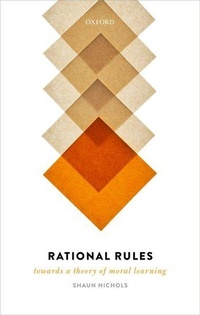
Rational Rules
Towards a Theory of Moral Learning
Published on 11. February 2021
Book
Hardback
266 pages
978-0-19-886915-3 (ISBN)
Description
Moral systems, like normative systems more broadly, involve complex mental representations. Rational Rules proposes that moral learning can be understood in terms of general-purpose rational learning procedures. Nichols argues that statistical learning can help answer a wide range of questions about moral thought: Why do people think that rules apply to actions rather than consequences? Why do people expect new rules to be focused on actions rather than consequences? How do people come to believe a principle of liberty, according to which whatever is not expressly prohibited is permitted? How do people decide that some normative claims hold universally while others hold only relative to some group? The resulting account has both empiricist and rationalist features: since the learning procedures are domain-general, the result is an empiricist theory of a key part of moral development, and since the learning procedures are forms of rational inference, the account entails that crucial parts of our moral system enjoy rational credentials. Moral rules can also be rational in the sense that they can be effective for achieving our ends, given our ecological settings. Rational Rules argues that at least some central components of our moral systems are indeed ecologically rational: they are good at helping us attain common goals. Nichols argues that the account might be extended to capture moral motivation as a special case of a much more general phenomenon of normative motivation. On this view, a basic form of rule representation brings motivation along automatically, and so part of the explanation for why we follow moral rules is that we are built to follow rules quite generally.
Reviews / Votes
The book should be read widely, not just by ethicists interested in the origins and rationality of commonsense morality but by philosophers and scientists concerned with moral development, moral education, and how moral knowledge might be implemented in AI. * Joshua May, University of Alabama at Birmingham, Ethics * A valuable addition to the literature concerning the formation and origin of moral rules, Rational Rules retains a firm commitment to the role played by Recommended. Graduate students, researchers, faculty. * R. T. Lee, Trinity College, CHOICE * ...very sophisticated discussions of statistical inference and learning theory with an equally sophisticated discussion of what this kind of learning might mean for a range of metaethical concerns... * James Bernard Murphy, Metascience *More details
Language
English
Place of publication
Oxford
United Kingdom
Target group
Professional and scholarly
Product notice
sewn/stitched
Cloth over boards
Dimensions
Height: 218 mm
Width: 142 mm
Thickness: 20 mm
Weight
476 gr
ISBN-13
978-0-19-886915-3 (9780198869153)
Copyright in bibliographic data and cover images is held by Nielsen Book Services Limited or by the publishers or by their respective licensors: all rights reserved.
Schweitzer Classification
Other editions
Additional editions
E-Book
02/2021
1st Edition
OUP eBook
€57.99
Available for download
E-Book
02/2021
1st Edition
OUP eBook
€57.99
Available for download
Person
Shaun Nichols is Professor of Philosophy at Cornell University.
Content
Preface
PART I: RATIONALITY AND RULES
1: Rationality and morality: Setting the stage
2: The wrong and the bad: On the nature of moral representations
PART II: STATISTICAL LEARNING OF NORM SYSTEMS
3: Scope
4: Priors
5: Closure
6: Status
PART III: PHILOSOPHICAL IMPLICATIONS
7: Moral empiricism
8: Rational rules and normative propriety
9: Rational rules, relativism, and universalism
10: Is it rational to be moral?
PART I: RATIONALITY AND RULES
1: Rationality and morality: Setting the stage
2: The wrong and the bad: On the nature of moral representations
PART II: STATISTICAL LEARNING OF NORM SYSTEMS
3: Scope
4: Priors
5: Closure
6: Status
PART III: PHILOSOPHICAL IMPLICATIONS
7: Moral empiricism
8: Rational rules and normative propriety
9: Rational rules, relativism, and universalism
10: Is it rational to be moral?