

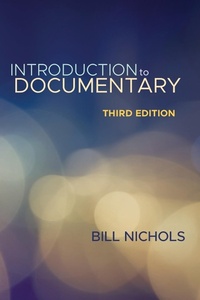
Introduction to Documentary, Third Edition
3rd Edition
Published on 27. March 2017
Book
Hardback
280 pages
978-0-253-02634-7 (ISBN)
Description
The third edition of Bill Nichols's best-selling text provides an up-to-date introduction to the most important issues in documentary history and criticism. A new chapter, "I Want to Make a Documentary: Where Do I Start?" guides readers through the steps of planning and preproduction and includes an example of a project proposal for a film that went on to win awards at major festivals. Designed for students in any field that makes use of visual evidence and persuasive strategies, Introduction to Documentary identifies the genre's distinguishing qualities and teaches the viewer how to read documentary film. Each chapter takes up a discrete question, from "How did documentary filmmaking get started?" to "Why are ethical issues central to documentary filmmaking?" Here Nichols has fully rewritten each chapter for greater clarity and ease of use, including revised discussions of earlier films and new commentary on dozens of recent films from The Cove to The Act of Killing and from Gasland to Restrepo.
Reviews / Votes
Documentary film has never been more popular - nor creatively complex - and Bill Nichols's book gives a concise over-view of the genre while tackling the important ideas, issues, and conundrums that we as filmmakers all face.- Mark Lewis (Filmmaker) This new edition of Introduction to Documentary is incisive and magisterial, a brilliantly organized and ambitious analysis of that enigmatic, open-ended, and vital are of cinema in which reality is not so much documented as transformed. Nichols addresses with ambition and humility all the key questions about what happens - ethically, aesthetically, and politically - when real people agree to play themselves, and collaborate with the filmmaker to transform their lives for the screen.
- Joshua Oppenheimer (Director, Producer, Filmmaker)
More details
Edition
Third Edition
Language
English
Place of publication
Bloomington, IN
United States
Target group
Professional and scholarly
Edition type
New edition
Product notice
Paper over boards
Illustrations
113 b&w illus., 5 tables - 113 Illustrations, black and white - 6 Tables, black and white
Dimensions
Height: 260 mm
Width: 183 mm
Thickness: 19 mm
Weight
725 gr
ISBN-13
978-0-253-02634-7 (9780253026347)
Copyright in bibliographic data and cover images is held by Nielsen Book Services Limited or by the publishers or by their respective licensors: all rights reserved.
Schweitzer Classification
Other editions
Additional editions
Bill Nichols
Introduction to Documentary, Third Edition
E-Book
03/2017
3rd Edition
Indiana University Press
from
€25.59
Available for download
Person
Bill Nichols is Professor Emeritus of Cinema at San Francisco State University. He is author of Representing Reality: Issues and Concepts in Documentary (IUP), Blurred Boundaries: Questions of Meaning in Contemporary Culture (IUP), and Speaking Truths with Film: Evidence, Ethics, Politics in Documentary.
Content
Acknowledgments
Introduction
1. How Can We Define Documentary Film?
2. Why Are Ethical Issues Central to Documentary Filmmaking?
3. What Gives Documentaries a Voice of Their Own?
4. What Makes Documentaries Engaging and Persuasive?
5. How Did Documentary Filmmaking Get Started?
6. How Can We Differentiate among Documentary Models and Modes? What Are the Poetic, Expository, and Reflexive Modes?
7. How Can We Describe the Observational, Participatory, and Performative Modes of Documentary Film?
8. How Have Documentaries Addressed Social and Political Issues?
9. How Can We Write Effectively about Documentary?
10. I Want to Make a Documentary. Where Do I Start?
Appendix A: Sample Film Project Proposal: Sex with Sam
Notes on Source Material
Index
Introduction
1. How Can We Define Documentary Film?
2. Why Are Ethical Issues Central to Documentary Filmmaking?
3. What Gives Documentaries a Voice of Their Own?
4. What Makes Documentaries Engaging and Persuasive?
5. How Did Documentary Filmmaking Get Started?
6. How Can We Differentiate among Documentary Models and Modes? What Are the Poetic, Expository, and Reflexive Modes?
7. How Can We Describe the Observational, Participatory, and Performative Modes of Documentary Film?
8. How Have Documentaries Addressed Social and Political Issues?
9. How Can We Write Effectively about Documentary?
10. I Want to Make a Documentary. Where Do I Start?
Appendix A: Sample Film Project Proposal: Sex with Sam
Notes on Source Material
Index