

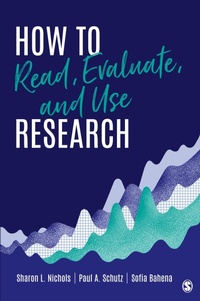
How to Read, Evaluate, and Use Research
1st Edition
Published on 9. August 2023
Book
Paperback/Softback
264 pages
978-1-5443-6148-2 (ISBN)
Description
This text helps students learn how to select, read, understand, and evaluate the research they read. Many texts focus on the process of conducting research and not as much on how students in applied disciplines can assess and apply that research in their future professional lives; this text aims to fill that gap. Organized in the same way as a research article, the book includes a chapter on literature reviews and research questions, followed by three methods chapters (quantitative, qualitative, and mixed methods), and a chapter on research conclusions and implications. The book includes a wealth of pedagogical features including Learning Objectives, Check Your Understanding questions, a Guided Application exercise in each chapter, suggested further reading, and a glossary. Three research articles, used as exemplars throughout, are included in the appendix to the book.
Reviews / Votes
This book will support learning for students and researchers in all avenues. Through introduction and development of key research topics, readers will gain a deeper understanding of some of the important fundamental concepts of research. -- Kristina Harshman The authors provide a well-defined yet simple explanation of how students can find, analyze, and apply research to their own evidence-based practice. -- Hollea Ryan This is an excellent and readable resource for doctoral students starting their dissertation process and at the beginning of their work to identify, integrate and apply scholarship to emerging research projects. It is one of the better texts I have seen in recent years that synthesizes the basic concepts for research methods and scholarly inquiry. -- Felice D. Billups Nichols et al. do a good job showing why research is important. I love that finding peer-reviewed sources is treated as a separate topicthan the literature review. -- Trevor Brooks
More details
Edition
1. Auflage
Language
English
Place of publication
Thousand Oaks
United States
Target group
College/higher education
Dimensions
Height: 229 mm
Width: 152 mm
Thickness: 17 mm
Weight
427 gr
ISBN-13
978-1-5443-6148-2 (9781544361482)
Copyright in bibliographic data and cover images is held by Nielsen Book Services Limited or by the publishers or by their respective licensors: all rights reserved.
Schweitzer Classification
Persons
Paul A. Schutz, PhD is currently a Professor in the Department of Educational Psychology at the University of Texas at San Antonio. His research interests include the nature of emotion, the influence of emotional experiences on teachers' identity development, research methods and issues related to race and social justice. He has several publications related to the use of mixed methods and has taught a variety of different research methods course, including qualitative, quantitative and mixed methods research courses. He is a past president for Division 15: Educational Psychology of the American Psychological Association and a former co-editor of the Educational Researcher: Research News and Comment, a lead journal for the American Educational Research Association.
Content
Chapter 1: Introduction and Overview
Organizing Terms and Concepts
Why Scientific Literacy Is Important
Nature of Data-Driven Research: Introduction to Research Methods
Conclusion
Chapter 2: Introduction and Overview of Data-Driven Articles
Searching for Scientific Evidence
How to Cull Through Data-Driven Articles
Sections of Data-Driven Articles
Results
Conclusion
Chapter 3: Literature Review
What Is Involved in the Construction of a Useful Literature Review?
What Are Some of the Potential Goals of a Literature Review?
What Is in the Literature Review?
Conclusion
Chapter 4: Methods and Results: Quantitative Approaches
Overview
Quantitative Methods
Putting It All Together
Chapter 5: Methods and Results: Qualitative Approaches
Overview
Qualitative Methods
Looking Out for Rigor
Putting It All Together
Chapter 6: Methods and Results: Mixed Methods Approaches
Overview
What Are Some Benefits Associated With Mixed Method Research?
What Are Some Purposes of Mixed Method Research?
Integration in Mixed Methods Research
Looking Out for Rigor
Chapter 7: Putting it All Together - Discussion, Conclusions, and Implications
Overview
Ending a Research Article
Putting It All Together-Reading and Evaluating Research From Start to Finish
Organizing Terms and Concepts
Why Scientific Literacy Is Important
Nature of Data-Driven Research: Introduction to Research Methods
Conclusion
Chapter 2: Introduction and Overview of Data-Driven Articles
Searching for Scientific Evidence
How to Cull Through Data-Driven Articles
Sections of Data-Driven Articles
Results
Conclusion
Chapter 3: Literature Review
What Is Involved in the Construction of a Useful Literature Review?
What Are Some of the Potential Goals of a Literature Review?
What Is in the Literature Review?
Conclusion
Chapter 4: Methods and Results: Quantitative Approaches
Overview
Quantitative Methods
Putting It All Together
Chapter 5: Methods and Results: Qualitative Approaches
Overview
Qualitative Methods
Looking Out for Rigor
Putting It All Together
Chapter 6: Methods and Results: Mixed Methods Approaches
Overview
What Are Some Benefits Associated With Mixed Method Research?
What Are Some Purposes of Mixed Method Research?
Integration in Mixed Methods Research
Looking Out for Rigor
Chapter 7: Putting it All Together - Discussion, Conclusions, and Implications
Overview
Ending a Research Article
Putting It All Together-Reading and Evaluating Research From Start to Finish