

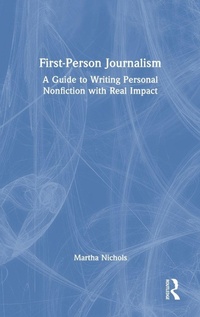
First-Person Journalism
A Guide to Writing Personal Nonfiction with Real Impact
1st Edition
Published on 12. November 2021
Book
Hardback
196 pages
978-0-367-67648-3 (ISBN)
Description
A first-of-its-kind guide for new media times, this book provides practical, step-by-step instructions for writing first-person features, essays, and digital content.
Combining journalism techniques with self-exploration and personal storytelling, First-Person Journalism is designed to help writers to develop their personal voice and establish a narrative stance. The book introduces nine elements of first-person journalism-passion, self-reporting, stance, observation, attribution, counterpoints, time travel, the mix, and impact. Two introductory chapters define first-person journalism and its value in building trust with a public now skeptical of traditional news media. The nine practice chapters that follow each focus on one first-person element, presenting a sequence of "voice lessons" with a culminating writing assignment, such as a personal trend story or an open letter. Examples are drawn from diverse nonfiction writers and journalists, including Ta-Nehisi Coates, Joan Didion, Helen Garner, Alex Tizon, and James Baldwin. Together, the book provides a fresh look at the craft of nonfiction, offering much-needed advice on writing with style, authority, and a unique point of view.
Written with a knowledge of the rapidly changing digital media environment, First-Person Journalism is a key text for journalism and media students interested in personal nonfiction, as well as for early-career nonfiction writers looking to develop this narrative form.
Combining journalism techniques with self-exploration and personal storytelling, First-Person Journalism is designed to help writers to develop their personal voice and establish a narrative stance. The book introduces nine elements of first-person journalism-passion, self-reporting, stance, observation, attribution, counterpoints, time travel, the mix, and impact. Two introductory chapters define first-person journalism and its value in building trust with a public now skeptical of traditional news media. The nine practice chapters that follow each focus on one first-person element, presenting a sequence of "voice lessons" with a culminating writing assignment, such as a personal trend story or an open letter. Examples are drawn from diverse nonfiction writers and journalists, including Ta-Nehisi Coates, Joan Didion, Helen Garner, Alex Tizon, and James Baldwin. Together, the book provides a fresh look at the craft of nonfiction, offering much-needed advice on writing with style, authority, and a unique point of view.
Written with a knowledge of the rapidly changing digital media environment, First-Person Journalism is a key text for journalism and media students interested in personal nonfiction, as well as for early-career nonfiction writers looking to develop this narrative form.
More details
Language
English
Place of publication
London
United Kingdom
Publishing group
Taylor & Francis Ltd
Target group
College/higher education
Dimensions
Height: 240 mm
Width: 161 mm
Thickness: 16 mm
Weight
487 gr
ISBN-13
978-0-367-67648-3 (9780367676483)
Copyright in bibliographic data and cover images is held by Nielsen Book Services Limited or by the publishers or by their respective licensors: all rights reserved.
Schweitzer Classification
Other editions
Additional editions
Book
11/2021
1st Edition
Routledge
€57.50
Shipment within 15-20 days
E-Book
11/2021
1st Edition
Routledge
€51.49
Available for download
E-Book
11/2021
1st Edition
Routledge
€51.49
Available for download
Person
Martha Nichols cofounded Talking Writing, a nonprofit digital magazine. A longtime writer, journalist, and editor, she is a faculty instructor in journalism at the Harvard University Extension School. She is also the editor of and a contributor to Into Sanity: Essays About Mental Health, Mental Illness, and Living in Between.
Content
Contents
Preface: Personal Journalism for Challenging Times
PART ONE: What Is First-Person Journalism?
Chapter 1: How I Became a First-Person Journalist
Defining first-person journalism
Permission to say "I"
Is it ever too personal?
Self-reporting: "What do I know?"
How to use this book
Why gonzo got it wrong-and right
Chapter 2: The Ethics of Personal Reporting
He said, she said
The limits of objectivity
Liars, thieves, and postmodernists
Fictional selves versus true selves
Embracing the active "I"
PART TWO: Developing an Active "I" Voice
Chapter 3: Locating Your Passion: What do I want to write about?
Don't bore yourself
Don't perform your emotions
Don't scream at readers
Cultivating curiosity: passion for facts
Responding to the world
Personal story: write about a "wart"
Chapter 4: Investigating Yourself: How do I know my own story is true?
Why memories are not facts
Fact checking the basics
Fact checking with family and friends
Reporting on your "I"
Reporting on what you haven't said
Admitting what you'll never know
Memory essay: write about an early memory
Sample story: "Hurricane Warnings"
Chapter 5: Establishing Your Stance: How close am I to the story?
From POV to first-person stance
Determining your emotional distance
Personal example: reining in myself
Addressing readers: five stances
Rethinking voice: active response
Review: your personal take on a media work
PART THREE: Reporting Beyond the Self
Chapter 6: Observing Real Life: How do I describe people and places?
Relevance versus vagueness
Three kinds of details
Conveying the feel of a place
Reporting what people do and say
Direct reporting of events
The art of capsule description
Local profile: write about a neighborhood place
Chapter 7: Attributing Sources: Where do my facts come from?
What is attribution?
Sources in first-person features
Attribution tags and linking
Danger! Avoid voice hijacks
The curse of knowledge
How-to piece: explain with three tips
Chapter 8: Convincing Readers: What's my argument and who disagrees?
The curse of unconscious feeling
Point-counterpoint
Not all experts are the same
Establishing first-person authority
Open letter: address a public figure or topic
PART FOUR: Storytelling to Make an Impact
Chapter 9: Moving Through Time: How have I and the world changed?
Sequence: what comes first?
Chronology: orienting readers in time
Time machine: shifting between past and present selves
Trends: personal and cultural
Personal trend story: write about changes in food, music, or weather
Chapter 10: Organizing a Story: How do I mix everything together?
What's in the mix?
Classic feature formula: lead + nut graf
Scene breaks and dramatic tension
Essays: emotional journeys
New mix: feature or essay?
Sample outline: "Why I'll Never Surf Again"
Chapter 11: Revising for Impact: What do I really want to say?
Test your idea: pitching
Focus your idea: taglines
Focus your voice: cutting and selecting
Connect to the world: your impact
Story revision: complete a feature or essay
Impact Plan: how do you know?
End Note: Witnessing the World with Empathy
25 Rules for First-Person Journalism
Index
Preface: Personal Journalism for Challenging Times
PART ONE: What Is First-Person Journalism?
Chapter 1: How I Became a First-Person Journalist
Defining first-person journalism
Permission to say "I"
Is it ever too personal?
Self-reporting: "What do I know?"
How to use this book
Why gonzo got it wrong-and right
Chapter 2: The Ethics of Personal Reporting
He said, she said
The limits of objectivity
Liars, thieves, and postmodernists
Fictional selves versus true selves
Embracing the active "I"
PART TWO: Developing an Active "I" Voice
Chapter 3: Locating Your Passion: What do I want to write about?
Don't bore yourself
Don't perform your emotions
Don't scream at readers
Cultivating curiosity: passion for facts
Responding to the world
Personal story: write about a "wart"
Chapter 4: Investigating Yourself: How do I know my own story is true?
Why memories are not facts
Fact checking the basics
Fact checking with family and friends
Reporting on your "I"
Reporting on what you haven't said
Admitting what you'll never know
Memory essay: write about an early memory
Sample story: "Hurricane Warnings"
Chapter 5: Establishing Your Stance: How close am I to the story?
From POV to first-person stance
Determining your emotional distance
Personal example: reining in myself
Addressing readers: five stances
Rethinking voice: active response
Review: your personal take on a media work
PART THREE: Reporting Beyond the Self
Chapter 6: Observing Real Life: How do I describe people and places?
Relevance versus vagueness
Three kinds of details
Conveying the feel of a place
Reporting what people do and say
Direct reporting of events
The art of capsule description
Local profile: write about a neighborhood place
Chapter 7: Attributing Sources: Where do my facts come from?
What is attribution?
Sources in first-person features
Attribution tags and linking
Danger! Avoid voice hijacks
The curse of knowledge
How-to piece: explain with three tips
Chapter 8: Convincing Readers: What's my argument and who disagrees?
The curse of unconscious feeling
Point-counterpoint
Not all experts are the same
Establishing first-person authority
Open letter: address a public figure or topic
PART FOUR: Storytelling to Make an Impact
Chapter 9: Moving Through Time: How have I and the world changed?
Sequence: what comes first?
Chronology: orienting readers in time
Time machine: shifting between past and present selves
Trends: personal and cultural
Personal trend story: write about changes in food, music, or weather
Chapter 10: Organizing a Story: How do I mix everything together?
What's in the mix?
Classic feature formula: lead + nut graf
Scene breaks and dramatic tension
Essays: emotional journeys
New mix: feature or essay?
Sample outline: "Why I'll Never Surf Again"
Chapter 11: Revising for Impact: What do I really want to say?
Test your idea: pitching
Focus your idea: taglines
Focus your voice: cutting and selecting
Connect to the world: your impact
Story revision: complete a feature or essay
Impact Plan: how do you know?
End Note: Witnessing the World with Empathy
25 Rules for First-Person Journalism
Index