

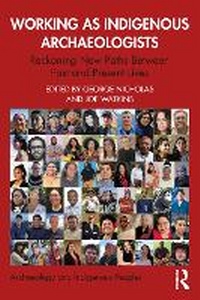
Working as Indigenous Archaeologists
Reckoning New Paths Between Past and Present Lives
1st Edition
Published on 30. September 2024
Book
Hardback
644 pages
978-1-032-02537-7 (ISBN)
Description
Working as Indigenous Archaeologists explores the often-contentious relationship between Indigenous and other formerly colonized peoples and Archaeology through their own voices.
Over the past 35-plus years, the once-novel field of Indigenous Archaeology has become a relatively familiar part of the archaeological landscape. It has been celebrated, criticized, and analyzed as to its practical and theoretical applications, and its political nature. No less important are the life stories of its Indigenous practitioners. What has brought some of them to become practicing archaeologists or heritage managers? What challenges have they faced from both inside and outside their communities? And why haven't more pursued Archaeology as a vocation or avocation? This volume is a collection of 60 autobiographical chapters by Indigenous archaeologists and heritage specialists from around the world-some community based, some academic, some in other realms-who are working to connect past and present in meaningful, and especially personal ways. As Archaeology continues to evolve, there remain strong tensions between an objective, science-oriented, evidentiary-based approach to knowing the past and a more subjective, relational, humanistic approach informed by local values, traditional knowledge, and holistic perspective. While there are no maps for these new territories, hearing directly from those Indigenous individuals who have pursued Archaeology reveals the pathways taken. Those stories will provide inspiration and confidence for those curious about what lies ahead.
This is an important volume for anyone interested in the present state and future of the archaeological discipline.
Over the past 35-plus years, the once-novel field of Indigenous Archaeology has become a relatively familiar part of the archaeological landscape. It has been celebrated, criticized, and analyzed as to its practical and theoretical applications, and its political nature. No less important are the life stories of its Indigenous practitioners. What has brought some of them to become practicing archaeologists or heritage managers? What challenges have they faced from both inside and outside their communities? And why haven't more pursued Archaeology as a vocation or avocation? This volume is a collection of 60 autobiographical chapters by Indigenous archaeologists and heritage specialists from around the world-some community based, some academic, some in other realms-who are working to connect past and present in meaningful, and especially personal ways. As Archaeology continues to evolve, there remain strong tensions between an objective, science-oriented, evidentiary-based approach to knowing the past and a more subjective, relational, humanistic approach informed by local values, traditional knowledge, and holistic perspective. While there are no maps for these new territories, hearing directly from those Indigenous individuals who have pursued Archaeology reveals the pathways taken. Those stories will provide inspiration and confidence for those curious about what lies ahead.
This is an important volume for anyone interested in the present state and future of the archaeological discipline.
Reviews / Votes
"Nearly three decades ago, archaeologist Bruce Trigger observed that "archaeology will not be a decolonized discipline until there are a substantial number of fully qualified and practicing Native archaeologists." Whatever a "substantial" number might be, archaeology is not yet there, but the number of Indigenous archaeologists is rapidly trending upward. The 56 archaeologists featured in Working as Indigenous Archaeologists can be added to the 36 featured in the 2010 volume Being and Becoming Indigenous Archaeologists. Their goals, challenges, and accomplishments in telling their peoples' stories show what a decolonized archaeology will look like and what a far more inclusive and valuable discipline it can become."~ Larry J. Zimmerman, PhD, Professor emeritus of Anthropology & Museum Studies, Indiana University Indianapolis.
"This is a splendid book. It opens the door to many paths not yet taken by archaeologists and offers a glimpse of a new era of understanding. It introduces a brighter future for archaeology than I could ever have imagined. This book is my favorite book."
~ K. Anne Pyburn, Provost's Professor of Anthropology, Indiana University, USA.
More details
Series
Language
English
Place of publication
London
United Kingdom
Publishing group
Taylor & Francis Ltd
Target group
General
Illustrations
207 s/w Abbildungen, 207 s/w Photographien bzw. Rasterbilder
207 Halftones, black and white; 207 Illustrations, black and white
Dimensions
Height: 234 mm
Width: 156 mm
Weight
1240 gr
ISBN-13
978-1-032-02537-7 (9781032025377)
Copyright in bibliographic data and cover images is held by Nielsen Book Services Limited or by the publishers or by their respective licensors: all rights reserved.
Schweitzer Classification
Other editions
Additional editions
George Nicholas | Joe Watkins
Working as Indigenous Archaeologists
Reckoning New Paths Between Past and Present Lives
Book
approx. 07/2026
1st Edition
Routledge
€63.50
Not yet published
George Nicholas | Joe Watkins
Working as Indigenous Archaeologists
Reckoning New Paths Between Past and Present Lives
E-Book
09/2024
1st Edition
Routledge
€68.49
Available for download
George Nicholas | Joe Watkins
Working as Indigenous Archaeologists
Reckoning New Paths Between Past and Present Lives
E-Book
09/2024
1st Edition
Routledge
€68.49
Available for download
Persons
George Nicholas is Distinguished Professor of Archaeology at Simon Fraser University, Canada, and holds adjunct faculty positions at Hokkaido University and Flinders University. An anthropologically oriented archaeologist, he has worked with and for Indigenous groups worldwide for over 35 years. He was founding director of SFU's Indigenous Archaeology program in Kamloops, BC (1991-2005), and director of the Intellectual Property Issues in Cultural Heritage (IPinCH) project (2008-2016). His work focuses on research ethics, intellectual property, intangible heritage, archaeological theory, and Indigenous Archaeology. Previous publications include At a Crossroads: Archaeology and First Peoples in Canada (1997) and Being and Becoming Indigenous Archaeologists (2010).
Joe Watkins is a member of the Choctaw Nation of Oklahoma and has been involved in archaeology, anthropology and heritage preservation initiatives for more than 50 years. His book Indigenous Archaeology: American Indian Values and Scientific Practice (2000) is considered a foundational work in establishing Indigenous Archaeology as an internationally acknowledged area of Archaeology. He has published numerous articles and book chapters on the ethical practice of anthropology and anthropology's relationships with descendant communities and populations, including American Indians, Australian Aboriginals, New Zealand Maori, and the Japanese Ainu. He was President of the Society for American Archaeology from 2018 to 2021.
Joe Watkins is a member of the Choctaw Nation of Oklahoma and has been involved in archaeology, anthropology and heritage preservation initiatives for more than 50 years. His book Indigenous Archaeology: American Indian Values and Scientific Practice (2000) is considered a foundational work in establishing Indigenous Archaeology as an internationally acknowledged area of Archaeology. He has published numerous articles and book chapters on the ethical practice of anthropology and anthropology's relationships with descendant communities and populations, including American Indians, Australian Aboriginals, New Zealand Maori, and the Japanese Ainu. He was President of the Society for American Archaeology from 2018 to 2021.
Content
Acknowledgements; A Word About Words; Part 1. Framing the Conversation: Introduction Reckoning New Paths; Part 2. Listening and Learning: 1 Feminist Archaeologies from the Borders; 2 Seeking My Center Place: Migrations through Science and Tradition; 3 Starting Archaeological Studies as a Mature Student in My 40s; 4 Indigenous Archaeology and My Responsibility to Archaeological Legacies; 5 Decolonizing Maya Discourse of Identity as an Archaeologist; 6 Archaeological Double Agency; 7 Mayaland Deciphered: Archaeologies of the Self; 8 Where We Ultimately Belong; 9 Fresh Ideas from a Murdi Geoarchaeologist; 10 From My Tradition to My Profession: Moving between the "Gentiles," Archaeologies, and the Hills of Colors; 11 All Roads Lead Home: Thinking about Archaeology Through Emotions and Affectivitions; 12 Working as a Proud Archaeologist Where I Originate; 13 Country, Language, Culture and Ancestors: The Cultural and Archaeological Journey of a Wiradjuri-Wangaaypuwan winarr; 14 Earth Mother, Sky Father, and Everything Inbetween; 15 Recalling Indigenous Knowledge in Cape Town; 16 From a Barman to a Scholar: Sharing the Experience of Being an Archaeologist and a Heritage Scholar in Tanzania; 17 Being and Becoming One of the Voices of Haitian Archaeology; 18 Coming Home with a Vengeance: Indigenous Activism on the Margins of Archaeology; 19 What Makes Me Different; 20 Making Inuit Archaeology Matter in Kalaallit Nunaat; 21 Finding Strength in Culture and History; 22 Raiders of a Lost Identity: Indigeneity and Archaeology in the Dominican Republic; 23 NDEE Archaeologist???; 24 Learning and Teaching with Love: An Indigenous Auntie's Journey in Archaeology; 25 Becoming an African Archaeologist; 26 Being an Indigenous Archaeologist is a Calling: Finding Purpose in Archaeology; 27 My Story as an Indigenous Archaeologist and the Story of the Sami Prehistory in Archaeology; 28 The Past is Exactly How it Should Be: Lessons in Indigenous Archaeology from a Birch Bark Biter; 29 Being More Than an Indigenous Archaeologist; 30 From Dictionary to Archaeology: My Intellectual Journey; 31 Being "Indigenous'' is Weird; 32 Aboriginal Cultural Heritage; 33 The Path to Recognizing One's Own Indigenous Identity: Implications and Challenges for an Archaeologist from the Peruvian Andes; 34 Growing up within the Territory of Great Zimbabwe; 35 Being a Nyikina Archaeologist; 36 Being Indigenous Archaeologists; 37 Laklano, the Daughter of the Sun and Her Journey; 38 Rima O Te Rapa Nui -- The Hand of Rapa Nui; 39 Reflections of a Oaxacan on Community Archaeological Work in Changing Times; 40 When Science Becomes Personal: Practicing Scientific Research as a Borikua Archaeologist; 41 A Journey to and from Archaeology; 42 Finding a Sense of Belonging in a Discipline that Thinks You're Extinct; 43 Becoming a Cahiksicahiks Archaeologist; 44 Being an Indigenous Archaeologist in Sudan; 45 My Indian Name is a Pyroepistemology ("Fire is a Cleansing Path"); 46 Reweaving Relations: An Indigenous Archaeologist's Journey; 47 My Difficult Journey through the Ethiopian Historical Layers; 48 Walking the Walk: The Adventures of an Indigenous Decolonialist in the Land of Archaeology; 49 Being a Female Papua New Guinea Archaeologist: Finding My Feet Through Understanding the Past; 50 I Ka wa ma mua, ka wa ma hope: Using Our Past to Inform Our Future: Cultural Heritage Stewardship By and For Our People; 51 Reclaiming Our Voices: An Indigenous Archaeologist's Feminist Approach to Rock art and Heritage; 52 Being a iTaukei Archaeologist; 53 Developing a Wai Wai Archaeology to Strengthen Ancestral Knowledge; 54 Knowledge as Wisdom to and from Archaeology; 55 The Land is Our Mother; 56 De Goi?zii ("Place Names"); Part 3. Reflective Essays: 57 Object Lessons: Reflexive Research & Restorative Methodologies; 58 Archaeology and Maya Studies among Contemporary Mayans; 59 Learning How to Dig Deep in Order to Thrive; 60 He maha nga whaiwhakaro: Reflections of a Wahine Maori Archaeologist; 61 Afterword.