

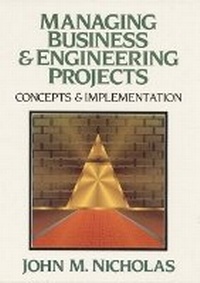
Managing Business and Engineering Projects
Concepts and Implementation
Published on 1. January 1990
Book
Hardback
496 pages
978-0-13-551854-0 (ISBN)
Description
An overview of the concepts and technology of project management as they apply to a wide range of business and technical situations.
More details
Language
English
Place of publication
United States
Publishing group
Pearson Education (US)
Target group
Professional and scholarly
Dimensions
Height: 244 mm
Width: 186 mm
Thickness: 30 mm
Weight
996 gr
ISBN-13
978-0-13-551854-0 (9780135518540)
Copyright in bibliographic data and cover images is held by Nielsen Book Services Limited or by the publishers or by their respective licensors: all rights reserved.
Schweitzer Classification
Other editions
New editions
Book
11/2000
2nd Edition
Pearson
€44.56
Article exhausted; check for reprint
Content
1. Introduction.
I. PHILOSOPHY AND CONCEPTS.
2. What Is Project Management?
3. Systems and Organizations.
4. Systems Methodologies.
II. SYSTEMS DEVELOPMENT CYCLE.
5. Systems Development Cycle: Early Stages.
6. Systems Development Cycle: Middle and Later Stages.
III. ORGANIZATION BEHAVIOR.
7. Project Organization Structure.
8. Project Roles, Responsibility, and Authority.
9. Managing Conflict and Stress in Projects.
IV. SYSTEMS AND PROCEDURES.
10. Work Definition and Scheduling.
11. Network Scheduling and PERT.
12. CPM, Network Resource Allocation and Extensions.
13. Cost Estimating and Budgeting.
14. Project Control.
15. Project Management Information Systems.
16. Project Evaluation, Reporting, and Termination.
17. Project Failure, Success, and Lessons Learned.
Appendices.
I. PHILOSOPHY AND CONCEPTS.
2. What Is Project Management?
3. Systems and Organizations.
4. Systems Methodologies.
II. SYSTEMS DEVELOPMENT CYCLE.
5. Systems Development Cycle: Early Stages.
6. Systems Development Cycle: Middle and Later Stages.
III. ORGANIZATION BEHAVIOR.
7. Project Organization Structure.
8. Project Roles, Responsibility, and Authority.
9. Managing Conflict and Stress in Projects.
IV. SYSTEMS AND PROCEDURES.
10. Work Definition and Scheduling.
11. Network Scheduling and PERT.
12. CPM, Network Resource Allocation and Extensions.
13. Cost Estimating and Budgeting.
14. Project Control.
15. Project Management Information Systems.
16. Project Evaluation, Reporting, and Termination.
17. Project Failure, Success, and Lessons Learned.
Appendices.