

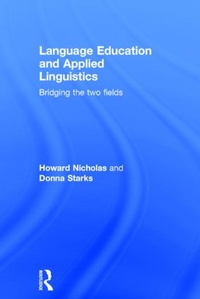
Language Education and Applied Linguistics
Bridging the two fields
1st Edition
Published on 21. February 2014
Book
Hardback
194 pages
978-0-415-53440-6 (ISBN)
Description
Language Education and Applied Linguistics: bridging the two fields provides a starting point for students and researchers in both Language and Education who wish to interpret and use insights from the field of Applied Linguistics, and for Applied Linguists who wish to engage in dialogue with language educators and researchers in education.
Providing a framework for understanding the resources individuals use to communicate, this accessible and innovative text will enable teachers and learners to understand and discuss features and tools used in communication.
This framework enables:
Learners to explore their current language abilities and their desired future communicative abilities, empowering them to engage with their own language learning needs
Language educators to explore central concerns in multiliteracy, digital literacies, plurilingualism and plurilingual development
Applied Linguistics students to understand theories of applied linguistics and language education
Sociolinguists to bring their research into education
Language Education and Applied Linguistics can be used by students, teachers, researchers and teacher educators to explore multilingual contexts and communicative purposes in language classrooms, language education and applied linguistics.
Providing a framework for understanding the resources individuals use to communicate, this accessible and innovative text will enable teachers and learners to understand and discuss features and tools used in communication.
This framework enables:
Learners to explore their current language abilities and their desired future communicative abilities, empowering them to engage with their own language learning needs
Language educators to explore central concerns in multiliteracy, digital literacies, plurilingualism and plurilingual development
Applied Linguistics students to understand theories of applied linguistics and language education
Sociolinguists to bring their research into education
Language Education and Applied Linguistics can be used by students, teachers, researchers and teacher educators to explore multilingual contexts and communicative purposes in language classrooms, language education and applied linguistics.
Reviews / Votes
'This is no ordinary textbook on the application of linguistic study to education. Nicholas and Starks offer a novel, dynamic framework that integrates notions of self, multiplicity, and communicative repertoire in order to explain the intersection of language and education. Educators who care about language and linguists who care about education need to read this foundational resource.' - Walt Wolfram, North Carolina State University, USA'Written in an amazingly lucid style, this book brings together two fields that have so much to offer each other yet have hitherto been rather separate. The result is a refreshing critique of linguistics, applied linguistics and language education, offering new conceptualisations of language, literacy, cognition, and learning. It should be read and re-read by anyone interested in language learning and language use in today's plurilingual world.' - Li Wei, Birkbeck College, University of London, UK
'By reframing language as the communicative repertoire available to each individual within a multiplicity of needs, practices and contexts, this book offers a theoretical and practical bridge between language education and psycho-/sociolinguistic SLA. At a time when language education scholars are increasingly drawn to anthropology and language socialization research, the book offers a much needed reconceptualization of language, language learning and language use for researchers in language and literacy education and reminds them of what the field of applied linguistics has to offer. Eminently suited for any undergraduate or graduate course dealing with language study for educators, introduction to applied linguistics, educational linguistics or applied language studies.' - Claire Kramsch, University of California, Berkeley, USA
'Language Education and Applied Linguistics: bridging the two fields is an accessible book for students and teachers who want to connect the two disciplines from theoretical and practical perspectives. The comprehensive concept of Multiplicity, based on the combination of societal resources and individuals'communicative repertoires, is the main contribution of the book. Nicholas and Sparks provide a clear summary of the state of the art and give sufficient historical context to introduce their construct. They develop the four dimensions, in intricate relationships with elements, threads and features. As a result, the proposed framework represents a dynamic continuum that blurs boundaries between disciplines. This fluid tool becomes beneficial for those interested in common zones between Language, Applied Linguistics and Language Education.' - Laura Dubcovsky, University of California, Davis, The LINGUIST List
'The authors of this book have eloquently articulated the current issues in applied linguistics and language education and this book shows a wide range of insightful ideas related to those areas. Thus, those who are new to the realm of materials development should take this gold mine of tips and start the process of materials development with the knowledge provided in this book.' - Karim Sadeghi and Maryam Soleimani, Urmia University, Iran
More details
Language
English
Place of publication
London
United Kingdom
Publishing group
Taylor & Francis Ltd
Target group
College/higher education
Postgraduate and Undergraduate
Illustrations
60 s/w Zeichnungen
60 Line drawings, black and white
Dimensions
Height: 234 mm
Width: 156 mm
Weight
430 gr
ISBN-13
978-0-415-53440-6 (9780415534406)
Copyright in bibliographic data and cover images is held by Nielsen Book Services Limited or by the publishers or by their respective licensors: all rights reserved.
Schweitzer Classification
Other editions
Additional editions
E-Book
02/2014
1st Edition
Routledge
€62.99
Available for download
E-Book
02/2014
1st Edition
Routledge
€63.49
Available for download
Book
02/2014
1st Edition
Routledge
€69.50
Shipment within 15-20 days
Persons
Howard Nicholas is a Senior Lecturer in Language Education in the Faculty of Education at La Trobe University. Trained as an applied linguist and language teacher, his research interests focus on second language acquisition, plurilingualism, language teaching and policy as well as learning with mobile devices. He has published in the areas of second language learning and teaching, learning with mobile devices and language teacher recruitment, education and employment.
Donna Starks is a Senior Lecturer in the Faculty of Education at La Trobe University. Trained as a linguist, her research interests focus on the interface between language, identity and ethnicity. She has published in the areas of heritage language maintenance and lesser known varieties of English
Donna Starks is a Senior Lecturer in the Faculty of Education at La Trobe University. Trained as a linguist, her research interests focus on the interface between language, identity and ethnicity. She has published in the areas of heritage language maintenance and lesser known varieties of English
Content
PART A -MULTIPLICITY: A FRAMEWORK FOR UNDERSTANDING LANGUAGE
Chapter 1. Introduction: The need for a new conceptual framework; Chapter 2. Understanding the Communicative Repertoire and its first two dimensions; Chapter 3. Understanding Varieties; Chapter 4. Understanding Purposes;
PART B - UNDERSTANDING APPLIED LINGUISTICS
Chapter 5. Additional Language Acquisition; Chapter 6. Additional Language Literacies; Chapter 7. Multiplicity as ways of thinking and doing: a new perspective on plurilingualisms and multilingualisms;
PART C - DESIGNING LANGUAGE LEARNING
Chapter 8. Multiplicity as a framework for language education; Chapter 9. Concluding Remarks
Chapter 1. Introduction: The need for a new conceptual framework; Chapter 2. Understanding the Communicative Repertoire and its first two dimensions; Chapter 3. Understanding Varieties; Chapter 4. Understanding Purposes;
PART B - UNDERSTANDING APPLIED LINGUISTICS
Chapter 5. Additional Language Acquisition; Chapter 6. Additional Language Literacies; Chapter 7. Multiplicity as ways of thinking and doing: a new perspective on plurilingualisms and multilingualisms;
PART C - DESIGNING LANGUAGE LEARNING
Chapter 8. Multiplicity as a framework for language education; Chapter 9. Concluding Remarks