

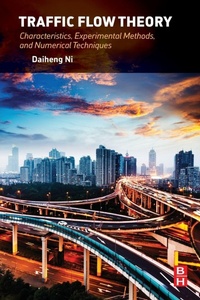
Traffic Flow Theory
Characteristics, Experimental Methods, and Numerical Techniques
Published on 27. October 2015
Book
Paperback/Softback
412 pages
978-0-12-804134-5 (ISBN)
Description
Creating Traffic Models is a challenging task because some of their interactions and system components are difficult to adequately express in a mathematical form. Traffic Flow Theory: Characteristics, Experimental Methods, and Numerical Techniques provide traffic engineers with the necessary methods and techniques for mathematically representing traffic flow. The book begins with a rigorous but easy to understand exposition of traffic flow characteristics including Intelligent Transportation Systems (ITS) and traffic sensing technologies.
More details
Language
English
Place of publication
Woburn
United States
Publishing group
Elsevier - Health Sciences Division
Target group
Professional and scholarly
Transportation Engineers, Traffic Engineers, Traffic System Designers, and Highway Engineers undergraduate and graduate student
Product notice
Paperback (trade)
Dimensions
Height: 229 mm
Width: 152 mm
Thickness: 23 mm
Weight
606 gr
ISBN-13
978-0-12-804134-5 (9780128041345)
Copyright in bibliographic data and cover images is held by Nielsen Book Services Limited or by the publishers or by their respective licensors: all rights reserved.
Schweitzer Classification
Other editions
New editions
Daiheng Ni
Traffic Flow Theory
Book
approx. 01/2026
2nd Edition
Butterworth-Heinemann
€185.69
Not yet published
Additional editions

E-Book
11/2015
Butterworth-Heinemann
€108.00
Available for download
Person
Dr. Ni has been a Professor at UMass Amherst since 2006. At the Georgia Institute of Technology, he earned his PhD in Transportation and Operations Research in 2004, his MSc in Industrial Engineering in 2003, his MSc in Transportation in 2001, and his MSc in Mechanical Engineering at the Beijing Agricultural Engineering University in 1994. His research interests focus on traffic flow modeling and simulation, intelligent transportation systems, traffic sensing and information technology, connected and automated vehicles. He is an Associate Editor for the Journal of Intelligent Transportation Systems (Taylor & Francis) and a 'friend' member of the TRB Committee on Traffic Flow Theory and Characteristics (ACP50).
Content
Table of Contents
Part I Traffic Flow Characteristics
1 Traffic Sensing Technologies
2 Traffic Flow Characteristics I
3 Traffic Flow characteristics II
4 Equilibrium Traffic Flow Models
Part II Macroscopic Modeling
5 Conservation Law
6 Waves
7 Shock and Rarefaction Waves
8 LWR Model
9 Numerical Solutions
10 Simplified Theory of K-Waves
11 High-Order Models
Part III Microscopic Modeling
12 Microscopic Modeling
13 Pipes and Forbes Models
14 General Motors Models
15 Gipps Model
16 More Single-Regime Models
17 More Intelligent Models
Part IV Picoscopic Modeling
18 Picoscopic Modeling
19 Engine Modeling
20 Vehicle Modeling
21 The Field Theory
22 Longitudinal Control Model
Part V The Unified Perspective
23 The Unified Diagram
24 Multiscale Traffic Flow Modeling
Part I Traffic Flow Characteristics
1 Traffic Sensing Technologies
2 Traffic Flow Characteristics I
3 Traffic Flow characteristics II
4 Equilibrium Traffic Flow Models
Part II Macroscopic Modeling
5 Conservation Law
6 Waves
7 Shock and Rarefaction Waves
8 LWR Model
9 Numerical Solutions
10 Simplified Theory of K-Waves
11 High-Order Models
Part III Microscopic Modeling
12 Microscopic Modeling
13 Pipes and Forbes Models
14 General Motors Models
15 Gipps Model
16 More Single-Regime Models
17 More Intelligent Models
Part IV Picoscopic Modeling
18 Picoscopic Modeling
19 Engine Modeling
20 Vehicle Modeling
21 The Field Theory
22 Longitudinal Control Model
Part V The Unified Perspective
23 The Unified Diagram
24 Multiscale Traffic Flow Modeling