

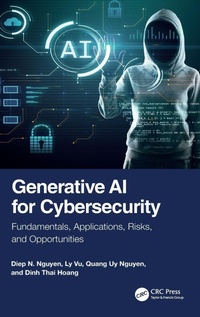
Generative AI for Cybersecurity
Fundamentals, Applications, Risks, and Opportunities
1st Edition
Will be published approx. on 16. December 2025
Book
Hardback
272 pages
978-1-032-82009-5 (ISBN)
Description
This book lays a systematic foundation for professionals, researchers, and industry readers who are interested the applications and implications of generative AI for cybersecurity. It covers the latest advances in generative AI and its applications, risks, and opportunities in cybersecurity.
The authors first introduce the fundamental background of generative AI, the latest cybersecurity issues, and related potential applications in cybersecurity systems. Following this, they comprehensively review the state-of-the-art research and development, covering various aspects of generative AI applications in this area and related challenges and issues, such as training data availability, computational complexity, generalization to different scenarios, AI governance, quantum-empowered AI and many more. These discussions provide a strong understanding of recent advances in the two fields of generative AI and cybersecurity and the convergence of these domains, which will help readers to shape the field as it matures. Hands-on experiments presented throughout will also give them the practical skills for success. By leveraging its capabilities, readers can overcome challenges, understand the risks, enhance performance, and unlock new opportunities for handling the challenges of cybersecurity with generative AI. Consequently, they will be able to apply their knowledge to utilize generative AI in cybersecurity applications to prevent economic and other losses due to cyber risks such as phishing, fake news, deepfake-based fraud, and other cyberattacks.
The contents of this book are appropriate for a wide range of readers from general readers to industry experts and scientists. Because it bridges the gap between generative AI and cybersecurity, experts from both fields will benefit from the information presented within. Students with a background in either area will also benefit from the approach that leads from general to specific applications.
The authors first introduce the fundamental background of generative AI, the latest cybersecurity issues, and related potential applications in cybersecurity systems. Following this, they comprehensively review the state-of-the-art research and development, covering various aspects of generative AI applications in this area and related challenges and issues, such as training data availability, computational complexity, generalization to different scenarios, AI governance, quantum-empowered AI and many more. These discussions provide a strong understanding of recent advances in the two fields of generative AI and cybersecurity and the convergence of these domains, which will help readers to shape the field as it matures. Hands-on experiments presented throughout will also give them the practical skills for success. By leveraging its capabilities, readers can overcome challenges, understand the risks, enhance performance, and unlock new opportunities for handling the challenges of cybersecurity with generative AI. Consequently, they will be able to apply their knowledge to utilize generative AI in cybersecurity applications to prevent economic and other losses due to cyber risks such as phishing, fake news, deepfake-based fraud, and other cyberattacks.
The contents of this book are appropriate for a wide range of readers from general readers to industry experts and scientists. Because it bridges the gap between generative AI and cybersecurity, experts from both fields will benefit from the information presented within. Students with a background in either area will also benefit from the approach that leads from general to specific applications.
More details
Language
English
Place of publication
London
United Kingdom
Publishing group
Taylor & Francis Ltd
Target group
College/higher education
Professional and scholarly
Postgraduate, Professional Reference, and Undergraduate Advanced
Illustrations
6 s/w Tabellen, 80 s/w Abbildungen, 5 s/w Photographien bzw. Rasterbilder, 75 s/w Zeichnungen
6 Tables, black and white; 75 Line drawings, black and white; 5 Halftones, black and white; 80 Illustrations, black and white
Dimensions
Height: 240 mm
Width: 161 mm
Thickness: 20 mm
Weight
602 gr
ISBN-13
978-1-032-82009-5 (9781032820095)
Copyright in bibliographic data and cover images is held by Nielsen Book Services Limited or by the publishers or by their respective licensors: all rights reserved.
Schweitzer Classification
Other editions
Additional editions
Diep N. Nguyen | Ly Vu | Quang Uy Nguyen
Generative AI for Cybersecurity
Fundamentals, Applications, Risks, and Opportunities
E-Book
12/2025
CRC Press
€172.99
Available for download
Diep N. Nguyen | Ly Vu | Quang Uy Nguyen
Generative AI for Cybersecurity
Fundamentals, Applications, Risks, and Opportunities
E-Book
12/2025
CRC Press
€172.99
Available for download
Persons
Diep N. Nguyen is the Head of UTS 5G/6G Lab, Director of the Agile Communications and Computing group, Faculty of Engineering and Information Technology, University of Technology Sydney, Australia. He also holds adjunct positions at other universities in the US, Vietnam, and Japan. He received his ME and Ph.D from the University of California San Diego and The University of Arizona in 2008 and 2013, respectively.
Ly T Vu is a Lecturer of at Le Quy Don Technical University (LQDTU). She received her BE and MS degrees from LQDTU, Vietnam, and Inha University, Korea, in 2011 and 2014, respectively. She received her PhD degrees from LQDTU, Vietnam, and University Technology of Sydney, Australia, in 2020 and 2024, respectively.
Quang Uy Nguyen is Deputy Head of the Computer Science Department and Director of the Intelligent Computing Research Group at Le Quy Don Technical University. He obtained his BSc, MSc, and PhD in 2004, 2007, and 2011, respectively. He is a member of IEEE.
Dinh Thai Hoang is an Associate Professor at University of Technology Sydney. He attained his PhD from the School of Computer Science and Engineering, Nanyang Technological University, Singapore, in 2016. He was listed among the World's Top 2% Scientists by Stanford University from 2020 to 2024.
Ly T Vu is a Lecturer of at Le Quy Don Technical University (LQDTU). She received her BE and MS degrees from LQDTU, Vietnam, and Inha University, Korea, in 2011 and 2014, respectively. She received her PhD degrees from LQDTU, Vietnam, and University Technology of Sydney, Australia, in 2020 and 2024, respectively.
Quang Uy Nguyen is Deputy Head of the Computer Science Department and Director of the Intelligent Computing Research Group at Le Quy Don Technical University. He obtained his BSc, MSc, and PhD in 2004, 2007, and 2011, respectively. He is a member of IEEE.
Dinh Thai Hoang is an Associate Professor at University of Technology Sydney. He attained his PhD from the School of Computer Science and Engineering, Nanyang Technological University, Singapore, in 2016. He was listed among the World's Top 2% Scientists by Stanford University from 2020 to 2024.
Content
PART I Fundamental Background 1. Generative AI and Its Related Components 2. Cybersecurity Fundamental: Threats, Impacts, and Countermeasures 3. Generative AI as Potential Solutions and Risks to Cybersecurity PART II Applications of Generative AI for Cybersecurity 4. Representation Learning-based Generative AI in Cybersecurity 5. Generative AI for Data Synthesis in Cybersecurity 6. Generative AI for Sequence Learning in Cybersecurity 7. Generative AI for Adversarial Learning in Cybersecurity 8. Case Studies and Detailed Implementation/Experiments PART III Conclusion and Future Perspectives 9. Emerging Topics of Generative AI in Cybersecurity 10. Future Directions and Open Challenges