

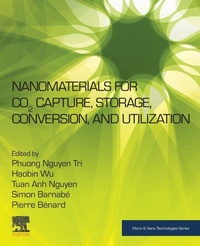
Nanomaterials for CO2 Capture, Storage, Conversion and Utilization
Published on 15. April 2021
Book
Paperback/Softback
394 pages
978-0-12-822894-4 (ISBN)
Description
The gradual increase of population and the consequential rise in the energy demands in recent years have led to the widespread use of fossil fuels. CO2 transformation by various processes is considered as a promising alternative technology. This book sets out the fundaments of how nanomaterials are being used for this purpose.
Nanomaterials for CO2 Capture, Storage, Conversion and Utilization summarizes the research, development and innovations in the capture, storage, transformation and utilization of CO2 into useful products and raw chemicals for industry. This is achieved by using advanced processes such as CO2 reforming, bi-reforming and tri-reforming of hydrocarbons or biomass derivatives; homogeneous and heterogeneous hydrogenation; photochemical reduction; photoelectrochemical reduction; electrochemical reduction; biochemical reduction; supercritical CO2 technology; advanced catalyst synthesis for CO2 conversion; organic carbonates for polymers synthesis from CO2, and CO2 capture and sequestration. The systematic and updated reviews on the mentioned sectors, especially on the use of nanotechnology for the transformation of CO2 is scarce in the literature. Thus, the book addresses the recent knowledge gaps and potential solutions of the storage, utilization and transformation of CO2 as well as its promising applications.
This is an important reference source for materials scientists, engineers and energy scientists who want to understand how nanotechnology is helping us to solve some of the world's major energy problems.
Nanomaterials for CO2 Capture, Storage, Conversion and Utilization summarizes the research, development and innovations in the capture, storage, transformation and utilization of CO2 into useful products and raw chemicals for industry. This is achieved by using advanced processes such as CO2 reforming, bi-reforming and tri-reforming of hydrocarbons or biomass derivatives; homogeneous and heterogeneous hydrogenation; photochemical reduction; photoelectrochemical reduction; electrochemical reduction; biochemical reduction; supercritical CO2 technology; advanced catalyst synthesis for CO2 conversion; organic carbonates for polymers synthesis from CO2, and CO2 capture and sequestration. The systematic and updated reviews on the mentioned sectors, especially on the use of nanotechnology for the transformation of CO2 is scarce in the literature. Thus, the book addresses the recent knowledge gaps and potential solutions of the storage, utilization and transformation of CO2 as well as its promising applications.
This is an important reference source for materials scientists, engineers and energy scientists who want to understand how nanotechnology is helping us to solve some of the world's major energy problems.
More details
Series
Language
English
Place of publication
United States
Target group
Professional and scholarly
Materials scientists, engineers, environmental scientists and energy scientists
Product notice
Paperback (trade)
Dimensions
Height: 235 mm
Width: 191 mm
Thickness: 21 mm
Weight
680 gr
ISBN-13
978-0-12-822894-4 (9780128228944)
Copyright in bibliographic data and cover images is held by Nielsen Book Services Limited or by the publishers or by their respective licensors: all rights reserved.
Schweitzer Classification
Other editions
Additional editions
Phuong Nguyen-Tri | Haobin Wu | Simon Barnabe
Nanomaterials for CO2 Capture, Storage, Conversion and Utilization
E-Book
04/2021
Elsevier
€210.00
Available for download
Persons
Dr. Phuong Nguyen-Tri is a Professor in the Departement de Chimie, Biochimie et Physique at the Universite du Quebec a Trois-Rivieres in Trois-Rivieres, Quebec, Canada. He is the founder of the Laboratory of Advanced Materials for Energy and Environment at the Universite du Quebec a Trois-Rivieres. He holds an M.Sc. degree from Ecole Nationale Superieure de Chimie de Mulhouse, France and a Ph.D. degree in Material Sciences from the Conservatoire National des Arts et Metiers in Paris, France in 2009. He worked for two years (2009-2011) as a non-tenure track Assistant Professor in the Department of Industrial Polymers (now Laboratoire Procedes et Ingenierie en Mecanique et Materiaux, Paris) at the Conservatoire National des Arts et Metiers in Paris. During 2011-2015, he worked in the Department of Mechanical Engineering at the Ecole de Technologie Superieure ETS, Montreal, Canada as a researcher for the Research Chair in Protective Materials and Equipment for Occupational Health and Safety. From 2015 to 2019, Dr. Nguyen-Tri worked as a Research Officer in the Department of Chemistry at the Universite de Montreal, Canada before accepting a professorship position at the Universite du Quebec a Trois-Rivieres. His main research interests are in nanomaterials, hybrid nanoparticles, smart coatings, polymer crystallization, polymer blends and composites. Dr. Nguyen-Tri has edited 11 books (including 8 books by Elsevier). He has served as an Editor of many special issues in the ISI indexed journals. Dr. Nguyen-Tri is an Editorial Board Member for journals including RSEM, PLoS One (PNAS) and SN Applied Science (Springer). Haobin Wu is a Professor at the School of Materials Science and Engineering, Zhejiang University, China. His research interests are metal-organic framework-related materials for sustainable energy, designed synthesis of micro-/nanostructured materials, electrochemical energy storage technologies, and electrocatalysis and electrochemical production of fuels. Simon Barnabe is a Professor, entrepreneur, field researcher, and consultant in the Department of Chemistry, Biochemistry and Physics, at the University of Quebec, Trois-Rivieres, Canada. His areas of research interest are applied microbiology (industrial and environmental); recovery of residues by fermentation; pretreatment of residues; community biorefinery, reactive biomass fractionation, biofuels, bio-ingredients for eco-materials, local or local co-products; microalgae production and algorinage. Pierre Benard is a Professor in the Hydrogen Research Institute, at the University of Quebec at Trois-Rivieres, Canada. His research focuses on microporous adsorbers, supercritical adsorption, mechanics of computational fluids, simulation methods in statistical physics, thermodynamic modeling, carbon nanostructures, condensed matter physics, and statistical physics of inhomogeneous fluids. Tuan Anh Nguyen is a Senior Principal Research Scientist at the Institute for Tropical Technology, Vietnam Academy of Science and Technology, Hanoi, Vietnam. He received a BS in physics from Hanoi University in 1992, a BS in economics from Hanoi National Economics University in 1997, and a PhD in chemistry from the Paris Diderot University, France, in 2003. He was a Visiting Scientist at Seoul National University, South Korea, in 2004, and the University of Wollongong, Australia, in 2005. He then worked as a Postdoctoral Research Associate and Research Scientist at Montana State University, United States in 2006-09. In 2012 he was appointed as the Head of the Microanalysis Department at the Institute for Tropical Technology. His research areas of interest include smart sensors, smart networks, smart hospitals, smart cities, complexiverse, and digital twins. He has edited more than 74 books for Elsevier, 12 books for CRC Press, 1 book for Springer, 1 book for RSC, and 2 books for IGI Global. He is the Editor-in-Chief of Kenkyu Journal of Nanotechnology & Nanoscience.
Editor
Professor, Departement de Chimie, Biochimie et Physique, Universite du Quebec a Trois-Rivieres, Trois-Rivieres, Quebec, Canada
School of Materials Science and Engineering, Zhejiang University, China
Department of Chemistry, Biochemistry and Physics, University of Quebec, Trois-Rivieres, Canada
Hydrogen Research Institute, University of Quebec, Trois-Rivieres, Canada
Senior Principal Research Scientist, Institute for Tropical Technology, Vietnam Academy of Science and Technology, Hanoi, Vietnam
Content
1. CO2 capture, storage, transformation and utilization: an introduction
2. Photoelectrochemical reduction of carbon dioxide
3. Nanocatalyst for CO2 hydrogenation
4. Porous polymers based adsorbent materials for CO2 capture
5. From Nanoparticle to Single Atom catalyst for Electrocatalytic Reduction of Carbon dioxide
6. Nanomaterials for photocatalytic reduction of carbon dioxide
7. Nanomaterials for CO2 conversion to valuable compounds
8. Nanomaterials for photocatalytic and cold plasma catalytic hydrogenation of CO2 to CO, CH4 and CH3OH
9. Electrochemical reduction of CO2 using shape-controlled nanoparticles
10. Conversion CO2 towards valuable compounds
11. Nanomaterials for photocatalytic reduction of carbon dioxide
12. CO2 adsorption with Covalent Organic Frameworks (COF)
13. Reduction of carbon dioxide using nanophotocatalysts
14. 2D nanomaterials for CO2 Reduction and transformation
2. Photoelectrochemical reduction of carbon dioxide
3. Nanocatalyst for CO2 hydrogenation
4. Porous polymers based adsorbent materials for CO2 capture
5. From Nanoparticle to Single Atom catalyst for Electrocatalytic Reduction of Carbon dioxide
6. Nanomaterials for photocatalytic reduction of carbon dioxide
7. Nanomaterials for CO2 conversion to valuable compounds
8. Nanomaterials for photocatalytic and cold plasma catalytic hydrogenation of CO2 to CO, CH4 and CH3OH
9. Electrochemical reduction of CO2 using shape-controlled nanoparticles
10. Conversion CO2 towards valuable compounds
11. Nanomaterials for photocatalytic reduction of carbon dioxide
12. CO2 adsorption with Covalent Organic Frameworks (COF)
13. Reduction of carbon dioxide using nanophotocatalysts
14. 2D nanomaterials for CO2 Reduction and transformation