

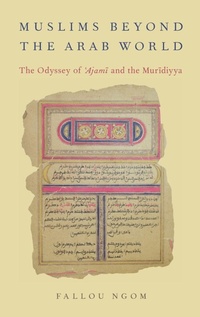
Muslims beyond the Arab World
The Odyssey of Ajami and the Muridiyya
Published on 4. August 2016
Book
Hardback
334 pages
978-0-19-027986-8 (ISBN)
Description
Muslims beyond the Arab World explores the tradition of writing African languages using the Arabic script 'Ajami and the rise of the Muridiyya order of Islamic Sufi in Senegal, founded by Shaykh Ahmadu Bamba Mbakke (1853-1927). The book demonstrates how the development of the 'Ajami literary tradition and the flourishing of the Muridiyya into one of sub-Saharan Africa's most powerful and dynamic Sufi organizations are entwined. It offers a close reading of the rich hagiographic and didactic written, recited, and chanted 'Ajami texts of the Muridiyya, works largely unknown to scholars. The texts describe the life and Sufi odyssey of the order's founder, his conflicts with local rulers and Muslim clerics and the French colonial administration, and the traditions and teachings he championed that shaped the identity and practices of his followers.
In analyzing these Murid 'Ajami texts, Fallou Ngom evaluates prevailing representations of the movement and offers alternative perspectives. He demonstrates how, without the knowledge of the French colonial administration, the Murids were able to use their written, recited, and chanted 'Ajami materials as an effective means of mass communication to convey the personal journey of Shaykh Ahamadu Bamba, his doctrine, the virtues he stood for and cultivated among his followers: self-reliance, strong faith, the pursuit of excellence, nonviolence, and optimism in the face of adversity. This, according to Muslims beyond the Arab World, is the source of the surprising resilience, appeal, and expansion of Muridiyya.
In analyzing these Murid 'Ajami texts, Fallou Ngom evaluates prevailing representations of the movement and offers alternative perspectives. He demonstrates how, without the knowledge of the French colonial administration, the Murids were able to use their written, recited, and chanted 'Ajami materials as an effective means of mass communication to convey the personal journey of Shaykh Ahamadu Bamba, his doctrine, the virtues he stood for and cultivated among his followers: self-reliance, strong faith, the pursuit of excellence, nonviolence, and optimism in the face of adversity. This, according to Muslims beyond the Arab World, is the source of the surprising resilience, appeal, and expansion of Muridiyya.
Reviews / Votes
"[T]he book is essential reading for advanced scholars of the Muriydiyya or Islam in Africa and it will be key to the scholar who constructs the regional odyssey of Ajamiy that is, thesociohistorical emergence of West African vernacular language literacy in Muslim contexts."--Religious Studies Review
"For those who wish to make sense of recent events in West Africa, Ngom's book is an excellent place to begin. He corrects many false images of Africa as a continent without writing and demonstrates the dangers of relying exclusively upon oral culture and colonialist-written sources alone. Ngom's book has set a new standard for African studies."--Reading Religion
"Fallou Ngom lifts us a giant step toward decolonizing what 'literacy' can mean, while giving writing in Wolof, the dominant language of Senegal, its rightful place among Muslim literatures of the world. 'Ajami is the modification of Arabic script to accommodate local languages, and for centuries it has been used to communicate people's own senses of purpose, place, and divine province, as it does for Murids and other Senegalese Sufis. Ngom's evocative pages
make abundantly clear what has been lost to most Africanist scholars who have ignored the richly self-reflexive resources of 'Ajami."-Allen F. Roberts, Professor of World Arts and Cultures, University of
California, Los Angeles
"Fallou Ngom's Muslims beyond the Arab World is a brilliant demonstration that Islam in Sub-Saharan Africa is not peripheral to a Muslim world centered on Arab societies: it is its own center and has produced throughout the centuries an important literature in Arabic, but also often in 'Ajami, that is, texts written in the local languages adapting and using the Arabic script. Fallou Ngom's work is centered on the 'Ajamization of Islamic
sciences and literature by Muslim scholars who authored important texts in Wolof, in poetry and in prose, following the recommendation of Shaykh Ahmadu Bamba, the founder of the Muridiyya Sufi order. Ngom's book makes
manifest that Islam is one and plural, that it speaks Arabic, the language of the Qur'an, but other Islamic languages as well, Wolof being one great example eloquently presented here as a language of written erudition."-Souleymane Bachir Diagne, author of African Art as Philosophy: Senghor, Bergson and the Idea of Negritude
"This 'Ajami odyssey makes a signal contribution to the study of Islamic thought in Africa and beyond. Ngom skillfully illustrates how the Muridiyya Sufi order has used African languages materials to make meaning and history, thereby becoming one of the most dynamic Islamic movements in the world today. By focusing on how Murids have articulated and embodied a unique vision of the past deeply rooted in humanistic values of peace, service, and ethics, Ngom also
casts precious light on the development of vernacular languages, cultures, and historicities throughout the Muslim world."-Rudolph T. Ware, Associate Professor of History, University of Michigan
More details
Series
Language
English
Place of publication
New York
United States
Target group
College/higher education
Illustrations
21 illus., 14 music ex.
Dimensions
Height: 240 mm
Width: 161 mm
Thickness: 23 mm
Weight
666 gr
ISBN-13
978-0-19-027986-8 (9780190279868)
Copyright in bibliographic data and cover images is held by Nielsen Book Services Limited or by the publishers or by their respective licensors: all rights reserved.
Schweitzer Classification
Other editions
Additional editions
E-Book
06/2016
1st Edition
OUP eBook
€73.99
Available for download
E-Book
06/2016
1st Edition
OUP eBook
€57.49
Available for download
Person
Fallou Ngom is Director of the African Studies Center at Boston University.
Content
Acknowledgements
Abbreviations
Note on Sources
Chronology
About the Companion Website
Introduction
Chapter 1: Exceptionality and Equality
Chapter 2: Ethics over Ritual
Chapter 3: Odyssey by Sea: Sanctity of Suffering I
Chapter 4: Odyssey by Land: Sanctity of Suffering II
Chapter 5: Service for Salvation
Conclusion
Notes
Sources and Bibliography
Index
Abbreviations
Note on Sources
Chronology
About the Companion Website
Introduction
Chapter 1: Exceptionality and Equality
Chapter 2: Ethics over Ritual
Chapter 3: Odyssey by Sea: Sanctity of Suffering I
Chapter 4: Odyssey by Land: Sanctity of Suffering II
Chapter 5: Service for Salvation
Conclusion
Notes
Sources and Bibliography
Index