

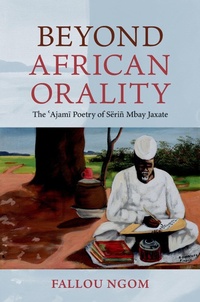
Beyond African Orality
The 'Ajami Poetry of Serin Mbay Jaxate
Will be published approx. on 3. December 2025
Book
Hardback
248 pages
978-0-19-780779-8 (ISBN)
Description
Beyond African Orality offers the first English translation and interpretation of sixty Wolof Ajami poems (Wolof written with an enriched form of the Arabic script) by Serin Mbay Jaxate (c. 1876-1947), a follower of the Senegalese Muridiyya Sufi order founded by Shaykh Ahmadu Bamba Mbakke (1853-1927). Serin Mbay Jaxate was one of the greatest Sufi poets of Africa - a wise moralist and an astute social critic, he kept a sharp eye on his compatriots and the unfolding historical, cultural, and religious transformations in his society. His poems focused on praising the virtues of his Sufi master, Shaykh Ahmadu Bamba, and fostering the pursuit of spiritual and moral excellence, which he construed as the best investment to achieve success in this life and paradise in the hereafter.
His Ajami poems capture every facet of rural Wolof farming communities of his time. To communicate more effectively with his audiences, he deployed numerous metaphors drawn from the local fauna, flora, livestock, farming activities, planting and harvesting seasons, sports such as wrestling and target shooting, hunting, culinary habits, and the climate. Unlike his Muslim colleagues who often code-switched between classical Arabic and the local lingua franca of Wolof and included Quranic or Arabic liturgical quotes in their poems, Serin Mbay Jaxate opted to minimize Arabic structures in his work, preferring rural Wolof words for more efficient communication with his agrarian African audiences. His work demonstrates how Ajami has served as a key literary medium and source of knowledge in Muslim Africa.
His Ajami poems capture every facet of rural Wolof farming communities of his time. To communicate more effectively with his audiences, he deployed numerous metaphors drawn from the local fauna, flora, livestock, farming activities, planting and harvesting seasons, sports such as wrestling and target shooting, hunting, culinary habits, and the climate. Unlike his Muslim colleagues who often code-switched between classical Arabic and the local lingua franca of Wolof and included Quranic or Arabic liturgical quotes in their poems, Serin Mbay Jaxate opted to minimize Arabic structures in his work, preferring rural Wolof words for more efficient communication with his agrarian African audiences. His work demonstrates how Ajami has served as a key literary medium and source of knowledge in Muslim Africa.
More details
Series
Language
English
Place of publication
New York
United States
Target group
College/higher education
Product notice
sewn/stitched
Cloth over boards
Illustrations
100 b&w halftones
Dimensions
Height: 226 mm
Width: 160 mm
Thickness: 33 mm
Weight
499 gr
ISBN-13
978-0-19-780779-8 (9780197807798)
Copyright in bibliographic data and cover images is held by Nielsen Book Services Limited or by the publishers or by their respective licensors: all rights reserved.
Schweitzer Classification
Other editions
Additional editions
E-Book
09/2025
OUP eBook
€70.49
Available for download
Person
Fallou Ngom is Professor of Anthropology at Boston University. His research focuses on African 'Ajami literatures (African languages written in Arabic script). He has held Fulbright, ACLS, and Guggenheim fellowships. His work has been supported by grants from the National Endowment for the Humanities, the US Department of Education, and the British Library Endangered Archives Programme. His book, Muslims beyond the Arab World: The Odyssey of Ajami and the Muridiyya (Oxford University Press, 2016), won the 2017 Melville J. Herskovits Prize for the best book in African studies. He received the 2024 Boston University Provost's Scholar-Teacher of the Year Award.
Content
- Introduction
- Part I: Praise Songs: Celebrating Spiritual and Moral Excellence
- Part II: Prayer Songs: Pleading for Spiritual and Moral Flourishing
- Part III: Didactic Songs I: Cultivating Spiritual Excellence
- Part IV: Didactic Songs II: Cultivating Moral Excellence
- Part V: Songs of the Hereafter: Preparing for Tomorrow
- Conclusion
- Glossary
- Sources and Bibliography
- Notes
- Index