

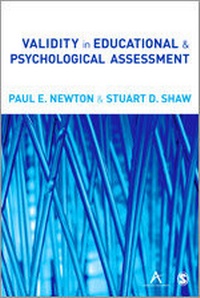
Validity in Educational and Psychological Assessment
1st Edition
Published on 22. April 2014
Book
Hardback
280 pages
978-1-4462-5322-9 (ISBN)
Description
Validity is the hallmark of quality for educational and psychological measurement. But what does quality mean in this context? And to what, exactly, does the concept of validity apply? These apparently innocuous questions parachute the unwary inquirer into a minefield of tricky ideas. This book guides you through this minefield, investigating how the concept of validity has evolved from the nineteenth century to the present day. Communicating complicated concepts straightforwardly, the authors answer questions like:
What does 'validity' mean?
What does it mean to 'validate'?
How many different kinds of validity are there?
When does validation begin and end?
Is reliability a part of validity, or distinct from it?
This book will be of interest to anyone with a professional or academic interest in evaluating the quality of educational or psychological assessments, measurements and diagnoses.
What does 'validity' mean?
What does it mean to 'validate'?
How many different kinds of validity are there?
When does validation begin and end?
Is reliability a part of validity, or distinct from it?
This book will be of interest to anyone with a professional or academic interest in evaluating the quality of educational or psychological assessments, measurements and diagnoses.
Reviews / Votes
'Countless books have addressed validity, but this is the first volume to provide a comprehensive treatment of the evolution of validity theory in the last century and a framework for evaluating educational and psychological testing in the 21st century.' -- Wayne J. Camara 'In this groundbreaking book, Newton and Shaw show how the "consensus" view of validity-that validity is not a property of tests, but of inferences made on the basis of the evidence they elicit-was at best rather shallow. Notably, the "consensus" view leaves unresolved important tensions between those who see validation as a never-ending process (e.g., Cronbach, Messick) and those who understand the needs of those who produce assessments to be able to say that they have undertaken necessary due diligence to attest to the quality of assessments (e.g., Ebel, Kane). As well as providing an excellent, scholarly review of the history of the idea of validity, Newton and Shaw show how a modified version of Messick's facet model of validity can produce a rigorously grounded, and yet practical, approach to assuring the quality of educational and psychological assessments. Every serious scholar of assessment should read this book.' -- Dylan Wiliam 'At last - a scholarly and well-argued book that means validity, the key concept in any assessment, is no longer an essentially American debate. Its scope, logic and clarity will quickly make it the standard international text.' -- Gordon Stobart 'With concerns over the validity of educational and psychological tests and assessments growing, this book by Paul Newton and Stuart Shaw is a welcome, and much needed, contribution to the measurement literature. Anyone concerned with the technical quality and value propositions surrounding large-scale testing and assessment ought to read this book. Newton and Shaw take the reader through the history of "validity" as researchers across time and across disciplines use the term. In doing so, they advance the debate by offering a unique and novel framework for assessing issues of test validity. Newton and Shaw leave us with some new concepts-theoretical plausibility and practical viability-for judging the evidence in support of a test's validity. This book presents today's and tomorrow's perspectives on validity as the core idea in educational and psychological assessment. It is a must read for those working in the broad field of psychometrics.' -- Howard T. Everson [This book] was enlightening in terms of helping me reflect on a range of issues around testing and validity. It provides a good way of thinking about these issues in a way that takes into account a range of views from different stakeholders about why a particular testing policy exists. The framework enables different agendas to be made explicit and tensions between different purposes of a particular policy laid bare. It provides a way of critically evaluating policy and making decisions about implementing testing and assessment policies. I wish I had read this book before writing a sub chapter called 'Why Assess?' - covering the same ground on issues of dyslexia assessment would have been easier using Newton and Shaw's revised framework...I would recommend the book to experienced practitioners who want to reconsider the validity of assessments that they undertake. It is perhaps useful for trainers as a book that enables trainee psychologists to consider the social context in which psychometric measures are used and to consider validity in terms which take them beyond the technical aspects of testing and assessment. It is also a useful book for policy makers to consider, especially around the social issues related to assessment and testing policy implementation. -- Dr Garry Squires, programme director for the Doctorate in Educational Psychology, University of Manchester An ideal text for post-graduate courses on educational or psychological assessment, and selections would also make strong contributions to reading lists for under-graduate courses. There is plenty in it for more seasoned scholars of assessment theory as well ... because the historical survey and analysis of the literature is so insightful -- Michael Johnston In an accessible, statistics-free treatment, Newton and Shaw first distinguish assessment validity from related concepts (such as research validity), before tracing its evolution through the primarily US-led assessment research tradition over the past century. As doctoral students we hope to tap into issues at the cutting edge of the field, and Newton and Shaw's book enables this, providing the background and theory needed to contribute to contemporary assessment research. -- Ricky JeffreyMore details
Language
English
Place of publication
London
United Kingdom
Target group
College/higher education
Professional and scholarly
Dimensions
Height: 242 mm
Width: 170 mm
Weight
621 gr
ISBN-13
978-1-4462-5322-9 (9781446253229)
Copyright in bibliographic data and cover images is held by Nielsen Book Services Limited or by the publishers or by their respective licensors: all rights reserved.
Schweitzer Classification
Other editions
Additional editions
Paul E. Newton | Stuart D. Shaw
Validity in Educational and Psychological Assessment
E-Book
04/2014
1st Edition
SAGE Publications Ltd
€76.49
Available for download
Paul E. Newton | Stuart D. Shaw
Validity in Educational and Psychological Assessment
Book
04/2014
1st Edition
SAGE Publications Ltd
€85.50
Shipment within 15-20 days
Persons
Paul E. Newton is Professor of Educational Assessment at the Institute of Education, University of London. His research focuses primarily upon issues related to the evaluation of large-scale educational assessment systems, and he is particularly interested in theories of validity for educational and psychological measurement, past and present. He has published on a range of assessment topics, including validity, comparability, assessment purposes, national curriculum test reliability, and the public understanding of measurement inaccuracy.
Having obtained a PhD in developmental psychology, Paul moved into educational assessment and has spent most of his career as a researcher within a range of assessment agencies - including the Associated Examining Board, the National Foundation for Educational Research, the Qualifications and Curriculum Authority, Ofqual and Cambridge Assessment.
Paul is a member of the Editorial Board of the international journal Assessment in Education: Policy, Principles and Practice and has served on a variety of national and international committees, including the Executive Committee of the International Association for Educational Assessment. He was a member of the Assessment Reform Group, until its retirement in 2010, and is a Fellow of the Association for Educational Assessment - Europe.
Stuart D. Shaw is particularly interested in demonstrating how educational, vocational and second language English assessments meet the demands of validity, reliability and fairness. Stuart has a wide range of pub-lications in English second-language assessment and educational research journals. His assessment books include: Examining Writing: Research and practice in assessing second language writing (Shaw and Weir, 2007); The IELTS Writing Assessment Revision Project: Towards a revised rating scale (Shaw and Falvey, 2008); Validity in Educational and Psychological Assessment (Newton and Shaw, 2014); and Language Rich: Insights from multilingual schools (Shaw, Imam and Hughes, 2015). Stuart is a Fellow of the Association for Educational Assessment in Europe (AEA-E) and a Fellow of the Chartered Institute of Educational Assessors (CIEA).
Having obtained a PhD in developmental psychology, Paul moved into educational assessment and has spent most of his career as a researcher within a range of assessment agencies - including the Associated Examining Board, the National Foundation for Educational Research, the Qualifications and Curriculum Authority, Ofqual and Cambridge Assessment.
Paul is a member of the Editorial Board of the international journal Assessment in Education: Policy, Principles and Practice and has served on a variety of national and international committees, including the Executive Committee of the International Association for Educational Assessment. He was a member of the Assessment Reform Group, until its retirement in 2010, and is a Fellow of the Association for Educational Assessment - Europe.
Stuart D. Shaw is particularly interested in demonstrating how educational, vocational and second language English assessments meet the demands of validity, reliability and fairness. Stuart has a wide range of pub-lications in English second-language assessment and educational research journals. His assessment books include: Examining Writing: Research and practice in assessing second language writing (Shaw and Weir, 2007); The IELTS Writing Assessment Revision Project: Towards a revised rating scale (Shaw and Falvey, 2008); Validity in Educational and Psychological Assessment (Newton and Shaw, 2014); and Language Rich: Insights from multilingual schools (Shaw, Imam and Hughes, 2015). Stuart is a Fellow of the Association for Educational Assessment in Europe (AEA-E) and a Fellow of the Chartered Institute of Educational Assessors (CIEA).
Content
Validity and Validation
The Genesis of Validity: Mid-1800s-1951
The Fragmentation of Validity: 1952-1974
The (Re)Unification of Validity: 1975-1999
The Deconstruction of Validity: 2000-2012
Twenty-first-century Evaluation
The Genesis of Validity: Mid-1800s-1951
The Fragmentation of Validity: 1952-1974
The (Re)Unification of Validity: 1975-1999
The Deconstruction of Validity: 2000-2012
Twenty-first-century Evaluation