

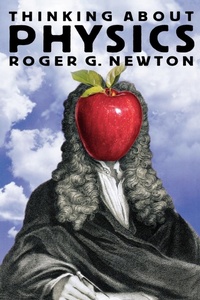
Thinking about Physics
Published on 24. March 2002
Book
Paperback/Softback
208 pages
978-0-691-09553-0 (ISBN)
Description
Physical scientists are problem solvers. They are comfortable "doing" science: they find problems, solve them, and explain their solutions. Roger Newton believes that his fellow physicists might be too comfortable with their roles as solvers of problems. He argues that physicists should spend more time thinking about physics. If they did, he believes, they would become even more skilled at solving problems and "doing" science. As Newton points out in this thought-provoking book, problem solving is always influenced by the theoretical assumptions of the problem solver. Too often, though, he believes, physicists haven't subjected their assumptions to thorough scrutiny. Newton's goal is to provide a framework within which the fundamental theories of modern physics can be explored, interpreted, and understood. "Surely physics is more than a collection of experimental results, assembled to satisfy the curiosity of appreciative experts," Newton writes. Physics, according to Newton, has moved beyond the describing and naming of curious phenomena, which is the goal of some other branches of science.
Physicists have spent a great part of the twentieth century searching for explanations of experimental findings. Newton agrees that experimental facts are vital to the study of physics, but only because they lead to the development of a theory that can explain them. Facts, he argues, should undergird theory. Newton's explanatory sweep is both broad and deep. He covers such topics as quantum mechanics, classical mechanics, field theory, thermodynamics, the role of mathematics in physics, and the concepts of probability and causality. For Newton the fundamental entity in quantum theory is the field, from which physicists can explain the particle-like and wave-like properties that are observed in experiments. He grounds his explanations in the quantum field. Although this is not designed as a stand-alone textbook, it is essential reading for advanced undergraduate students, graduate students, professors, and researchers. This is a clear, concise, up-to-date book about the concepts and theories that underlie the study of contemporary physics. Readers will find that they will become better-informed physicists and, therefore, better thinkers and problem solvers too.
Physicists have spent a great part of the twentieth century searching for explanations of experimental findings. Newton agrees that experimental facts are vital to the study of physics, but only because they lead to the development of a theory that can explain them. Facts, he argues, should undergird theory. Newton's explanatory sweep is both broad and deep. He covers such topics as quantum mechanics, classical mechanics, field theory, thermodynamics, the role of mathematics in physics, and the concepts of probability and causality. For Newton the fundamental entity in quantum theory is the field, from which physicists can explain the particle-like and wave-like properties that are observed in experiments. He grounds his explanations in the quantum field. Although this is not designed as a stand-alone textbook, it is essential reading for advanced undergraduate students, graduate students, professors, and researchers. This is a clear, concise, up-to-date book about the concepts and theories that underlie the study of contemporary physics. Readers will find that they will become better-informed physicists and, therefore, better thinkers and problem solvers too.
Reviews / Votes
"In Thinking About Physics, a fast-paced and challenging collection of essays, Newton appears as an opinionated yet approachable discussion leader... Newton cuts a wide swath and sprinkles his analysis with provocations that make it hard to be a passive reader."--Chris Quigg, Science "In brief, this book is a history of theoretical physics but is not lacking in interpretation of experimental results... [It] will interest anyone who wants to understand the basic concepts of physics."--Choice "Presents the essence of a great deal of modern physical theory in both a condensed and leisurely digestible form."--H. Rechenberg, European Journal of PhysicsMore details
Language
English
Place of publication
New Jersey
United States
Target group
Professional and scholarly
College/higher education
Product notice
Paperback (trade)
Illustrations
9 line illus.
Dimensions
Height: 234 mm
Width: 156 mm
Thickness: 12 mm
Weight
327 gr
ISBN-13
978-0-691-09553-0 (9780691095530)
Copyright in bibliographic data and cover images is held by Nielsen Book Services Limited or by the publishers or by their respective licensors: all rights reserved.
Schweitzer Classification
Other editions
Additional editions
Roger G. Newton
Thinking about Physics
E-Book
04/2022
1st Edition
Princeton University Press
€45.99
Available for download
Person
Roger G. Newton is Distinguished Professor Emeritus at Indiana University. He is editor of the Journal of Mathematical Physics and author of several books, including Scattering Theory of Waves and Particles, The Truth of Science, and What Makes Nature Tick?
Content
PrefaceIntroduction3Ch. 1Theories27Ch. 2The State of a Physical System43Ch. 3The Power of Mathematics58Ch. 4Fields and Particles86Ch. 5Symmetry in Physics106Ch. 6Causality and Probability124Ch. 7Arrows of Time150Ch. 8Quantum Mechanics and Reality165Epilogue179Further Reading181Bibliography187Index193