

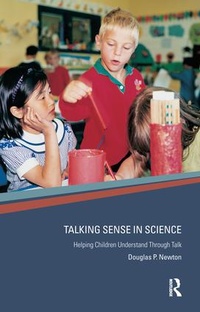
Talking Sense in Science
Helping Children Understand Through Talk
1st Edition
Published on 13. January 2017
Book
Hardback
188 pages
978-1-138-15888-7 (ISBN)
Description
Talking Sense in Science is a highly practical guide to getting the most out of primary science lessons through talking with children. This clearly written and straightforward book helps teachers to support understanding by developing their own interaction in the classroom. Each idea is described, illustrated and followed by a short task to develop teaching skills. This book looks at ways of understanding in science, and scientific language as well as how talk can support practical activities. Douglas Newton also addresses the ideas of what to say, when to say it and how to say it, with a view to developing understanding through science conversation. Examples given in the book span the range of primary school science topics, and provide an ideal sourcebook for lesson ideas. Talking Sense in Science is an essential buy for primary teachers who want an accessible way to improve their practice and their pupils' understanding in science. It is also an ideal learning tool for student teachers.
More details
Language
English
Place of publication
London
United Kingdom
Publishing group
Taylor & Francis Ltd
Target group
College/higher education
Professional and scholarly
Postgraduate, Professional, Professional Practice & Development, and Undergraduate
Dimensions
Height: 216 mm
Width: 138 mm
Weight
453 gr
ISBN-13
978-1-138-15888-7 (9781138158887)
Copyright in bibliographic data and cover images is held by Nielsen Book Services Limited or by the publishers or by their respective licensors: all rights reserved.
Schweitzer Classification
Other editions
Additional editions
E-Book
09/2003
Routledge
€52.49
Available for download
E-Book
09/2003
Routledge
€52.49
Available for download

Book
10/2001
1st Edition
Routledge
€59.50
Shipment within 15-20 days
Persons
Douglas Newton is Director of Teaching for Understanding at the University of Newcastle. He has written many books on science education, including co-authoring Coordinating Science Across the Primary School (1969 saes since 1998: GBP18321 revenue)
Content
Part I Understanding and Science: Why and What? 1.1 Why Understand? 1.2 Some Kinds of Understanding in Science 1.3 Getting to Know the Understandings you will Support 1.4 Scientific Language 1.5 Cumulative Summary Part II Helping Children Understand: Guiding Thought 2.1 Guiding Thought 2.2 Science Talk and Practical Activity 2.3 Changing Minds 2.4 Pressing for Understanding 2.5 Cumulative Summary Part III Doing More for Understanding 3.1 Building Bridges 3.2 Science Talk and Scaffolding 3.3 Science Talk and Modelling Thinking 3.4 Science Talk and Predicting 3.5 Science Talk and Inanimate Teachers 3.6 Science Talk and Stories 3.7 Science Talk and Games 3.8 Science Talk and Graphic Organisers 3.9 Cumulative Summary Part IV Conversations in Science 4.1 Conversations in Science 4.2 Conversations From Events 4.3 Conversations From Children's Questions 4.4 Conversations from Artifacts 4.5 Conversations from Pictures 4.6 Conversations from Stories and Poems 4.7 Who Takes the Initiative? 4.5 Cumulative Summary