

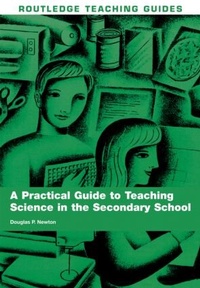
A Practical Guide to Teaching Science in the Secondary School
1st Edition
Published on 31. March 2008
Book
Paperback/Softback
118 pages
978-0-415-45364-6 (ISBN)
Description
A Practical Guide to Teaching Science in the Secondary School is designed to support student teachers as they develop their teaching skills and increase their broader knowledge and understanding for teaching science. It offers straightforward advice and inspiration on key topics such as planning, assessment, practical work, the science classroom, and on to the broader aspects of teaching science.
This thoroughly updated second edition reflects on new expectations, requirements, and practices in science teaching, with chapters exploring key and contemporary topics such as:
? The nature of science and scientific argument
? The various kinds of thinking emphasised in science and how to exercise them
? How to engage students in learning
? Assessment for and of learning
? Diverse needs and how to meet them
? The use of technology to support teaching and learning
? Learning at a distance.
Designed to be used independently or alongside the popular textbook Learning to Teach Science in the Secondary School, this book is packed with revised and updated case studies, examples of pupils' work, and resources and activities in every chapter. It provides everything trainee and early career teachers need to reflect on and develop their teaching practice, helping them to plan lessons across the subject in a variety of teaching situations.
This thoroughly updated second edition reflects on new expectations, requirements, and practices in science teaching, with chapters exploring key and contemporary topics such as:
? The nature of science and scientific argument
? The various kinds of thinking emphasised in science and how to exercise them
? How to engage students in learning
? Assessment for and of learning
? Diverse needs and how to meet them
? The use of technology to support teaching and learning
? Learning at a distance.
Designed to be used independently or alongside the popular textbook Learning to Teach Science in the Secondary School, this book is packed with revised and updated case studies, examples of pupils' work, and resources and activities in every chapter. It provides everything trainee and early career teachers need to reflect on and develop their teaching practice, helping them to plan lessons across the subject in a variety of teaching situations.
Reviews / Votes
The proposal was thoroughly reviewed and commented upon by one of the series editors. The author responded positively to all criticisms of the proposal.More details
Series
Language
English
Place of publication
London
United Kingdom
Publishing group
Taylor & Francis Ltd
Target group
College/higher education
Illustrations
2 s/w Photographien bzw. Rasterbilder, 2 s/w Tabellen
2 Tables, black and white; 2 Halftones, black and white
Dimensions
Height: 297 mm
Width: 210 mm
Weight
340 gr
ISBN-13
978-0-415-45364-6 (9780415453646)
Copyright in bibliographic data and cover images is held by Nielsen Book Services Limited or by the publishers or by their respective licensors: all rights reserved.
Schweitzer Classification
Other editions
New editions
Douglas P. Newton
A Practical Guide to Teaching Science in the Secondary School
Book
11/2022
2nd Edition
Routledge
€40.30
Shipment within 10-20 days
Additional editions
Douglas P. Newton
A Practical Guide to Teaching Science in the Secondary School
Book
03/2017
1st Edition
Routledge
€193.13
Article exhausted; check for reprint
Douglas P. Newton
A Practical Guide to Teaching Science in the Secondary School
E-Book
03/2008
1st Edition
Routledge
€48.29
Available for download
Person
Douglas P. Newton was a teacher for twenty-four years before he began training teachers. He is currently a Professorial Fellow at Durham University, UK.
Content
1. What Underpins your Teaching: Some Matters of Science and Science Education 2. Preparing to Teach Science: Planning for Learning 3. In the Classroom: Supporting Learning in Science 4. Assessing Learning in Science in the Classroom 5. Differences 6. Some Broader Aspects of Science Teaching