

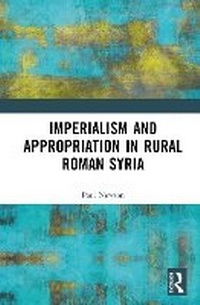
Imperialism and Appropriation in Rural Roman Syria
1st Edition
Published on 24. September 2025
Book
Hardback
266 pages
978-1-032-57347-2 (ISBN)
Description
This book reassesses our understanding of rural landscapes in the Near East between the first and fourth centuries CE. Previous histories of the Roman Near East have been influenced by an underlying set of assumptions, based mainly on readings of Classical literature, regarding the impact of Rome on this region.
To achieve these aims the book explores the nature of rural settlement in the Near East during the period through an in-depth examination of the material evidence. It also assesses current theories of Roman imperialism and acculturation and the extent to which the rural environment of the Near East was affected by such processes. Most work in this area is on the Roman West and this book offers an eastern model using archaeological examples. Recent archaeological data is introduced through a series of thematic chapters that address some of the most important factors that have shaped the rural environment including the ways in which the countryside was used and exploited, the changes triggered by the arrival of Rome and the extent to which the ritual and funerary landscapes of the rural environment were transformed during this period. Taken all together, this volume evaluates the impact of Roman rule on the Greek East as experienced in the realm of the rural.
Offering a new framework by which comparisons with other areas of the eastern half of the Roman Empire and the western provinces can be made, this book is for students and researchers interested in the process of imperialism, and the archaeology of the Near East and Roman Empire.
To achieve these aims the book explores the nature of rural settlement in the Near East during the period through an in-depth examination of the material evidence. It also assesses current theories of Roman imperialism and acculturation and the extent to which the rural environment of the Near East was affected by such processes. Most work in this area is on the Roman West and this book offers an eastern model using archaeological examples. Recent archaeological data is introduced through a series of thematic chapters that address some of the most important factors that have shaped the rural environment including the ways in which the countryside was used and exploited, the changes triggered by the arrival of Rome and the extent to which the ritual and funerary landscapes of the rural environment were transformed during this period. Taken all together, this volume evaluates the impact of Roman rule on the Greek East as experienced in the realm of the rural.
Offering a new framework by which comparisons with other areas of the eastern half of the Roman Empire and the western provinces can be made, this book is for students and researchers interested in the process of imperialism, and the archaeology of the Near East and Roman Empire.
More details
Language
English
Place of publication
London
United Kingdom
Publishing group
Taylor & Francis Ltd
Target group
College/higher education
Professional and scholarly
Academic and Postgraduate
Illustrations
67 s/w Abbildungen, 67 s/w Photographien bzw. Rasterbilder
67 Halftones, black and white; 67 Illustrations, black and white
Dimensions
Height: 234 mm
Width: 156 mm
Weight
670 gr
ISBN-13
978-1-032-57347-2 (9781032573472)
Copyright in bibliographic data and cover images is held by Nielsen Book Services Limited or by the publishers or by their respective licensors: all rights reserved.
Schweitzer Classification
Other editions
Additional editions
E-Book
09/2025
1st Edition
Routledge
€60.49
Available for download
E-Book
09/2025
1st Edition
Routledge
€60.49
Available for download
Person
Paul Newson is Associate Professor of Archaeology at the American University of Beirut, Lebanon. He is interested in landscape archaeology and the rural environments of the Graeco-Roman world, particularly in the Eastern Mediterranean; as well as post-colonial approaches and post-conflict cultural heritage. He has directed fieldwork in Syria, Libya and Lebanon.
Content
1. Roman imperialisms and the countryside; 2. 'Mapping' the Roman period countryside; 3. Who owned the countryside?; 4. The countryside culture; 5. Consuming Cultures; 6. Ritual landscapes; 7. Landscapes of the dead; 8. Conclusion