

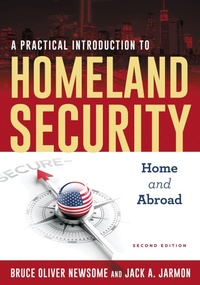
A Practical Introduction to Homeland Security
Home and Abroad
2nd Edition
Published on 17. March 2020
Book
Paperback/Softback
408 pages
978-1-5381-2565-6 (ISBN)
Description
This text provides students with a practical introduction to the concepts, structure, politics, law, hazards, threats, and practices of homeland security everywhere, focusing on US "homeland security," Canadian "public safety," and European "domestic security." It is a conceptual and practical textbook, not a theoretical work. It is focused on the knowledge and skills that will allow the reader to understand how homeland security is and should be practiced.
Globalization, population growth, migration, technology, aging infrastructure, and the simple trend to higher expectations are making homeland security more challenging. Yes, homeland security really is a global problem. The hyperconnectivity of today's world has reduced the capacity of the United States to act unilaterally or to solve homeland risks from within the borders alone.
Newsome and Jarmon explain the relevant concepts, the structural authorities and responsibilities that policymakers struggle with and within which practitioners must work, the processes that practitioners and professionals choose between or are obliged to use, the actual activities, and the end-states and outputs of these activities.
Moreover, this book presents the concept of homeland security as an evolving experience rather than an artifact of life since 2001. It is a profession that requires some forming from the ground up as well as the top down.
Globalization, population growth, migration, technology, aging infrastructure, and the simple trend to higher expectations are making homeland security more challenging. Yes, homeland security really is a global problem. The hyperconnectivity of today's world has reduced the capacity of the United States to act unilaterally or to solve homeland risks from within the borders alone.
Newsome and Jarmon explain the relevant concepts, the structural authorities and responsibilities that policymakers struggle with and within which practitioners must work, the processes that practitioners and professionals choose between or are obliged to use, the actual activities, and the end-states and outputs of these activities.
Moreover, this book presents the concept of homeland security as an evolving experience rather than an artifact of life since 2001. It is a profession that requires some forming from the ground up as well as the top down.
Reviews / Votes
Both authors bring related academic and practical experience to the topic of homeland security. [T]he combination of theoretical foundation, critical thinking, and practical application is refreshing. -- Craig Heatherly, Northeastern State UniversityMore details
Edition
2nd edition
Language
English
Place of publication
United States
Publishing group
Bloomsbury Publishing Plc
Target group
College/higher education
US School Grade: From College Freshman to College Graduate Student
Product notice
Paperback (trade)
Unsewn / adhesive bound
Illustrations
4 Maps
Dimensions
Height: 251 mm
Width: 178 mm
Thickness: 15 mm
Weight
658 gr
ISBN-13
978-1-5381-2565-6 (9781538125656)
Copyright in bibliographic data and cover images is held by Nielsen Book Services Limited or by the publishers or by their respective licensors: all rights reserved.
Schweitzer Classification
Other editions
Additional editions
E-Book
03/2020
2nd Edition
Rowman & Littlefield Publishers
€82.49
Available for download
E-Book
03/2020
2nd Edition
Rowman & Littlefield Publishers
€82.49
Available for download
Persons
Bruce Newsome has served as full-time faculty at the University of California, the post-graduate Defence Academy of the United Kingdom, and the University of Pennsylvania, where he taught courses on counterterrorism, intelligence, security and risk management. Before teaching, he was a full-time research scientist at the RAND Corporation in Santa Monica, California - consulting to the Office of the Secretary of Defense, Department of the Army, Department of the Navy, and Department of Homeland Security and equivalent departments of foreign governments. He has published more than 20 books or reports of relevance, most recently "Countering New(est) Terrorism" in January 2018, which was supported by units of the FBI Academy at Quantico. He volunteers his time to the Federal Bureau of Investigation, the Secret Service Electronic Crimes Task Force, and Infragard.
Jack Jarmon, Ph.D., lectures at universities and public audiences. He was the Associate Director of the Command Control and Interoperability Center for Advance Data Analysis at Rutgers University (a DHS Center for Excellence) and adjunct Professor at Seton Hall University. From 2008-2009 he was a lecturer at University of Pennsylvania. While with Arthur Andersen in Moscow in the mid-nineties he was a USAID technical advisor to the South Russian Privatization Center. He also was Director of Strategic Alliances at Nortel Networks, Brampton, Canada. Jarmon received his BA from Rutgers University, an MA from Fordham University in Russian/Soviet Area Studies, and a PhD from Rutgers University in Global Affairs.
Jack Jarmon, Ph.D., lectures at universities and public audiences. He was the Associate Director of the Command Control and Interoperability Center for Advance Data Analysis at Rutgers University (a DHS Center for Excellence) and adjunct Professor at Seton Hall University. From 2008-2009 he was a lecturer at University of Pennsylvania. While with Arthur Andersen in Moscow in the mid-nineties he was a USAID technical advisor to the South Russian Privatization Center. He also was Director of Strategic Alliances at Nortel Networks, Brampton, Canada. Jarmon received his BA from Rutgers University, an MA from Fordham University in Russian/Soviet Area Studies, and a PhD from Rutgers University in Global Affairs.
Content
Chapter 1: Conceptualizing Homeland Security
Chapter 2: Structuring Homeland Security
Chapter 3: Laws of Homeland Security
Chapter 4: Transnational Crime
Chapter 5: Terrorism
Chapter 6: Chemical, Biological, Nuclear, Radioactive, Explosive, and Energy (CBNREE) Hazards
Chapter 7: Natural Risks
Chapter 8: Intelligence
Chapter 9: Emergency Management
Chapter 10: Physical Site and Infrastructure Security
Chapter 11: Information, Communications, and Cyber Security
Chapter 12: Immigration and Border Security
Chapter 13: Transport Security
Glossary
Chapter 2: Structuring Homeland Security
Chapter 3: Laws of Homeland Security
Chapter 4: Transnational Crime
Chapter 5: Terrorism
Chapter 6: Chemical, Biological, Nuclear, Radioactive, Explosive, and Energy (CBNREE) Hazards
Chapter 7: Natural Risks
Chapter 8: Intelligence
Chapter 9: Emergency Management
Chapter 10: Physical Site and Infrastructure Security
Chapter 11: Information, Communications, and Cyber Security
Chapter 12: Immigration and Border Security
Chapter 13: Transport Security
Glossary