

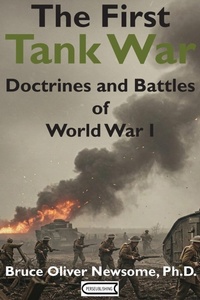
The First Tank War
Doctrines and Battles of World War I
Published on 23. March 2025
Book
Paperback/Softback
256 pages
978-1-951171-24-7 (ISBN)
Description
The proposed mechanical solutions to the stalemate of the Great War (1914-1918) included big-wheel landships, wheeled bridge-pushers, trench-straddling personnel carriers, self-propelled artillery, and machine-gun carriers. The preferred acquisition was named "tank," but even the tank remained contested, between different weights, armaments, types of mobility, and protection levels. The doctrine too remained contested. Indeed, many of the same questions are asked today. Should tanks surprise the enemy or be preceded by bombardment? Should tanks assault by day or night? Should they be concentrated or distributed? Should they be combined with all arms, some arms, or no other arm? Should they lead or follow other arms? Should they sustain a penetration or hit and run? Should they hold objectives or rally to the rear? Should they aim at enemy fortifications, or infantry, or artillery, or supplies, or headquarters? Going back to the archives and the battlefields, this book reviews the doctrines and battles of the Great War, and rediscovers the enduring principles of mechanized warfare. 254 pages, 23 maps, 23 tables of data, 26 photographs
More details
Language
English
Product notice
Paperback (trade)
Unsewn / adhesive bound
Dimensions
Height: 234 mm
Width: 156 mm
Thickness: 17 mm
Weight
582 gr
ISBN-13
978-1-951171-24-7 (9781951171247)
Copyright in bibliographic data and cover images is held by Nielsen Book Services Limited or by the publishers or by their respective licensors: all rights reserved.
Schweitzer Classification
Person
Bruce Oliver Newsome, Ph.D., is a historian, political scientist, and defence, risk, and security consultant. He held standing faculty positions at University of Texas, University of San Diego, University of California Berkeley, University of Pennsylvania, and the Defence Academy of the United Kingdom. Before teaching, he spent five years at the RAND Corporation, advising national governments on defence and security. He served in the British Army reserves, US Army National Guard, and Texas State Guard.