

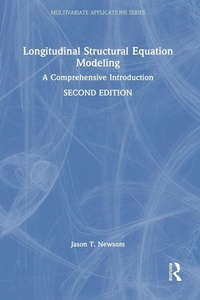
Longitudinal Structural Equation Modeling
A Comprehensive Introduction
2nd Edition
Published on 31. October 2023
Book
Hardback
502 pages
978-1-032-20283-9 (ISBN)
Description
Longitudinal Structural Equation Modeling is a comprehensive resource that reviews structural equation modeling (SEM) strategies for longitudinal data to help readers determine which modeling options are available for which hypotheses.
This accessibly written book explores a range of models, from basic to sophisticated, including the statistical and conceptual underpinnings that are the building blocks of the analyses. By exploring connections between models, it demonstrates how SEM is related to other longitudinal data techniques and shows when to choose one analysis over another. Newsom emphasizes concepts and practical guidance for applied research rather than focusing on mathematical proofs, and new terms are highlighted and defined in the glossary. Figures are included for every model along with detailed discussions of model specification and implementation issues and each chapter also includes examples of each model type, descriptions of model extensions, comment sections that provide practical guidance, and recommended readings.
Expanded with new and updated material, this edition includes many recent developments, a new chapter on growth mixture modeling, and new examples. Ideal for graduate courses on longitudinal (data) analysis, advanced SEM, longitudinal SEM, and/or advanced data (quantitative) analysis taught in the behavioral, social, and health sciences, this new edition will continue to appeal to researchers in these fields.
This accessibly written book explores a range of models, from basic to sophisticated, including the statistical and conceptual underpinnings that are the building blocks of the analyses. By exploring connections between models, it demonstrates how SEM is related to other longitudinal data techniques and shows when to choose one analysis over another. Newsom emphasizes concepts and practical guidance for applied research rather than focusing on mathematical proofs, and new terms are highlighted and defined in the glossary. Figures are included for every model along with detailed discussions of model specification and implementation issues and each chapter also includes examples of each model type, descriptions of model extensions, comment sections that provide practical guidance, and recommended readings.
Expanded with new and updated material, this edition includes many recent developments, a new chapter on growth mixture modeling, and new examples. Ideal for graduate courses on longitudinal (data) analysis, advanced SEM, longitudinal SEM, and/or advanced data (quantitative) analysis taught in the behavioral, social, and health sciences, this new edition will continue to appeal to researchers in these fields.
Reviews / Votes
"This is a "must have" volume on examining change from a SEM perspective. It is thoughtfully put together beginning with a number of basic principles/concepts in the latent variable approach to change (e.g., longitudinal measurement invariance, linear and nonlinear growth). It then moves into a number of intermediate approaches (cross-lagged panel models, latent class, latent transition, and latent growth mixture models). The final chapters provide more advanced topics (time series and dynamic structural equation models, survival analysis, and missing data). The various topics covered are extensive, clearly presented, and well supported with examples and references that readers can use to work through the analyses."Ronald H. Heck, University of Hawaii
"This book offers a schematic, comprehensive, and well-structured resource for understanding, applying, and teaching most of the techniques related to Longitudinal SEM. The book follows a specific flow based on the difficulties of the topics. It starts with a clear introduction to latent variable modeling, then moves on widely used longitudinal applications (e.g., measurement invariance, cross-lagged panel models), and finally offers chapters on more advanced and recent topics (e.g., LST, Mixture Modeling, and DSEM). The structure of the book also allows the reader to directly access the topics of interest. Both from an applied and teaching perspective, it is difficult to think of a more complete and better structured book on longitudinal SEM."
Enrico Perinelli, University of Trento (Italy)
"I've cited Jason Newsom's first edition of Longitudinal Structural Equation Modeling many times, and his second edition continues the tradition of clear, accessible presentations that cover both the basics of analysis and modeling strategies for longitudinal data and extra details that experts would appreciate. An impressive, authoritative work."
Rex Kline, Concordia University
More details
Series
Edition
2nd edition
Language
English
Place of publication
London
United Kingdom
Publishing group
Taylor & Francis Ltd
Target group
College/higher education
Postgraduate
Illustrations
115 s/w Abbildungen, 115 s/w Zeichnungen
115 Line drawings, black and white; 115 Illustrations, black and white
Dimensions
Height: 260 mm
Width: 183 mm
Thickness: 32 mm
Weight
1166 gr
ISBN-13
978-1-032-20283-9 (9781032202839)
Copyright in bibliographic data and cover images is held by Nielsen Book Services Limited or by the publishers or by their respective licensors: all rights reserved.
Schweitzer Classification
Other editions
Additional editions
Book
10/2023
2nd Edition
Routledge
€109.40
Shipment within 10-20 days
E-Book
10/2023
2nd Edition
Routledge
€104.99
Available for download
E-Book
10/2023
2nd Edition
Routledge
€104.99
Available for download
Previous edition
Book
06/2015
1st Edition
Routledge
€267.41
Article exhausted; check for reprint
Person
Jason T. Newsom is professor of psychology at Portland State University, Portland, Oregon, USA.
Content
Contents
List of Figures
List of Tables
Preface to the Second Editon
Preface to the First Edition
Acknowledgements
Example Data Sets
Chapter 1. Review of Some Key Latent Variable Principles
Chapter 2. Longitudinal Measurement Invariance
Chapter 3. Structural Models for Comparing Dependent Means and Proportions
Chapter 4. Fundamental Concepts of Stability and Change
Chapter 5. Cross-Lagged Panel Models
Chapter 6. Latent State-Trait Models
Chapter 7. Linear Latent Growth Curve Models
Chapter 8. Nonlinear Latent Growth Curve Models
Chapter 9. Nonlinear Latent Growth Curve Models
Chapter 10. Latent Class and Latent Transition
Chapter 11. Growth Mixture Models
Chapter 12. Intensive Longitudinal Models: Time Series and Dynamic Structural Equation Models
Chapter 13. Survival Analysis Models
Chapter 14. Missing Data and Attrition
Appendix A: Notation
Appendix B: Why Does the Single Occasion Scaling Constraint Approach Work?
Appendix C: A Primer on the Calculus of Change
Glossary
Index
List of Figures
List of Tables
Preface to the Second Editon
Preface to the First Edition
Acknowledgements
Example Data Sets
Chapter 1. Review of Some Key Latent Variable Principles
Chapter 2. Longitudinal Measurement Invariance
Chapter 3. Structural Models for Comparing Dependent Means and Proportions
Chapter 4. Fundamental Concepts of Stability and Change
Chapter 5. Cross-Lagged Panel Models
Chapter 6. Latent State-Trait Models
Chapter 7. Linear Latent Growth Curve Models
Chapter 8. Nonlinear Latent Growth Curve Models
Chapter 9. Nonlinear Latent Growth Curve Models
Chapter 10. Latent Class and Latent Transition
Chapter 11. Growth Mixture Models
Chapter 12. Intensive Longitudinal Models: Time Series and Dynamic Structural Equation Models
Chapter 13. Survival Analysis Models
Chapter 14. Missing Data and Attrition
Appendix A: Notation
Appendix B: Why Does the Single Occasion Scaling Constraint Approach Work?
Appendix C: A Primer on the Calculus of Change
Glossary
Index