

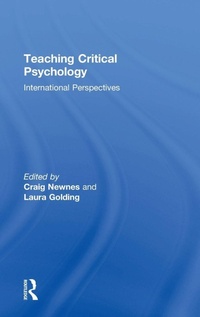
Teaching Critical Psychology
International Perspectives
1st Edition
Published on 21. August 2017
Book
Hardback
282 pages
978-1-138-28833-1 (ISBN)
Description
This edited volume may be the 'definitive text' on methods and content in teaching psychology from an international and critical perspective. Chapters from internationally renowned contributors working clinically, educationally and in the community with a range of client groups, outline critical teaching by and for professionals and service recipients.
This timely book offers a unique, research-based and philosophically coherent approach to teaching psychology including teaching methods, the lecture content of radical approaches to modern psychology and debates as to whether the aim of teaching is to liberate or control. Themes include the nature of pedagogy, the importance of teaching and learning style, the relevance of context and content and the ways in which traditional teaching forms a part of the disciplinary rather than critical project.
Teaching Critical Psychology offers guidance in teaching pupils, students, peers and those on academic programmes at under-graduate and post-graduate level.
This timely book offers a unique, research-based and philosophically coherent approach to teaching psychology including teaching methods, the lecture content of radical approaches to modern psychology and debates as to whether the aim of teaching is to liberate or control. Themes include the nature of pedagogy, the importance of teaching and learning style, the relevance of context and content and the ways in which traditional teaching forms a part of the disciplinary rather than critical project.
Teaching Critical Psychology offers guidance in teaching pupils, students, peers and those on academic programmes at under-graduate and post-graduate level.
Reviews / Votes
"This unusual indispensable book lays bare critical psychology as a fully-fledged part of academic life. It is a primer with a difference; it links theory and practice in a way that out-flanks its host discipline, and, crucially, addresses the form as well as the content of mainstream psychology, showing teachers, students and practitioners what can be done to turn psychology into what it always promised to be, but can only become by being rigorously self-critical."Ian Parker, Emeritus Professor of Management, University of Leicester, UK
More details
Language
English
Place of publication
London
United Kingdom
Publishing group
Taylor & Francis Ltd
Target group
College/higher education
Professional and scholarly
Postgraduate and Professional
Illustrations
5 s/w Tabellen, 6 s/w Zeichnungen
5 Tables, black and white; 6 Line drawings, black and white
Dimensions
Height: 240 mm
Width: 161 mm
Thickness: 21 mm
Weight
625 gr
ISBN-13
978-1-138-28833-1 (9781138288331)
Copyright in bibliographic data and cover images is held by Nielsen Book Services Limited or by the publishers or by their respective licensors: all rights reserved.
Schweitzer Classification
Other editions
Additional editions
E-Book
11/2017
Routledge
€55.49
Available for download
E-Book
11/2017
Routledge
€55.49
Available for download
Book
08/2017
1st Edition
Routledge
€63.70
Shipment within 10-20 days
Persons
Craig Newnes is a Consultant Critical Psychologist, editor and author. He has published numerous works and is Editor of The Journal of Critical Psychology, Counselling and Psychotherapy. For 19 years he was the Editor of Clinical Psychology Forum, the in-house practice journal of the Division of Clinical Psychology of The British Psychological Society and Director of Psychological Therapies for Shropshire's Community and Mental Health Services (NHS) Trust.
Laura Golding is Programme Director of the University of Liverpool's Doctorate in Clinical Psychology and chair of the British Psychological Society's Division of Clinical Psychology Conference Committee. Much of her career has been spent working in the National Health Service (NHS) in the North West of England with adults with intellectual disabilities.
Laura Golding is Programme Director of the University of Liverpool's Doctorate in Clinical Psychology and chair of the British Psychological Society's Division of Clinical Psychology Conference Committee. Much of her career has been spent working in the National Health Service (NHS) in the North West of England with adults with intellectual disabilities.
Content
Contents
Preface: On critical pedagogy Peter McLaren
Chapter One: Teaching psychology critically David Fryer & Rachael Fox
Chapter Two: Ten suggestions for critical teaching John Cromby
Chapter Three: Towards coherence in teaching critical Psy Craig Newnes
Chapter Four: Teaching disability, teaching critical disability studies Dan Goodley, Katherine Runswick-Cole and Michael Miller
Chapter Five: Fear and loathing in the education system Robbie Piper
Chapter Six: What can teachers of critical and community psychology learn from their learners? Olivia Fakoussa, Gemma Budge, Mandeep Singh Kallu, Annie Mitchell and Rachel Purtell
Chapter Seven: Teaching indigenous psychology: A conscientisation, de-colonisation, and psychological literacy approach to curriculum Pat Dudgeon, Dawn Darlaston-Jones, & Abigail Bray
Chapter Eight: Psy and the law: The Law Project for Psychiatric Rights' public education approach Jim Gottstein
Chapter Nine: Teaching withdrawal of antipsychotics and antidepressants to professionals and recipients Peter Lehmann
Chapter Ten: Human rights and critical psychology Beth Greenhill & Laura Golding
Chapter Eleven: Children's experiences of domestic violence: A teaching and training challenge Jane Callaghan, Lisa Fellin & Joanne Alexander
Chapter Twelve: Supervision: A principles based approach Sara Tai
Chapter Thirteen: Training that domesticates or education that liberates? Tensions and dilemmas related to teaching critical psychology in the context of UK clinical psychology training Anne Cooke
Contributors
Name Index
Subject Index
Preface: On critical pedagogy Peter McLaren
Chapter One: Teaching psychology critically David Fryer & Rachael Fox
Chapter Two: Ten suggestions for critical teaching John Cromby
Chapter Three: Towards coherence in teaching critical Psy Craig Newnes
Chapter Four: Teaching disability, teaching critical disability studies Dan Goodley, Katherine Runswick-Cole and Michael Miller
Chapter Five: Fear and loathing in the education system Robbie Piper
Chapter Six: What can teachers of critical and community psychology learn from their learners? Olivia Fakoussa, Gemma Budge, Mandeep Singh Kallu, Annie Mitchell and Rachel Purtell
Chapter Seven: Teaching indigenous psychology: A conscientisation, de-colonisation, and psychological literacy approach to curriculum Pat Dudgeon, Dawn Darlaston-Jones, & Abigail Bray
Chapter Eight: Psy and the law: The Law Project for Psychiatric Rights' public education approach Jim Gottstein
Chapter Nine: Teaching withdrawal of antipsychotics and antidepressants to professionals and recipients Peter Lehmann
Chapter Ten: Human rights and critical psychology Beth Greenhill & Laura Golding
Chapter Eleven: Children's experiences of domestic violence: A teaching and training challenge Jane Callaghan, Lisa Fellin & Joanne Alexander
Chapter Twelve: Supervision: A principles based approach Sara Tai
Chapter Thirteen: Training that domesticates or education that liberates? Tensions and dilemmas related to teaching critical psychology in the context of UK clinical psychology training Anne Cooke
Contributors
Name Index
Subject Index