

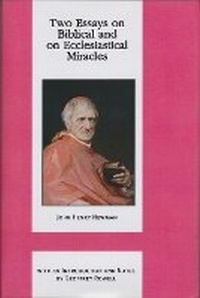
Two Essays on Biblical and on Ecclesiastical Miracles
Published on 15. September 2010
Book
Hardback
277 pages
978-0-268-03607-2 (ISBN)
Description
The essays in this volume were written when John Henry Newman was a Fellow of Oriel College, Oxford. He wrote the first, on biblical miracles "The Miracles of Scripture," in 1825-26, as a relatively young man; the other, "The Miracles of Early Ecclesiastical History," was written in 1842-43. A comparison of the two essays displays a shift in Newman's theological stances.
In the earlier essay, Newman argues in accordance with the theology of evidence of his time, maintaining that the age of miracles was limited to those recorded in the Old Testament scriptures and in the Gospels and Acts. He asserts that biblical miracles served to demonstrate the divine inspiration of biblical revelation and to attest to the divinity of Christ. However, with the end of the apostolic age, the age of miracles came to an end; miracles reported from the early ages of the Church Newman dismissed as suspicious and possibly fraudulent. With this view, Newman entered into an ongoing debate between the skepticism of Hume and Paine and its continuation in the utilitarianism of Bentham, on the one hand, and the views of Christian apologists rebutting Hume's arguments, on the other.
In "The Miracles of Early Ecclesiastical History," Newman can be seen as coming closer to accepting the doctrines of the Catholic Church. He rejects the stance he took in "The Miracles of Scripture," now arguing for a continuity of sacred history between the biblical and ecclesiastical periods. He had clearly abandoned the position of "evidence theologians" that miracles ended after the time of the Apostles. Newman's movement between the writing of the two essays is essentially a growing into a deeper awareness of the Church as a divine society in whose life miracles and supernatural gifts were to be expected.
In the earlier essay, Newman argues in accordance with the theology of evidence of his time, maintaining that the age of miracles was limited to those recorded in the Old Testament scriptures and in the Gospels and Acts. He asserts that biblical miracles served to demonstrate the divine inspiration of biblical revelation and to attest to the divinity of Christ. However, with the end of the apostolic age, the age of miracles came to an end; miracles reported from the early ages of the Church Newman dismissed as suspicious and possibly fraudulent. With this view, Newman entered into an ongoing debate between the skepticism of Hume and Paine and its continuation in the utilitarianism of Bentham, on the one hand, and the views of Christian apologists rebutting Hume's arguments, on the other.
In "The Miracles of Early Ecclesiastical History," Newman can be seen as coming closer to accepting the doctrines of the Catholic Church. He rejects the stance he took in "The Miracles of Scripture," now arguing for a continuity of sacred history between the biblical and ecclesiastical periods. He had clearly abandoned the position of "evidence theologians" that miracles ended after the time of the Apostles. Newman's movement between the writing of the two essays is essentially a growing into a deeper awareness of the Church as a divine society in whose life miracles and supernatural gifts were to be expected.
Reviews / Votes
"The two essays on miracles by Newman in this volume were written when he was a fellow of Oriel College, Oxford. . . . This edition also contains a new 36-page introduction and editor's notes . . . by Rowell, who is Anglican bishop of Gibraltar." -New Testament Abstracts"Besides their historical value as windows into the Victorian-era arguments regarding miracles, these essays are noteworthy in that they show a concrete instance of development in Newman's thought. Obviously, the principle of development was important in Newman's understanding of the history of the Church, but a development analogous to the church's growth can also be seen in Newman's own intellectual and spiritual journey." -Catholic Books Review
More details
Series
Language
English
Place of publication
Notre Dame IN
United States
Target group
Professional and scholarly
Dimensions
Height: 229 mm
Width: 152 mm
Thickness: 28 mm
Weight
918 gr
ISBN-13
978-0-268-03607-2 (9780268036072)
Copyright in bibliographic data and cover images is held by Nielsen Book Services Limited or by the publishers or by their respective licensors: all rights reserved.
Schweitzer Classification
Persons
Geoffrey Rowell is Bishop of the Church of England Diocese of Gibraltar in Europe. From 1972 to 1993, he was Chaplain, Fellow, and Tutor in Theology at Keble College, Oxford. Among his many books and articles are Hell and the Victorians and The Vision Glorious: Themes and Personalities of the Catholic Revival in the Church of England.