

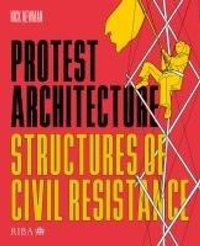
Protest Architecture
Structures of civil resistance
1st Edition
Published on 1. July 2024
Book
Paperback/Softback
224 pages
978-1-915722-17-1 (ISBN)
Description
A complex bamboo pyramid to block a busy crossing in London. A maze of 'mini Stonehenge' brick structures to hinder government crackdowns in Hong Kong. The takeover of a Dallas highway to create a temporary public square.
Architects have often used their skills in struggles for civil rights, gender equality and climate justice. Illuminating the role that design has played in protest movements, Nick Newman explores the colliding worlds of architecture and activism through the stories of those who have built for change.
Using historic and contemporary examples, Protest Architecture analyses the design problems and solutions faced by protestors on the streets through detailed drawings, photography and expert insight.
From beacons to barricades, towers to treehouses, this unique design typology demonstrates architectural influence over moments of societal change.
This is a retelling of protest history through the eyes of an architect.
Architects have often used their skills in struggles for civil rights, gender equality and climate justice. Illuminating the role that design has played in protest movements, Nick Newman explores the colliding worlds of architecture and activism through the stories of those who have built for change.
Using historic and contemporary examples, Protest Architecture analyses the design problems and solutions faced by protestors on the streets through detailed drawings, photography and expert insight.
From beacons to barricades, towers to treehouses, this unique design typology demonstrates architectural influence over moments of societal change.
This is a retelling of protest history through the eyes of an architect.
More details
Language
English
Place of publication
London
United Kingdom
Target group
Professional Practice & Development
Dimensions
Height: 209 mm
Width: 168 mm
Thickness: 14 mm
Weight
564 gr
ISBN-13
978-1-915722-17-1 (9781915722171)
Copyright in bibliographic data and cover images is held by Nielsen Book Services Limited or by the publishers or by their respective licensors: all rights reserved.
Schweitzer Classification
Other editions
Additional editions
E-Book
07/2024
1st Edition
RIBA Publishing
€44.99
Available for download
E-Book
07/2024
1st Edition
RIBA Publishing
€44.99
Available for download
Person
Nick Newman is a Director of Studio Bark and U-Build. His experience spans environmental architecture, climate activism, building performance evaluation and deep energy retrofits. Nick is a Passivhaus Designer and has contributed to a number of journals and publications, including Everything Needs to Change (RIBA Publishing, 2021), Environmental Design Pocketbook (RIBA Publishing, 2015) and the Passivhaus Designer's Manual (Routledge, 2015). He speaks regularly at events on behalf of the studio and was named a 'Rising Sustainability Star' by Building magazine in 2014. Nick is an advocate for radical responses to the Climate Emergency, and has been arrested in October 2019, December 2019, and September 2020 for his involvement in the Extinction Rebellion protests, which brought Central London to a standstill.
Content
About the Author
Acknowledgements
Introduction
Part 1: Defining Protest Architecture
1.1 What is protest architecture?
1.2 A story of architecture and protest
1.3 Protest movements
1.4 The boundaries of protest architecture
1.5 Architectural precedents
Part 2: Forms of Protest Architecture
2.1 Reappropriation
2.2 Occupation
2.3 Alteration
2.4 Barricades
2.5 Tunnels
2.6 Treehouses
2.7 Tripods
2.8 Towers
2.9 Beacons
2.10 Pavilions and Exhibitions
2.11 Festivals
2.12 Student Proposals
2.13 New Forms of Practice
Part 3: Protest Design
3.1 Design Principles
3.2 Protest v Planning
3.3 Health and Safety and its Role in Protest
3.4 The Economics of Protest Architecture
3.5 Concepts and Messaging
3.6 Logistics
3.7 Professional and Legal Considerations
Afterword
Author Note
Bibliography
References Image Credits
Acknowledgements
Introduction
Part 1: Defining Protest Architecture
1.1 What is protest architecture?
1.2 A story of architecture and protest
1.3 Protest movements
1.4 The boundaries of protest architecture
1.5 Architectural precedents
Part 2: Forms of Protest Architecture
2.1 Reappropriation
2.2 Occupation
2.3 Alteration
2.4 Barricades
2.5 Tunnels
2.6 Treehouses
2.7 Tripods
2.8 Towers
2.9 Beacons
2.10 Pavilions and Exhibitions
2.11 Festivals
2.12 Student Proposals
2.13 New Forms of Practice
Part 3: Protest Design
3.1 Design Principles
3.2 Protest v Planning
3.3 Health and Safety and its Role in Protest
3.4 The Economics of Protest Architecture
3.5 Concepts and Messaging
3.6 Logistics
3.7 Professional and Legal Considerations
Afterword
Author Note
Bibliography
References Image Credits