

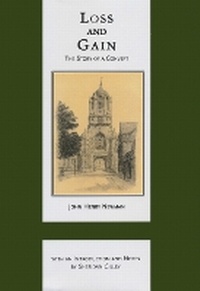
Loss and Gain
The Story of a Convert
Published on 15. May 2015
Book
Hardback
277 pages
978-0-268-03613-3 (ISBN)
Description
It may seem surprising to discover that a Catholic cardinal was a novelist, and Newman advanced this as an obstacle to his own canonization: "Saints are not literary men," he wrote, "they do not love the classics, they do not write Tales." He was only fit "to black the saints' shoes-if Saint Philip uses blacking, in heaven."
The background to Loss and Gain was a controversial one. Newman wrote the book in part to provide a title for publication by James Burns, of the later celebrated firm of Burns and Oates, who had lost his stable of Anglican authors by converting in 1847 to Catholicism.
An understanding of the novel requires some knowledge of its Oxford background, of the university setting, which was compared in the fierceness of its loyalties by Newman's friend Richard Church to a Renaissance Italian city, implying an assassin with a stiletto round every corner. In short, there is a sense in which, in spite of its fictional character, Loss and Gain is a work of controversy, full of echoes of old battles over whether the Thirty-Nine Articles of Religion and the Book of Common Prayer should be interpreted in a "Catholic" or a "Protestant" sense. It is a response, like Newman's other works, to a challenge, and so its hero, Charles Reding, as a student in Oxford, passes through the hands of the representatives of a number of Anglican parties and schools of theology before resolving his doubts in Rome.
The background to Loss and Gain was a controversial one. Newman wrote the book in part to provide a title for publication by James Burns, of the later celebrated firm of Burns and Oates, who had lost his stable of Anglican authors by converting in 1847 to Catholicism.
An understanding of the novel requires some knowledge of its Oxford background, of the university setting, which was compared in the fierceness of its loyalties by Newman's friend Richard Church to a Renaissance Italian city, implying an assassin with a stiletto round every corner. In short, there is a sense in which, in spite of its fictional character, Loss and Gain is a work of controversy, full of echoes of old battles over whether the Thirty-Nine Articles of Religion and the Book of Common Prayer should be interpreted in a "Catholic" or a "Protestant" sense. It is a response, like Newman's other works, to a challenge, and so its hero, Charles Reding, as a student in Oxford, passes through the hands of the representatives of a number of Anglican parties and schools of theology before resolving his doubts in Rome.
Reviews / Votes
"The work revolves around Oxford at a particular time and in the religious controversies of that time and place. It's observation of place and personalities is quite vivid." -Congregational Libraries Today"First published in 1848, Loss and Gain is the first of Newman's two novels (the other was Callista). The subtitle (originally an alternate title, added later) is a guide to the novel's subject matter, which is the move to the Catholic Church of the main character (mirroring Newman)." -Choice
More details
Series
Language
English
Place of publication
Notre Dame IN
United States
Target group
Professional and scholarly
Dimensions
Height: 203 mm
Width: 127 mm
Thickness: 32 mm
Weight
648 gr
ISBN-13
978-0-268-03613-3 (9780268036133)
Copyright in bibliographic data and cover images is held by Nielsen Book Services Limited or by the publishers or by their respective licensors: all rights reserved.
Schweitzer Classification
Persons
Sheridan Gilley is an Emeritus Reader in Theology at the University of Durham, an Honorary Fellow in Catholic History in its Catholic Studies Centre, a Fellow of the Royal Historical Society, and past president (2010-2011) of the Ecclesiastical History Society. Author of many books, many on Newman, he has published more than two hundred articles on modern English and Irish and Christian history.