

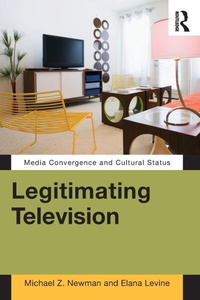
Legitimating Television
Media Convergence and Cultural Status
1st Edition
Published on 8. September 2011
Book
Paperback/Softback
232 pages
978-0-415-88026-8 (ISBN)
Description
Legitimating Television: Media Convergence and Cultural Status explores how and why television is gaining a new level of cultural respectability in the 21st century. Once looked down upon as a "plug-in drug" offering little redeeming social or artistic value, television is now said to be in a creative renaissance, with critics hailing the rise of Quality series such as Mad Men and 30 Rock. Likewise, DVDs and DVRs, web video, HDTV, and mobile devices have shifted the longstanding conception of television as a household appliance toward a new understanding of TV as a sophisticated, high-tech gadget.
Newman and Levine argue that television's growing prestige emerges alongside the convergence of media at technological, industrial, and experiential levels. Television is permitted to rise in respectability once it is connected to more highly valued media and audiences. Legitimation works by denigrating "ordinary" television associated with the past, distancing the television of the present from the feminized and mass audiences assumed to be inherent to the "old" TV. It is no coincidence that the most validated programming and technologies of the convergence era are associated with a more privileged viewership. The legitimation of television articulates the medium with the masculine over the feminine, the elite over the mass, reinforcing cultural hierarchies that have long perpetuated inequalities of gender and class.
Legitimating Television urges readers to move beyond the question of taste-whether TV is "good" or "bad"-and to focus instead on the cultural, political, and economic issues at stake in television's transformation in the digital age.
Newman and Levine argue that television's growing prestige emerges alongside the convergence of media at technological, industrial, and experiential levels. Television is permitted to rise in respectability once it is connected to more highly valued media and audiences. Legitimation works by denigrating "ordinary" television associated with the past, distancing the television of the present from the feminized and mass audiences assumed to be inherent to the "old" TV. It is no coincidence that the most validated programming and technologies of the convergence era are associated with a more privileged viewership. The legitimation of television articulates the medium with the masculine over the feminine, the elite over the mass, reinforcing cultural hierarchies that have long perpetuated inequalities of gender and class.
Legitimating Television urges readers to move beyond the question of taste-whether TV is "good" or "bad"-and to focus instead on the cultural, political, and economic issues at stake in television's transformation in the digital age.
Reviews / Votes
"Trenchantly, Michael Newman and Elana Levine observe that every new attempt to declare some form of television as especially valuable culturally or artistically 'is predicated on the systematic degradation of old television practices' and they demonstrate this insight through sharp history combined with comprehensive analysis of the contemporary context. Most refreshing in this respect is their self-aware sense of TV studies' own contribution to processes of legitimation. A rich, far-reaching study of the values we've given to TV across its complicated history." -Dana Polan, Professor of Cinema Studies, New York University"Legitimating Television offers a crucial intervention in the popular and scholarly conception of television's increasing cultural significance. ... As a teaching tool, Newman and Levine's engaging and clear style make Legitimating Television suitable for both the graduate and undergraduate classroom, especially as a counterpoint to popular or scholarly sources that regard the increased cultural status of contemporary television in a more favorable light." -Melinda E. S. Kohnen, New York University "Legitimating Television offers a crucial intervention in the popular and scholarly conception of television's increasing cultural significance. ... As a teaching tool, Newman and Levine's engaging and clear style make Legitimating Television suitable for both the graduate and undergraduate classroom, especially as a counterpoint to popular or scholarly sources that regard the increased cultural status of contemporary television in a more favorable light." -Melinda E. S. Kohnen, New York University
"Trenchantly, Michael Newman and Elana Levine observe that every new attempt to declare some form of television as especially valuable culturally or artistically 'is predicated on the systematic degradation of old television practices' and they demonstrate this insight through sharp history combined with comprehensive analysis of the contemporary context. Most refreshing in this respect is their self-aware sense of TV studies' own contribution to processes of legitimation. A rich, far-reaching study of the values we've given to TV across its complicated history." -Dana Polan, Professor of Cinema Studies, New York University
More details
Language
English
Place of publication
London
United Kingdom
Publishing group
Taylor & Francis Ltd
Target group
College/higher education
Illustrations
30 s/w Photographien bzw. Rasterbilder
30 Halftones, black and white
Dimensions
Height: 229 mm
Width: 152 mm
Thickness: 13 mm
Weight
343 gr
ISBN-13
978-0-415-88026-8 (9780415880268)
Copyright in bibliographic data and cover images is held by Nielsen Book Services Limited or by the publishers or by their respective licensors: all rights reserved.
Schweitzer Classification
Other editions
Additional editions
E-Book
02/2012
1st Edition
Routledge
€53.99
Available for download
E-Book
02/2012
1st Edition
Routledge
€53.99
Available for download
Book
09/2011
1st Edition
Routledge
€253.50
Shipment within 15-20 days
Persons
Michael Z. Newman is an assistant professor in the Department of Journalism, Advertising, and Media Studies at the University of Wisconsin-Milwaukee and the author of Indie: An American Film Culture.
Elana Levine is an associate professor in the Department of Journalism, Advertising, and Media Studies at the University of Wisconsin-Milwaukee and the author of Wallowing in Sex: The New Sexual Culture of 1970s American Television and co-editor of Undead TV: Essays on Buffy the Vampire Slayer.
Elana Levine is an associate professor in the Department of Journalism, Advertising, and Media Studies at the University of Wisconsin-Milwaukee and the author of Wallowing in Sex: The New Sexual Culture of 1970s American Television and co-editor of Undead TV: Essays on Buffy the Vampire Slayer.
Content
Contents
Acknowledgements
Legitimating Television
Another Golden Age?
The Showrunner as Auteur
Upgrading the Situation Comedy
Not a Soap Opera
The Television Image and the Image of the Television
Technologies of Agency
Television Scholarship and/as Legitimation
Bibliography
Acknowledgements
Legitimating Television
Another Golden Age?
The Showrunner as Auteur
Upgrading the Situation Comedy
Not a Soap Opera
The Television Image and the Image of the Television
Technologies of Agency
Television Scholarship and/as Legitimation
Bibliography