

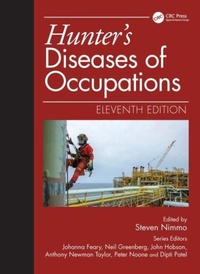
Hunter's Diseases of Occupations
Description
In the seven decades since its first publication, this award-winning text has remained the pre-eminent reference on diseases caused by work, universally recognised as the most authoritative source of information in the field. It remains an essential clinical resource, offering comprehensive coverage of a wide range of diverse topics from asbestos-related diseases, bioterrorism and major chemical incidents to employee wellness and working under the sea and at altitude, many of which are increasingly relevant in today's occupational health landscape.
The Eleventh Edition of Hunter's Diseases of Occupations has been fully revised and updated under a new and expanded team of expert editors and international contributors. It provides practitioners considering an occupational cause for a patient's condition with comprehensive coverage of diagnosing and managing work-related diseases as they manifest across industrialised societies globally.
Key Features:
· Continued focus on occupational disease central to previous editions, ensuring relevance and depth
· Expanded Work and Mental Health section, restructured under new authorship to reflect the growing significance of mental health in occupational settings
· New chapters cover emerging topics including methods and approaches to the prevention of occupational disease, non-ionizing and optical radiation, musculoskeletal disorders, emerging infections and pandemics, medically unexplained symptoms and more
· Digital supplements plus bundled eBook for maximum flexibility and optimised search functionality
The Eleventh Edition remains an indispensable resource for occupational and public health physicians, general practitioners, occupational health and safety professionals, and researchers and academics in these fields, as well as lawyers, employment specialists and human resource advisors.
More details
Other editions
Previous edition
Persons
Professor Steve Nimmo is a clinical academic and consultant in occupational medicine. He was editor of the journal Occupational Medicine for 7 years. He is the immediate past president of the Faculty of Occupational Medicine of the Royal College of Physicians. He served in the Royal Navy for 10 years and worked in the National Health for 20 years. He currently works as Chief Medical Officer for a multinational company.
Dr Johanna Feary is a clinical academic in occupational lung disease at Imperial College London and the Royal Brompton Hospital. She has published research, book chapters and clinical guidelines on a range of occupational lung diseases and was editor of the European Respiratory Society Monograph on Occupational and Environmental Lung Disease published in 2020. She is a past chair of the British Thoracic Society Specialist Advisory Group on Occupational and Environmental Lung Disease (2022-2025).
Professor Neil Greenberg is a consultant academic, occupational and forensic psychiatrist based at King's College London. He is the current (2026) President of the Society of Occupational Medicine. Neil served in the United Kingdom Military for more than 23 years and has published more than 400 scientific papers and book chapters.
John Hobson is a retired consultant occupational physician and former lecturer in occupational medicine at the Universities of Keele, Manchester and Birmingham. He was the editor of The Society of Occupational Medicine's journal, Occupational Medicine, between 2002 and 2018 and co-editor of the fifth and sixth editions of Fitness For Work, published by OUP.
Professor Sir Anthony Newman Taylor was Professor of Occupational and Environmental Medicine at National Heart and Lung Institute and consultant physician at Brompton Hospital, London, where he was Head of a joint Department of Occupational and Environmental Medicine between 1982 and 2012. He was Chair of Industrial Injuries Advisory Council between 1996 and 2008, of Independent Medical Expert Group of Armed Forces Compensation Scheme between 2010 and 2019 and of HSE Workplace Health Expert Committee between 2016 and 2025. He is currently chair of the Colt Foundation and Emeritus Professor of Occupational and Environmental Medicine at Imperial College, London.
Peter Noone is a consultant in occupational medicine and member of the occupational medicine faculty of the Royal College of Physicians of London, UK. He's deputy editor of Occupational Medicine Journal OUP and an Assistant Editor since 2008. He had 30 years experience in occupational medicine working in the NHS and the Irish Health service. He's a past president of the Travel Medicine Society of Ireland and ISOM. He's current a Medical Director for Ireland for Health Partners Group UK.
Dr Dipti Patel is a consultant in occupational medicine and travel medicine. She is the Director of the National Travel Health Network and Centre (NaTHNaC), the Chief Medical Officer at the Foreign, Commonwealth, and Development Office (FCDO), and an honorary lecturer in Population Health, Health Services Research, and Primary Care within the School of Health Sciences at Manchester University. Dipti is a Counsellor of the International Society of Travel Medicine. She is a member of the UK Malaria Expert Advisory Group, the Travel Subcommittee of the Joint Committee on Vaccination and Immunisation, and the WHO International Travel and Health Guideline Development Group.
Content
PART ONE - GENERAL CONSIDERATIONS
Section One: Diagnosis of Occupational Disease:
1: The occupational history
2: Occupational exposure to hazardous substances
3: Human Biomonitoring
Section Two: Extent and Attribution of Occupational Disease:
4:
5: Attribution of Disease
Section Three: Legal Issues:
6: Compensation Schemes
7: Medicolegal reports and the role of the expert witness
8: Assessment and reporting when malingering is suspected
PART TWO - DISEASES ASSOCIATED WITH CHEMICAL AGENTS:
Section One: Occupational Toxicology:
9: Occupational toxicology: general principles
10: Hazards and risks in occupational and environmental exposures
Section Two: Metals:
11: Antimony
12: Arsenic
13: Cadmium
14: Chromium
15: Cobalt
16: Gold
17: Lead
18: Mercury
19: Molybdenum
20: Nickel
21: Phosphorus
22: Silver
23: Tungsten
24: Silicon
25: Lithium
26: Aluminium
27: Beryllium
28: Copper
29: Iron
30: Magnesium
31: Manganese
32: Platinum Group Elements
33: Polonium
34: Thallium
35: Tin
36: Uranium
37: Vanadium
38: Zinc
Sction Three: Gases:
39: Gases
40: Deliberate release of nerve agents in warfare and by terrorists
Section Four: Other Chemical Exposures:
41: Organic Chemicals
42: Pesticides and other agrochemicals
43: Welding
44: The semiconductor industry
PART THREE - DISEASES ASSOCIATED WITH PHYSICAL AGENTS:
Section One: Noise:
45:
Section Two: Vibration:
46: Hand-arm vibration syndrome
47: Whole body vibration
Section Three: Heat and Cold:
48: Cold and Heat
Section Four: Barometric Pressure:
49: Diving and work at increased pressure
50: Working at high altitude
51: Aviation and Space Medicine
Section Five: Radiation:
52: Radiation Medicine
53: Non-ionizing radiation - Electromagnetic fields: static, extremely low frequency and radiofrequency fields
54: Optical radiation: IR, visible and UV radiation
PART FOUR - DISEASES RELATED TO ERGONOMIC AND MECHANICAL FACTORS:
Section One: The Musculoskeletal System:
55: Musculoskeletal Disorders
PART FIVE - OCCUPATION AND TRANSMISSIBLE DISEASES:
Section One: Occupational Infections:
56: Occupational Infections
57: Zoonoses
58: Emerging Infections and Pandemics
Section Two: Bioterrorism:
59: Bioterrorism
PART SIX - WORK AND MENTAL HEALTH:
Section One: Work and Stress:
60: Work and health
61: Primary prevention of mental health problems in the workplace
62: Early detection and intervention for mental health problems in workplace
63: Mental Healthcare Provision for Workers
64: Addictions and the workplace
65: Medically unexplained physical symptoms
PART SEVEN - RESPIRATORY DISORDERS:
Section One: General Issues:
66: Occupational lung diseases: a global perspective
67: Chronic airflow limitation, chronic bronchitis and emphysema
68: Health effects related to non-industrial workplace indoor environments
Section Two: Organic Dust Diseases:
69: Occupational asthma
70: Acute Inhalation Injuries
71: Byssinosis and other Cotton Related Conditions
72: Hypersensitivity pneumonitis
Section Three: Inorganic Dust Diseases:
73: Asbestos and asbestos-related disease
74: Epidemiology of asbestos-related diseases
75: Silica exposure and silicosis
76: Diseases caused by mineral dusts, other than asbestos, silica, beryllium, metals and coal
77: Metal Dust and Fumes
78: Beryllium and beryllium-related disease
79: Coal Workers' Lung Disease
PART EIGHT - OTHER EFFECTS OF WORKPLACE EXPOSURES:
Section One: Occupational Diseases of the Skin:
80: Occupational diseases of the skin
Section Two: Occupational Cancers:
81: Occupational cancer: epidemiology, biological mechanisms and biomarkers
Section Three: Other Systemic Effects:
82: Nephrotoxic effects of workplace exposures
83: Neurotoxic effects of workplace exposures
84: Hepatotoxic effects of workplace exposure
85: Workplace exposures and reproductive health
86: Haematologic and haemopoietic effects of workplace exposures: anaemias, leukaemias and lymphomas
Section Four: Shift Work:
87: Shiftwork and long working hours