

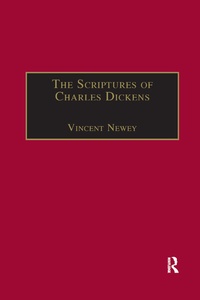
The Scriptures of Charles Dickens
Novels of Ideology, Novels of the Self
1st Edition
Published on 13. December 2019
Book
Paperback/Softback
328 pages
978-0-367-88812-1 (ISBN)
Description
This study focuses on Dickens's response to questions of identity, conduct, and social organization that emerged in an era of major cultural unsettlement and change, not least with the decline of religious certainty and the rise of materialism. An analysis of A Christmas Carol as a paradigm of his concerns and strategies in these fields is followed by close readings of novels from different stages of his career, Oliver Twist, David Copperfield, Great Expectations and Our Mutual Friend. These, and other works by Dickens, are seen to reflect ideologies currently at work in his society but also, more importantly, to participate in the construction of needful value systems and codes for regulating behaviour. Liberal humanism and middle-class hegemony feature largely in this process of culture formation, where Dickens played a crucial role in formulating and promulgating such salient guiding principles as those of sympathy, marriage and the family, economic responsibility, and hierarchy within and between groups. His treatment of the self is on one level driven by this project in shaping and stabilizing attitudes among a confederacy of readers, in that it offers positive models of development, of how to function and fit in; yet on another, especially in his sustained imaginative preoccupation with the figure of the outsider or misfit, this is one pre-eminent area where his writing transcends purposes of enculturation and paradoxically challenges its own ideological positions. His female characters in particular, as well as more obviously his anti-heroes, criminals, and other dissidents, are shown to question and subvert the moulds in which they are formally cast. The novels are confirmed not only as great creative achievements, an aspect this book consistently salutes, nor simply as a primary site of the evolving Victorian dispensation and revolution of ideas, but as a territory that predicts, engages, and illuminates our own complex modernity. Reference is made throug
Reviews / Votes
'Throughout his book Newey explores his themes with grace and clarity, and with some sustained digressions which can detain us rewardingly... Newey's reading of Dickens is intelligent and responsible, warm, communicative and with a rich scholarly immersion in nineteenth century sources which give the contexts for his arguments... the attentive reader should be prepared for the fact that in its last chapter Vincent Newey's study springs a surprise. The ideology of Our Mutual Friend, in this view, is far more complex that a first reading allows us to see. I will not spoil the surprise by summarising it in a review, it needs to be read in full the make its impact. It strengthens the claims that this strong and important new study of Dickens will have on the attention of all serious readers of this extraordinary and central novelist.' English 'Including a comprehensive bibliography, this meticulously documented study will be a valuable guide to readers of Dickens wanting to grasp his complicated moral system. Highly recommended.' ChoiceMore details
Series
Language
English
Place of publication
London
United Kingdom
Publishing group
Taylor & Francis Ltd
Target group
College/higher education
Dimensions
Height: 234 mm
Width: 156 mm
Weight
610 gr
ISBN-13
978-0-367-88812-1 (9780367888121)
Copyright in bibliographic data and cover images is held by Nielsen Book Services Limited or by the publishers or by their respective licensors: all rights reserved.
Schweitzer Classification
Other editions
Additional editions
E-Book
12/2016
Routledge
€60.99
Available for download
E-Book
12/2016
Routledge
€60.99
Available for download
Book
12/2003
1st Edition
Ashgate Publishing Limited
€215.77
Shipment within 3-4 weeks
Person
Vincent Newey is Emiritus Professor of English at University of Leicester.
Content
Contents: Introduction; A Christmas Carol: snatched?; Oliver Twist: hegemony and the transgressive imagination; David Copperfield: selving and social modelling; Great Expectations: Pip Pirrip's gospel for modern man; Our Mutual Friend: retrospective and reform; Index.