

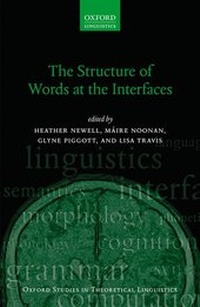
The Structure of Words at the Interfaces
Published on 11. May 2017
Book
Hardback
382 pages
978-0-19-877826-4 (ISBN)
Description
This volume takes a variety of approaches to the question 'what is a word?', with particular emphasis on where in the grammar wordhood is determined. Chapters in the book all start from the assumption that structures at, above, and below the 'word' are built in the same derivational system: there is no lexicalist grammatical subsystem dedicated to word-building. This type of framework foregrounds the difficulty in defining wordhood. Questions such as whether there are restrictions on the size of structures that distinguish words from phrases, or whether there are combinatory operations that are specific to one or the other, are central to the debate. In this respect, chapters in the volume do not all agree. Some propose wordhood to be limited to entities defined by syntactic heads, while others propose that phrasal structure can be found within words. Some propose that head-movement and adjunction (and Morphological Merger, as its mirror image) are the manner in which words are built, while others propose that phrasal movements are crucial to determining the order of morphemes word-internally. All chapters point to the conclusion that the phonological domains that we call words are read off of the morphosyntactic structure in particular ways. It is the study of this interface, between the syntactic and phonological modules of Universal Grammar, that underpins the discussion in this volume.
More details
Series
Language
English
Place of publication
Oxford
United Kingdom
Target group
College/higher education
Dimensions
Height: 241 mm
Width: 174 mm
Thickness: 29 mm
Weight
714 gr
ISBN-13
978-0-19-877826-4 (9780198778264)
Copyright in bibliographic data and cover images is held by Nielsen Book Services Limited or by the publishers or by their respective licensors: all rights reserved.
Schweitzer Classification
Other editions
Additional editions
Heather Newell | Máire Noonan | Glyne Piggott
The Structure of Words at the Interfaces
E-Book
06/2017
1st Edition
OUP eBook
€29.49
Available for download
Heather Newell | Maire Noonan | Glyne Piggott
The Structure of Words at the Interfaces
Book
05/2017
Oxford University Press
€73.00
Shipment within 15-20 days
Persons
Heather Newell is Assistant Professor in the Linguistics department at the Universite du Quebec a Montreal. Her work is an investigation of how morphological phenomena inform theories of phonology, morphology, and their interface. She is the former book review editor and current co-editor of the Canadian Journal of Linguistics.
Maire Noonan is a course lecturer at McGill University and coordinator of the Montreal Word Structure project. She has worked on Celtic syntax, covering topics such as the lexical semantics and syntax of stative verbs, long distance A-bar constructions, and person-number marking. Her recent research investigates spatial adpositional constructions in Germanic and Romance from a cartographic perspective.
Glyne Piggott is Emeritus Professor of Linguistics at McGill University. His research focuses on phonology, morphology, and the syntax-phonology interface, with special reference to Ojibwe (an Algonquian language). He is well known for his contributions to syllable structure, nasal harmony, and stress assignment. He has published in Linguistic Inquiry, Natural Language and Linguistic Theory, The Linguistic Review, Phonology, Lingua and Canadian Journal of Linguistics.
Lisa Travis is Professor in the Department of Linguistics at McGill University where she has been teaching since 1984. Her research focuses mainly on phrase structure, head movement, language typology, Austronesian languages (in particular, Malagasy and Tagalog), and the interface between syntax and phonology. Recent publications include Inner Aspect: The Articulation of VP (Springer, 2010), and she is the co-editor, with Jessica Coon and Diane Massam, of The Oxford Handbook of Ergativity (OUP, 2017).
Maire Noonan is a course lecturer at McGill University and coordinator of the Montreal Word Structure project. She has worked on Celtic syntax, covering topics such as the lexical semantics and syntax of stative verbs, long distance A-bar constructions, and person-number marking. Her recent research investigates spatial adpositional constructions in Germanic and Romance from a cartographic perspective.
Glyne Piggott is Emeritus Professor of Linguistics at McGill University. His research focuses on phonology, morphology, and the syntax-phonology interface, with special reference to Ojibwe (an Algonquian language). He is well known for his contributions to syllable structure, nasal harmony, and stress assignment. He has published in Linguistic Inquiry, Natural Language and Linguistic Theory, The Linguistic Review, Phonology, Lingua and Canadian Journal of Linguistics.
Lisa Travis is Professor in the Department of Linguistics at McGill University where she has been teaching since 1984. Her research focuses mainly on phrase structure, head movement, language typology, Austronesian languages (in particular, Malagasy and Tagalog), and the interface between syntax and phonology. Recent publications include Inner Aspect: The Articulation of VP (Springer, 2010), and she is the co-editor, with Jessica Coon and Diane Massam, of The Oxford Handbook of Ergativity (OUP, 2017).
Editor
Assistant ProfessorAssistant Professor, Linguistics Dept, Universite du Quebec a Montreal
Course Lecturer and Research AssistantCourse Lecturer and Research Assistant, Department of Linguistics, McGill University
Emeritus ProfessorEmeritus Professor, Department of Linguistics, McGill University
ProfessorProfessor, Department of Linguistics, McGill University
Content
1: Heather Newell, Maire Noonan, Glyne Piggott, and Lisa Travis: Introduction
2: Heather Newell: Nested phase interpretation and the PIC
3: Glyne Piggott and Lisa Travis: Wordhood and word internal domains
4: Bethany Lochbihler: Syntactic domain types and PF effects
5: Neil Myler: Exceptions to the 'Mirror Principle' and Morphophonological 'Action at a distance'
6: Kie Ross Zuraw: Quantitative component interaction: Data from Tagalog nasal substitution
7: Jonathan David Bobaljik and Heidi Harley: Suppletion is local: Evidence from Hiaki
8: Andres Pablo Salanova: The paradoxes of Mebengokre's analytic causative
9: Thomas Leu: Ein is Ein and that is that: A note on anti-homophony and meta-morphology
10: Maire Noonan: Dutch and German R-pronouns and P-stranding
11: Eric Mathieu, Brandon J. Fry, and Michael Barrie: Adjunction of complex heads inside words: A reply to Piggott and Travis (2013)
12: Tanya Slavin: Verb stem formation and event composition in Oji-Cree
13: Richard Compton: Adjuncts as a diagnostic of polysynthetic word-formation in Inuit
2: Heather Newell: Nested phase interpretation and the PIC
3: Glyne Piggott and Lisa Travis: Wordhood and word internal domains
4: Bethany Lochbihler: Syntactic domain types and PF effects
5: Neil Myler: Exceptions to the 'Mirror Principle' and Morphophonological 'Action at a distance'
6: Kie Ross Zuraw: Quantitative component interaction: Data from Tagalog nasal substitution
7: Jonathan David Bobaljik and Heidi Harley: Suppletion is local: Evidence from Hiaki
8: Andres Pablo Salanova: The paradoxes of Mebengokre's analytic causative
9: Thomas Leu: Ein is Ein and that is that: A note on anti-homophony and meta-morphology
10: Maire Noonan: Dutch and German R-pronouns and P-stranding
11: Eric Mathieu, Brandon J. Fry, and Michael Barrie: Adjunction of complex heads inside words: A reply to Piggott and Travis (2013)
12: Tanya Slavin: Verb stem formation and event composition in Oji-Cree
13: Richard Compton: Adjuncts as a diagnostic of polysynthetic word-formation in Inuit