

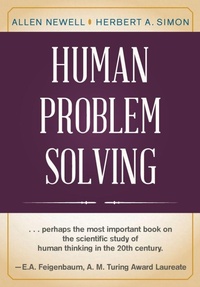
Human Problem Solving
Published on 14. February 2023
Book
Paperback/Softback
938 pages
978-1-64837-194-3 (ISBN)
Description
The Classic Study of Cognition by Two Pioneers of Artificial Intelligence
First published in 1972, this monumental work develops and defends the authors' information processing theory of human reasoning. Human reasoners, they argue, can be modeled as symbolic "information processing systems" (IPSs), abstracted entirely from physiological bases. Modeling subjects with IPSs yields predictive theories of their problem-solving behavior and performance, and psychological insight into their heuristics and methods.Newell and Simon's previous epoch-making collaborations included the General Problem Solver, the Logic Theorist, and the Information Processing Language. This book is a careful application of those ideas from artificial intelligence - the ideas of AI's first golden age - to cognitive psychology. The authors first develop the formal theory of information processing systems. They then report studies of three symbolic reasoning tasks, and analyze that data using the information processing paradigm. In the final section, they state their comprehensive theory of human problem-solving. The success of the models of cognition given in Human Problem Solving was a major piece of evidence for the physical symbol system hypothesis, which Newell and Simon would first state a few years later. Newell went on to co-develop the Soar cognitive architecture, and Simon to receive the Nobel Prize in Economics. The two jointly received the Turing Award in 1975 for the research program of which Human Problem Solving was the culmination.
This book is also available from Echo Point Books as a hardcover (ISBN 1635617928).
More details
Edition
Reprint ed.
Language
English
Product notice
Paperback (trade)
Unsewn / adhesive bound
Illustrations
Illustrations
Dimensions
Height: 244 mm
Width: 170 mm
Thickness: 50 mm
Weight
1582 gr
ISBN-13
978-1-64837-194-3 (9781648371943)
Copyright in bibliographic data and cover images is held by Nielsen Book Services Limited or by the publishers or by their respective licensors: all rights reserved.
Schweitzer Classification